Dear Spade, I have a whole patio of terracotta pots, and I would love to just leave them out there all winter and deal with them in spring. Will they survive, or am I setting myself up for a springtime pottery graveyard? — Terra-Cotta Troubled in Tulsa, Oklahoma
Oh, my friend, I love the optimism. I really do. Leaving the pots out there and dealing with them later sounds so beautifully efficient, right up until spring arrives and your favorite pot has split clean down the side like it heard bad news.
But here’s the thing: your instinct to ask first is exactly right, because this is one of those garden questions where the answer is a firm, friendly no — with a few sensible exceptions.
So, What’s the Deal with Terracotta?
Terracotta is gloriously porous. That is why plants love it in summer — water moves through the walls, the soil breathes, and roots stay cooler than they would in plastic. But that same porosity is the whole problem in winter. The clay soaks up water like a sponge, and when that water freezes, it expands. Ice does not negotiate. It pushes outward, and the pot cracks, chips, or flakes apart, sometimes in one dramatic split and sometimes in a slow, sad crumble you only notice in April.
Now, if you live somewhere winters stay mild and frost never really bites, your pots may sail through just fine. But here’s where it gets tricky: it only takes a few hard freeze-thaw cycles — cold night, sunny thaw, cold night again — to do the damage. Tulsa gets those. Most of the country gets those. And a pot that survives one winter is not guaranteed to survive the next, because every freeze leaves its little mark.
The Verdict
So let’s land this plainly: do not leave unglazed terracotta pots outside, full of soil, through a freezing winter. That is the verdict, and your spring self will be grateful you listened. Empty them, and get them under cover.
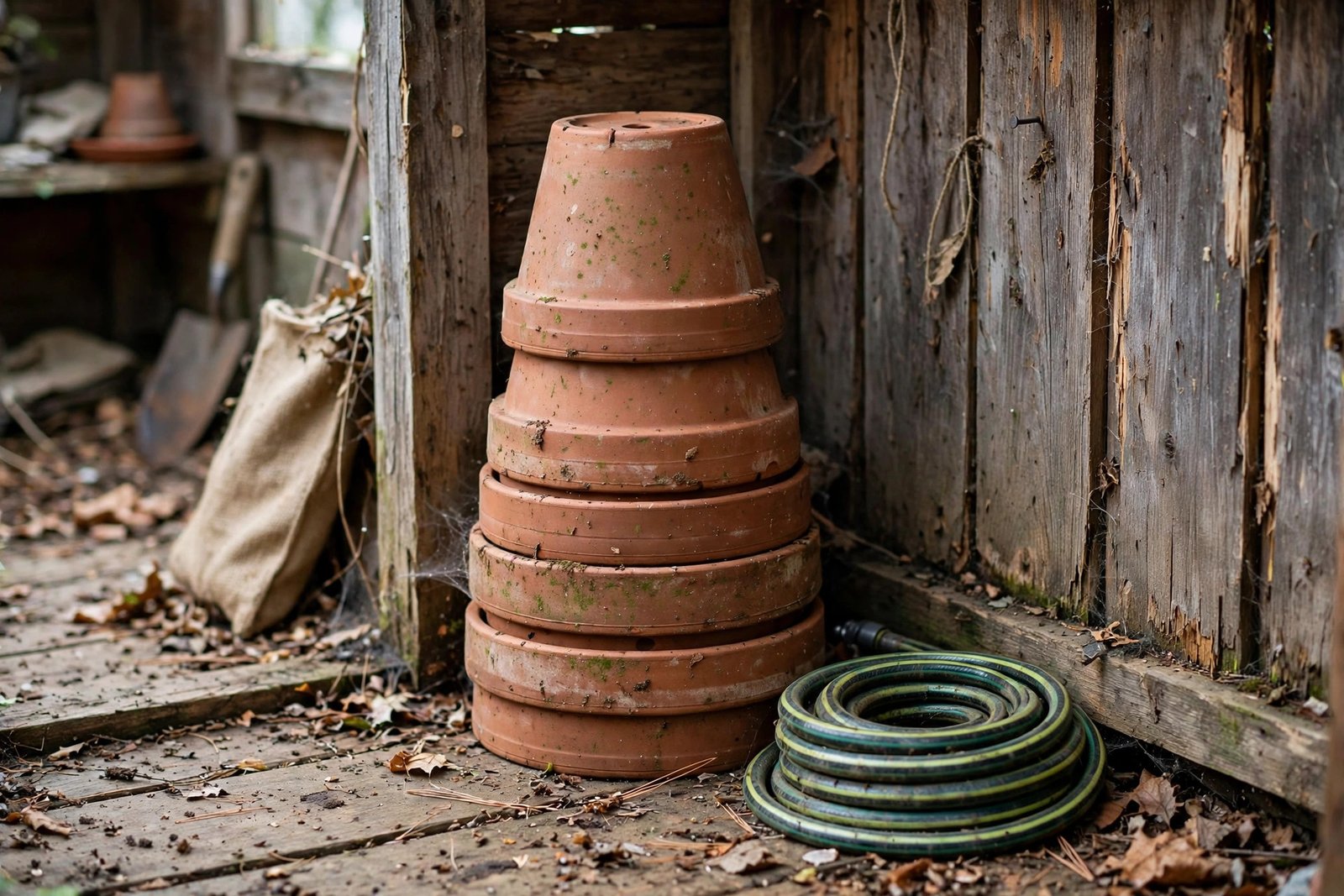
So, let’s talk solutions, because this is a solvable problem and none of it is hard. First, tip the pots out and scrub them clean — old soil holds moisture against the clay, which is exactly what you do not want. Let them dry completely, and I mean completely, a few days in the garage with the air moving. Then store them upside down in a garage, shed, or any spot that stays dry and out of the freeze-thaw swing. Upside down matters, because a pot sitting upright collects rain and snow, and we are back to the sponge problem.
Another thing — while you are out there, clear the pine needles and leaves off the patio and out of the saucers, because a clogged saucer holds water against the pot all winter. If you are doing a bigger patio sweep, a lawn sweeper built for pine needles makes short work of the needle drifts before they mat down and hold moisture.
What about the plants themselves? If a perennial is living in one of those pots, your best move is usually to plant it in the ground for winter, where the earth insulates its roots far better than a thin clay wall ever will. Or slip the whole root ball, pot and all, into a sheltered spot and mulch heavily around it. Just do not leave it sitting exposed on the patio, playing chicken with January.
Keep the Pots, Ditch the Worry
One last wrinkle, because somebody always asks: pots labeled frost-proof or frost-resistant — usually high-fired stoneware or glazed ware — are a different animal, and those can generally stay out. But plain, unglazed terracotta? That is the one that breaks your heart. Treat it kindly, bring it inside, and it will be waiting for you in spring, ready for another summer of doing what it does best.
Your pots survived the summer. Give them a winter indoors, and they will survive a dozen more. Seasonedly yours, The Seasoned Spade