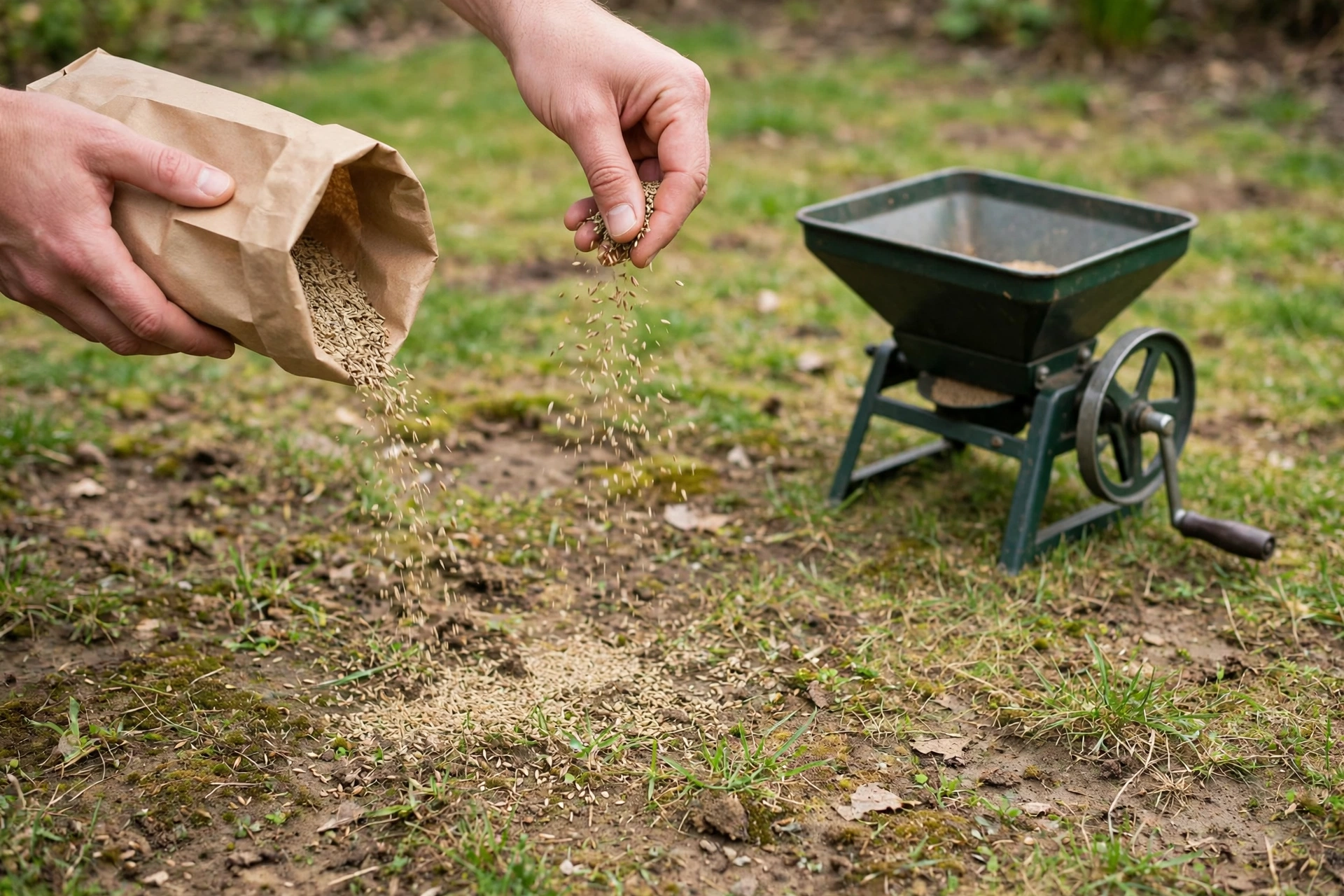
You buy the bag, guess at the spreader setting, and three weeks later the lawn comes up patchy in one spot and matted with weak seedlings in another. The fix is the rate, in pounds per 1,000 square feet, for the grass you actually planted.
Two Extension services publish those numbers, and they do not always agree. Penn State’s lawn-establishment guide gives one set of rates for cool-season grasses; the University of Tennessee’s turfgrass-establishment bulletin gives another for the same species, plus the warm-season grasses Penn State never covers. The tables below carry both, side by side, so you can see where they line up and where they don’t.
If you want the math done for your yard, run the numbers through our grass seed calculator — it turns your square footage and your rate into pounds of seed. Tall fescue gets its own tool, the tall fescue seeding rate calculator.
Cool-season grasses: new lawns
Rates are pounds of seed per 1,000 square feet. Penn State’s rates are designed to give about 1,000 to 2,000 seedlings per 1,000 square feet. Germination days come from Tennessee, which publishes them; Penn State does not list them.
| Species | Penn State rate | UT Extension rate | Days to germinate (UT) |
|---|---|---|---|
| Kentucky bluegrass | 2–3 | 1.5–2 | 14–21 |
| Tall fescue | 6–8 | 5–8 | 6–12 |
| Perennial ryegrass | 4–5 | 4–6 | 3–7 |
| Fine fescues (chewings, red, sheep) | 4–5 | 3–5 | 6–14 |
| Annual ryegrass | Not listed | 4–6 | 3–7 |
Where the two disagree, the table shows both. Kentucky bluegrass is the widest gap — Penn State says 2 to 3 pounds, Tennessee says 1.5 to 2. Each service wrote for its own state’s conditions, so use the rate that matches your region, and let your seed bag’s label have the last word.
Warm-season grasses: new lawns
Tennessee alone governs these — Penn State’s guide covers cool-season grasses only. Rates are pounds of seed per 1,000 square feet.
| Species | Rate (UT Extension) | Days to germinate |
|---|---|---|
| Bermudagrass, common (hulled seed) | 0.5–1 | 10–20 |
| Centipedegrass | 0.5–3 | 10–20 |
| Zoysia japonica | 0.5–3 | 10–14 |
Bermudagrass carries one footnote worth reading before you buy: the 0.5-to-1-pound rate assumes hulled seed. With unhulled seed, Tennessee says to double the rate — and expect 14 to 21 days or longer to germinate.
Mixtures, shade, and overseeding
Penn State’s table also covers the cases where one species is not the answer: mixes for sun and shade, and the higher rate for overseeding a thin lawn. All figures in this table are Penn State’s.
| Mixture or use | Rate (lb/1,000 sq ft) | Mix by weight |
|---|---|---|
| Kentucky bluegrass + perennial ryegrass (sunny) | 2–3 | 80–90% bluegrass, 10–20% ryegrass |
| Kentucky bluegrass + fine fescues + perennial ryegrass (sunny) | 3–4 | 40–60% bluegrass, 20–40% fine fescues, 10% ryegrass |
| Fine fescues + Kentucky bluegrass + perennial ryegrass (partial shade) | 4 | 40–50% fine fescues, 40–50% bluegrass, 10% ryegrass |
| Fine fescues (full shade) | 4–5 | 100% |
| Rough bluegrass (full shade) | 2–3 | 100% |
| Perennial ryegrass (overseeding or renovation) | 4–6 | 100% |
How to use the numbers
Weigh the seed. A bag’s label tells you purity and germination, and Penn State’s advice is to buy certified seed — it is the only real guarantee of cultivar purity. If the seed is not certified, the numbers above assume good seed, so adjust: Penn State’s example is a lot at 92 percent purity and 80 percent germination, which works out to 74 percent pure live seed, meaning 1.35 pounds of that seed for every pound the table calls for.
Then split the application. Set the spreader to deliver half the rate and cover the lawn twice, in opposite directions — Penn State’s method for an even stand with fewer skips.
And keep the limits in mind. These are Pennsylvania and Tennessee Extension numbers, not a national standard, and the warm-season rows rest on Tennessee alone. Your seed bag’s label governs — if it says something different from this table, follow the bag.
Start with the rate for your grass, weigh the seed, and make two passes instead of one. Guessing is what buys the second bag.
Sources
- Penn State Extension, “Lawn Establishment,” Table 1 — extension.psu.edu/lawn-establishment — fetched November 6, 2026.
- University of Tennessee Extension, W160-B, “Turfgrass Establishment Seeding” (Samples and Sorochan) — uthort.tennessee.edu — W160-B (PDF) — fetched November 6, 2026.