Your lawn greens up for two weeks after you feed it, then fades back to pale before the month is out. The bottle is probably not the problem. The gap is usually timing: liquid fertilizer feeds fast and fades fast, so the schedule matters more than the brand. Get the interval right and the green holds. Get it wrong in either direction and you pay for it — too far apart and the lawn starves between feedings, too close together and you scorch it.
The short answer is every 4 to 6 weeks during active growth, at the label rate, and never on dormant or drought-stressed grass. The rest of this guide sorts out what “active growth” means for your grass type, how to tell whether you are feeding too much or too little, and when to stop for the season. If you have not picked a fertilizer yet, our roundup of the best liquid lawn fertilizers covers the four bottles worth buying.
What the Fading Actually Means
A lawn that greens up and then fades on a two-week cycle is telling you the feeding wore off. Liquid fertilizer is available to the grass almost immediately — through the leaves and the soil — which is why you see results in days. The trade-off is that it does not linger the way a slow-release granular does. Most liquid fertilizers are built for a 4- to 6-week interval, and a lawn fed on that rhythm stays green instead of cycling between fed and hungry.
Before you change anything, check the label on the bottle you already own. The label rate governs — it accounts for that product’s concentration, and a 28-0-0 at double strength is a different risk than a balanced 16-4-8 at double strength. The ranges below are the general rhythm to aim for, not a replacement for the label.
Three Causes, Ranked
1. The interval is too long. This is the most common cause of the fade. If you fed once in spring and nothing since, the lawn simply ran out. Liquid feed lasts weeks, not months. The fix is a regular interval, not a bigger dose — doubling the rate to “make it last” is how lawns get burned.
2. The interval is too short, or the rate is too heavy. The opposite mistake looks different: dark green stripes where passes overlapped, brown leaf tips a day or two after spraying, or a burst of soft growth that wilts in the next hot spell. That is overfeeding, and the distinguishing check is the pattern — burn shows up in stripes or patches where the sprayer overlapped, while drought stress is more even across the lawn. The fix is to skip the next feeding, water deeply to dilute what is in the soil, and go back to the label rate.
3. The timing fights the season. Feeding cool-season grass in the heat of summer, or feeding any grass that has gone dormant in a dry spell, wastes the application and can damage the lawn. Dormant grass is not eating. Stressed grass cannot use a heavy feed. The fix is to feed when the grass is actively growing and the soil has moisture, and to hold off when it does not.
The Schedule by Grass Type
Cool-season grasses — Kentucky bluegrass, fescue, perennial ryegrass — grow hardest in spring and fall. Feed in spring as growth resumes, then again in early fall, which is the most important feeding of the year for these grasses. A light late-spring application fits between the two if the lawn is thin. Skip the middle of summer, when heat stress makes feeding a risk rather than a help.
Warm-season grasses — bermuda, zoysia, St. Augustine, centipede — grow hardest from late spring through summer. Feed every 4 to 6 weeks from late spring into early fall, while the grass is actively growing. Stop as growth slows in fall; a late feeding pushes soft growth into cold weather.
Across both types, that works out to roughly 3 to 5 liquid applications in a growing season for most lawns. The exact count depends on your grass, your soil, and the product — a soil test every few years tells you whether your lawn actually needs the phosphorus and potassium in a balanced feed or just nitrogen.
How to Apply on Schedule
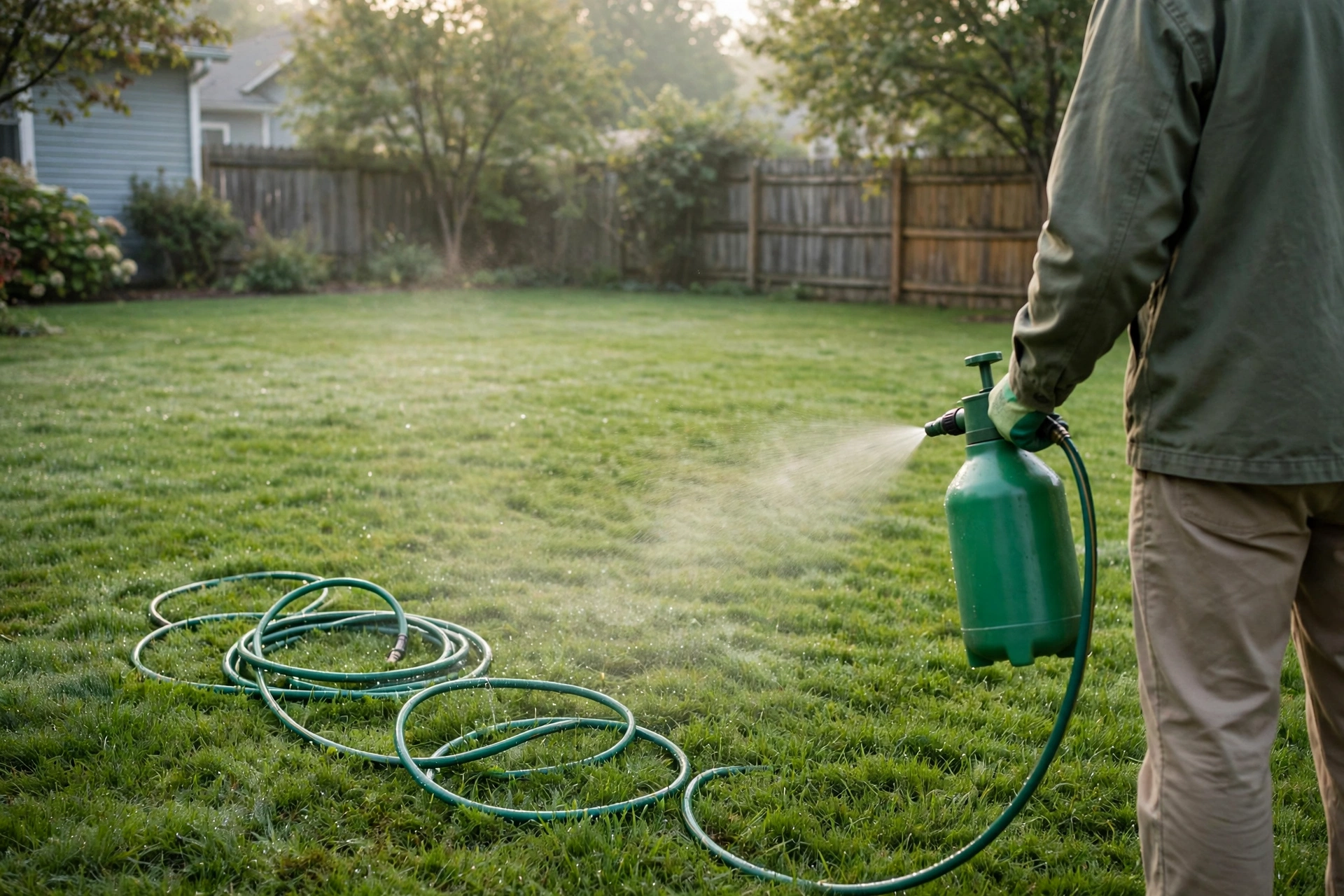
Spray when the lawn can use it. Early morning or evening, when the grass is not heat-stressed and the spray will not dry on the leaf in minutes. Avoid spraying before heavy rain, which washes the feed away before the roots take it up.
Water it in — with one exception. A light watering after spraying moves the fertilizer off the leaves and into the soil. The exception is a weed-and-feed: the weed killer needs to sit on the weed leaves, so do not water for 48 hours after that application. Our liquid fertilizer roundup flags which bottle carries that rule.
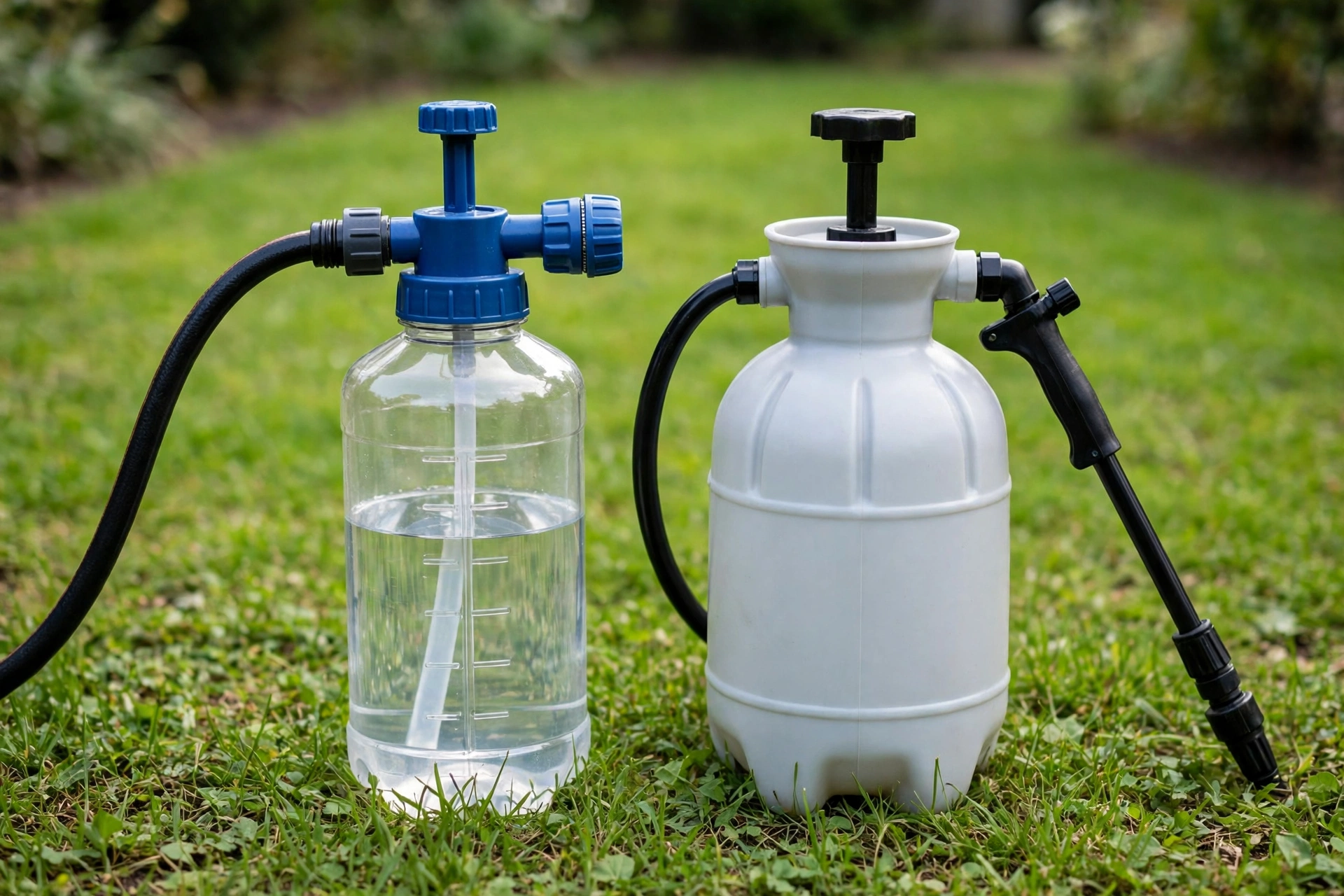
Keep your passes even. Overlap each pass slightly so there are no missed strips, but do not go back over the same strip twice. Double coverage is the most common cause of the dark-green-then-brown stripe pattern. Which sprayer you use changes how easy this is — a hose-end sprayer covers a big lawn fast, while a pump sprayer gives you control on a small one. See our hose-end vs. pump sprayer comparison to match the tool to your yard.
Measure, do not guess. A 32-ounce bottle of balanced liquid fertilizer covers about 3,200 square feet through a hose-end sprayer, mixed at 3 to 5 fluid ounces per gallon. Know your lawn’s square footage before you start — a tape measure and ten minutes beats a second bottle bought mid-job.
Signs You Have the Rhythm Right
A lawn on the right schedule holds its color between feedings instead of cycling green-pale-green. Growth is steady rather than explosive. No brown tips appear in the days after spraying, and no stripes show where passes overlapped. If you see steady color and steady growth, the interval is right — keep it, and let the lawn tell you when the season is over rather than the calendar.
When to Stop for the Season
Stop feeding when growth slows for the year: cool-season lawns after the fall feeding has had a few weeks to work in, warm-season lawns as temperatures drop and growth stalls. Feeding a lawn that has stopped growing pushes soft, tender blades into cold weather, and the fertilizer mostly washes away unused. One good fall feeding for cool-season grass, timed while the grass is still growing, does more than two late ones.
Bottom Line
Feed every 4 to 6 weeks while the grass is actively growing, at the label rate, and stop when growth stops. Spring and fall for cool-season lawns, late spring through early fall for warm-season lawns. That rhythm is what keeps the green from fading two weeks after every application.