A gallon of liquid fertilizer concentrate costs the same either way. What changes the result is the sprayer you mix it in — and the wrong one turns a twenty-minute job into an hour of pumping, refilling, and walking back to the faucet. The mistake is buying the sprayer for the yard you wish you had instead of the one you mow.
There are two ways to put liquid fertilizer on a lawn: a hose-end sprayer that mixes as you spray, or a pump sprayer you fill, pressurize, and carry. Both work. They just work at very different scales. If you have not picked a fertilizer yet, our roundup of the best liquid lawn fertilizers covers the four bottles worth buying — and every one of them goes through one of these two sprayers.
The Two Sprayers at a Glance
| Sprayer | How it works | Best for | Weak spot |
|---|---|---|---|
| Hose-end sprayer | Attaches to the hose; mixes concentrate with water as you spray | Whole lawns, 2,000 sq ft and up | Less precise; hard to spot-treat |
| Pump sprayer | You measure, mix, pressurize by hand, and carry the tank | Small lawns, spot treatments, edges | Slow on a big lawn; frequent refills |
Hose-End Sprayer: Fast, and Built for the Whole Lawn
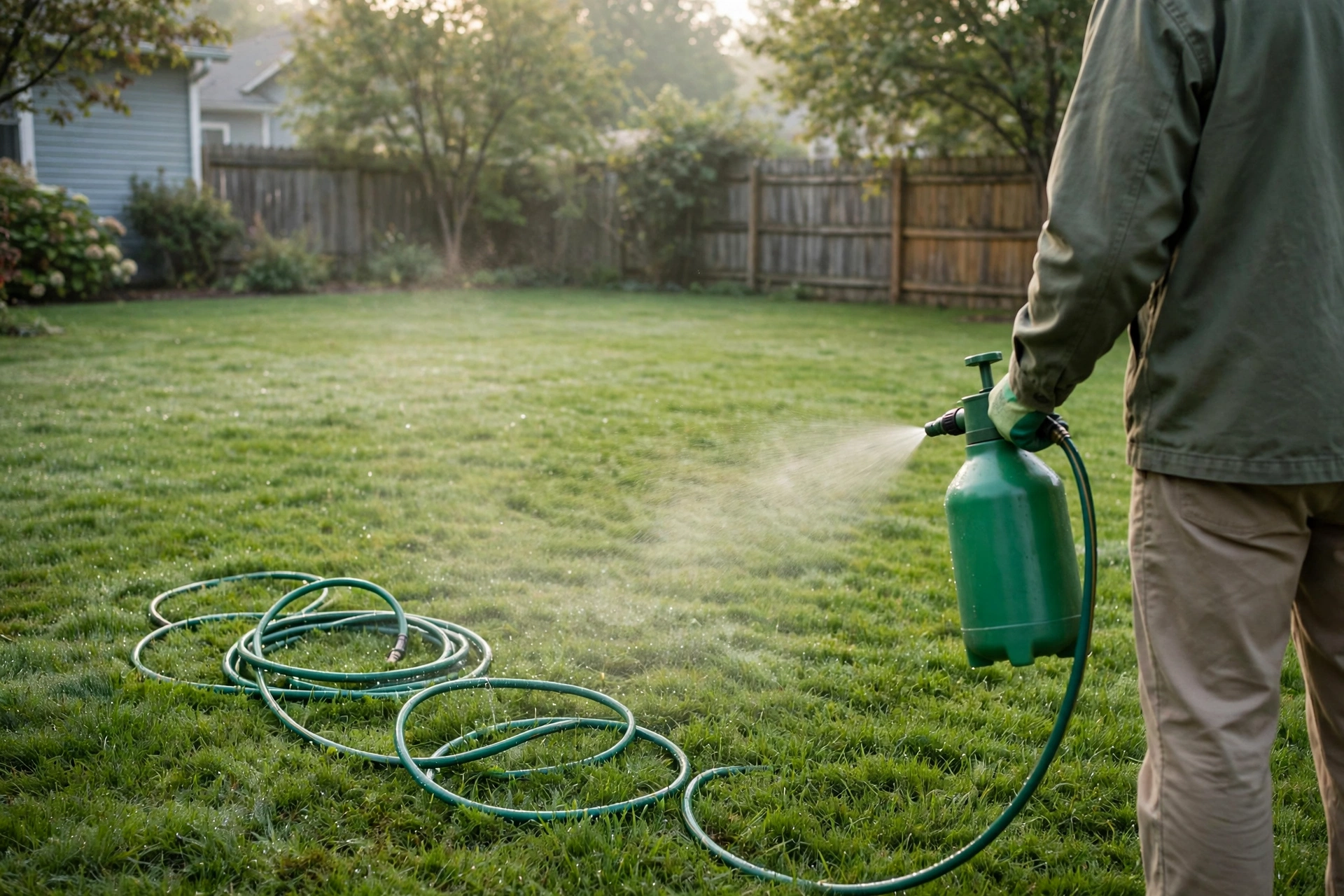
A hose-end sprayer screws onto the end of a garden hose. Water pressure pulls concentrate out of the bottle and mixes it on the way to the nozzle, so you walk the lawn and spray in one continuous pass. Many liquid fertilizers come with a hose-end sprayer built into the bottle — a 32-ounce bottle of balanced 16-4-8 covers about 3,200 square feet that way, with no measuring at all.
Speed is what you are buying. A typical suburban lawn takes twenty minutes or so with a hose-end sprayer, and the coverage is even as long as you keep a steady walking pace and overlap each pass slightly. The trade-off is control. The dilution is set by the sprayer, not by you, so you cannot put a heavier dose on a thin patch and a lighter one everywhere else. And a hose-end sprayer is a blunt tool for spot work: trying to feed one bare patch means wetting the healthy grass around it too.
Use it when: you are feeding the whole lawn, the lawn is 2,000 square feet or bigger, and the fertilizer bottle has a hose-end attachment or a dial you can set to the label rate.
Watch out for: walking speed. Walk too fast and the lawn gets a light dose; walk too slow and the overlap stripes show up as dark green bands a week later. Keep a steady pace and do not go back over a strip you already covered.
Pump Sprayer: Slow, Precise, and in Your Control
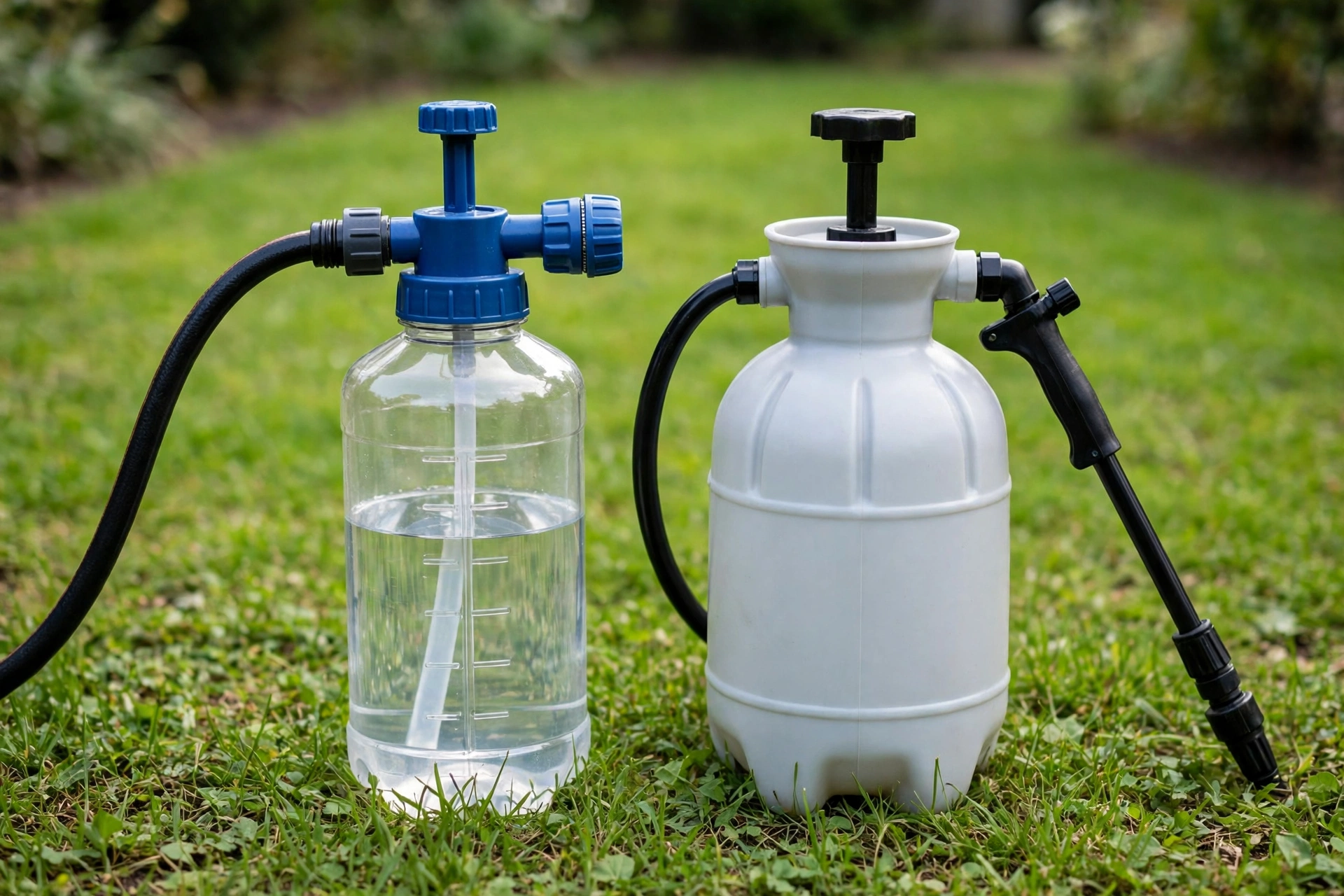
A pump sprayer is a tank — usually 1 or 2 gallons for a handheld model — that you fill with water, add the measured concentrate, pressurize with a hand pump, and carry. You decide the mix: 3 to 5 fluid ounces of a balanced liquid fertilizer per gallon of water, or 2 ounces per gallon for a kelp extract. You decide where it goes, one squeeze of the trigger at a time.
The precision is the point. A pump sprayer puts fertilizer exactly where you aim it, which makes it the right tool for a small lawn, a new patch of seed you are nursing along, or a weed-and-feed spot treatment on a handful of dandelions. The trade-off is time. A 1-gallon tank needs refilling several times on a big lawn, and every refill is a walk back to the faucet, a re-measure, and a re-pump. On a 5,000-square-foot lawn, that turns a twenty-minute job into an hour.
Use it when: the lawn is small, you are spot-treating or feeding a patch, or you want exact control over the mix rate.
Watch out for: the mix. Measure the concentrate with a measuring cup, not a guess poured from the bottle. A pump sprayer puts exactly what you mixed on the grass, so a heavy-handed pour lands as a heavy-handed dose.
Which One Fits Your Yard
Under 2,000 square feet: a pump sprayer. The lawn is small enough that one or two tanks cover it, and the control is worth the slower pace. A hose-end sprayer works too, but you will spend more time setting up the hose than spraying.
2,000 to 5,000 square feet: a hose-end sprayer for the whole-lawn feeding, and a pump sprayer kept on hand for spot treatments and edges. This is the combination most homeowners end up with, and it is the right one — each tool does the job the other does badly.
Over 5,000 square feet: a hose-end sprayer, full stop. A pump sprayer on a lawn this size means an hour of pumping and refilling. If you want precision on a big lawn, a backpack sprayer with a larger tank is the step up — but for most homeowners, the hose-end bottle the fertilizer already comes in is the answer.
Five Rules for Either Sprayer
Spray when the grass can use it. Early morning or evening, when the lawn is not heat-stressed and the spray will not dry on the leaf in minutes.
Know your square footage. A tape measure and ten minutes before you start beats a second bottle bought mid-job — and it keeps you from running out with a strip of lawn still unfed.
Overlap slightly, never double back. A small overlap between passes prevents missed strips. Going back over a strip you already sprayed doubles the dose there, and the dark green stripe it leaves is the most common visible mistake in liquid feeding.
Water it in — except weed-and-feed. A light watering after spraying moves fertilizer off the leaves and into the soil. The exception is a weed-and-feed, where the weed killer needs 48 hours on the weed leaves before any water. Our liquid fertilizer roundup flags which bottle carries that rule.
Match the feeding to the season. A sprayer cannot fix a schedule problem. Liquid fertilizer goes down every 4 to 6 weeks while the grass is actively growing — spring and fall for cool-season lawns, late spring through early fall for warm-season lawns. The full rhythm is in our guide to how often to apply liquid lawn fertilizer.
Bottom Line
Buy the hose-end sprayer — or the bottle with one built in — if your lawn is 2,000 square feet or bigger and you are feeding the whole thing. Buy the pump sprayer if your lawn is small or you are spot-treating. Most homeowners with a real lawn end up owning both — one for the whole lawn, one for the patches.