This site contains product affiliate links. We may receive a commission if you make a purchase after clicking on one of these links.
Every big group trip has the same problem, and nobody talks about it until the rain starts. Ten people, maybe twelve, and nowhere to stand up, get dry, and eat together. The little tents hold the sleeping bags. The picnic table holds the rain. Everybody ends up crouched in a car or huddled under a tarp, and the trip turns into a waiting game.
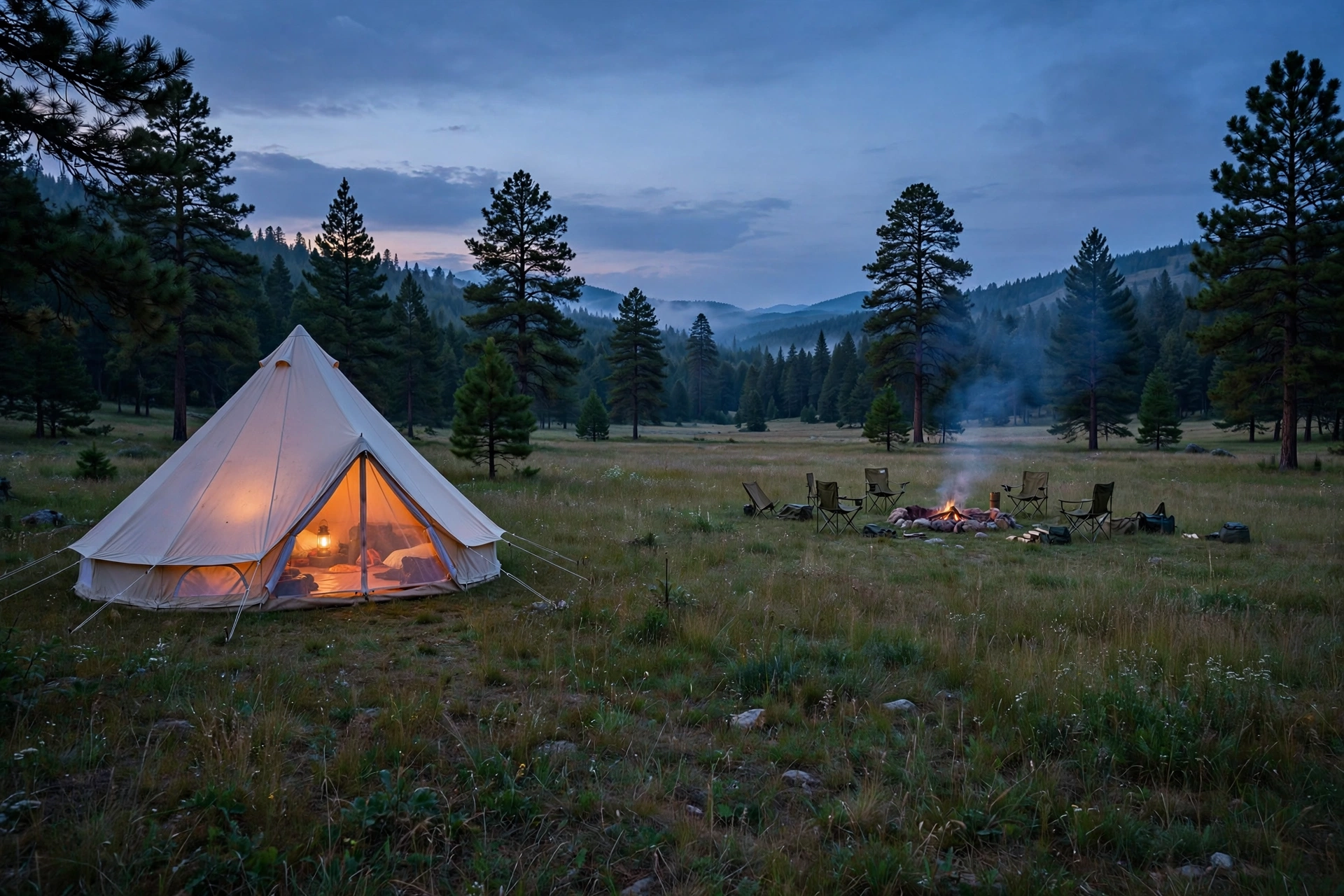
Vevor’s 16.4 ft canvas bell tent is the answer to that problem, and it costs $700.99. Sixteen feet across, a 10.3-foot peak you can stand under without ducking, room for 10 to 12 people, and a stove jack so a small camping stove can keep it warm when the temperature drops. Owners across the bell-tent range rate these tents 4.41 out of 5 across 410 reviews. The verdict up front: if your camping happens in groups, this is the tent that turns a campsite into a room.
That is a lot of money for a tent, and it is worth saying so plainly. A dome tent for two costs a fraction of it. But a dome tent for two does not hold twelve people, and it does not hold a stove. Measure this one against renting a cabin, or against buying the third and fourth tents you would otherwise carry and pitch. On those terms, the price starts to make sense.
What you get for $700.99
The tent itself is poly-cotton canvas with no PU coating, which matters more than it sounds. The weave breathes, so air moves through the fabric instead of trapping damp inside overnight. That is the difference between waking up dry and waking up with condensation dripping on your sleeping bag. The canvas also softens the light inside, so the tent glows warm in the morning instead of glaring white.
The kit is complete: the canopy, a PVC groundsheet that blocks ground moisture, galvanized iron tubes for the frame, stakes, adjustable nylon guy lines with buckles, and storage bags for packing it all up. The rain cover is silver-coated Oxford cloth, and it comes off when you do not need it. The mesh windows are B3 grade, and the top vents open and close with an adjustable cover and a drawstring, so you control the airflow instead of the weather controlling it.
Bring a second pair of hands for the first pitch. Once you know the order of things, one person can manage it. The frame spreads the tension across several points, the guy lines pull the canvas drum-tight, and the stakes hold it down. Galvanized tubes resist bending and rust, and the stitching at the stress points is reinforced. None of that makes it stormproof — Vevor’s own guidance says to take it down in heavy rain, snow, or strong winds — but it does make it a tent that holds its shape on an open field instead of flapping all night.
Standing up inside changes everything
The numbers are the story here. Sixteen point four feet across. A 10.3-foot peak in the middle. Side walls 5.3 feet high, so the usable space runs out to the edges instead of shrinking to a small circle in the center. Beds, chairs, and gear can live along the walls, and people can walk around without bending over. The door is 4.43 feet wide and 2.95 feet tall, which sounds like a small detail until you are carrying a cot and a cooler through it in the rain.
Ten to twelve people is the honest capacity, and it helps to picture what that means. Four cots with room to walk between them, or a circle of camp chairs with a table in the middle, or a dozen sleeping bags with gear stowed along the walls. The inner roof curtain opens to a clear panel, so you can see the stars from inside on a clear night. The double-layer door has a canvas panel outside and a mesh screen inside, with two-way zippers, so you can let the air in and keep the bugs out.
Ventilation is where big tents usually fail, and this one has the right parts. Mesh windows, top vents, a breathable canvas shell, and a door that works as a screen. Open the vents on a hot afternoon and the tent stays fresh. Close them on a cold night and the stove does the work. The 360-degree airflow is not a luxury in a tent this size — with ten people breathing inside it, it is the difference between a comfortable evening and a stuffy one.
The stove jack is the reason to buy it
Here is the feature that separates this tent from every big canvas tent without one. A stove jack lets you run a flue pipe through the canopy and use a compatible camping stove inside. A silicone fire mat comes with the tent to protect the fabric around the opening. Double-layer curtains block the wind, and the whole setup is built for the trips where warmth matters most: hunting camps, off-season weekends, winter glamping.
The safety rules are simple and they are not optional. Keep air flowing while the stove is running — the vents and the mesh door exist for exactly this. Never close the vent cover completely with a stove lit. A stove jack makes a tent warm. The vents stay open while the stove runs, the stove stays attended, and the tent comes down before heavy weather. Those three rules are the whole safety manual.
That honesty is the point. The stove jack is the reason to spend $700.99 on this tent instead of a cheaper big tent without one. If your camping stops when the cold arrives, you do not need it. If your camping keeps going — late fall, early spring, a hunting camp where the fire is the whole evening — the stove jack is the feature you will use every single trip.
Bell tent, cabin tent, or dome?
A tent is a shape before it is a product, and the shape decides what the trip feels like. Here is how the three shapes compare for a group.
| Shelter | Best for | Standing room | Stove use |
|---|---|---|---|
| Vevor bell tent, 16.4 ft | Groups of 10–12, all four seasons | 10.3 ft peak, 5.3 ft walls — stand anywhere | Built-in stove jack and fire mat |
| Cabin tent | Families who want walls and windows | Tall walls, but the floor plan is a rectangle | Almost never — no jack, no heat |
| Dome tent | Pairs and small families, fair weather | Stand in the middle, crouch at the edges | Not an option |
The bell tent wins on two things no other shape offers together: a round floor that fits a group around a center, and a stove jack that makes the cold months usable. A cabin tent gives you straight walls and windows, which is lovely for a family that camps in summer and wants a little house. A dome tent is light, cheap, and quick, which is exactly right for two people on a weekend. But neither of them holds twelve people around a stove on a cold November night. If your trips look like that, the bell tent is the shape the trip needs.
One more honest note: a 16.4-foot tent is a commitment. It is heavy to carry, it needs a big flat pitch, and it takes longer to dry than a small tent. You do not buy it for a solo overnight. You buy it because the group keeps getting bigger, or the season keeps getting longer, and the little tents stopped being enough. Our roundup of the best smokeless fire pits for backyards covers the other half of a cold-weather evening — the fire outside — and our Vevor bounce house review is the family-sized companion piece for the daytime, when the kids need somewhere to burn off energy before dinner.
Who should buy it, and who should not
Buy this bell tent if your camping happens in groups of six or more, if you camp past the end of summer, or if you have ever looked at a circle of friends standing in the rain and thought there has to be a better way to do this. It is built for exactly that trip: a standing-room shelter with a stove, room for everyone, and canvas that breathes instead of sweating.
Do not buy it if you camp alone or as a pair — a tent this size is a burden for two people, and a good dome tent will serve you better for a fraction of the price. Do not buy it if you only camp in July, either. The stove jack, the heavy canvas, and the four-season build are wasted on fair-weather weekends, and the money is better spent on the chairs and loungers you will actually sit in.
For everyone else, the verdict is simple: a group that camps together needs a room, not a row of little tents. This one gives you the room, the height, and the heat, and 410 owners across the bell-tent range put it at 4.41 out of 5. Pitch it once with the whole crew inside, stove going, rain on the canvas, and you will wonder why you spent so many trips crouching under tarps.
VEVOR Canvas Bell Tent, 16.4 ft, 4 Seasons, Stove Jack
Standing room for 10–12, a real stove jack, and 4.41 stars across the bell-tent range — the group tent for cold-weather trips.