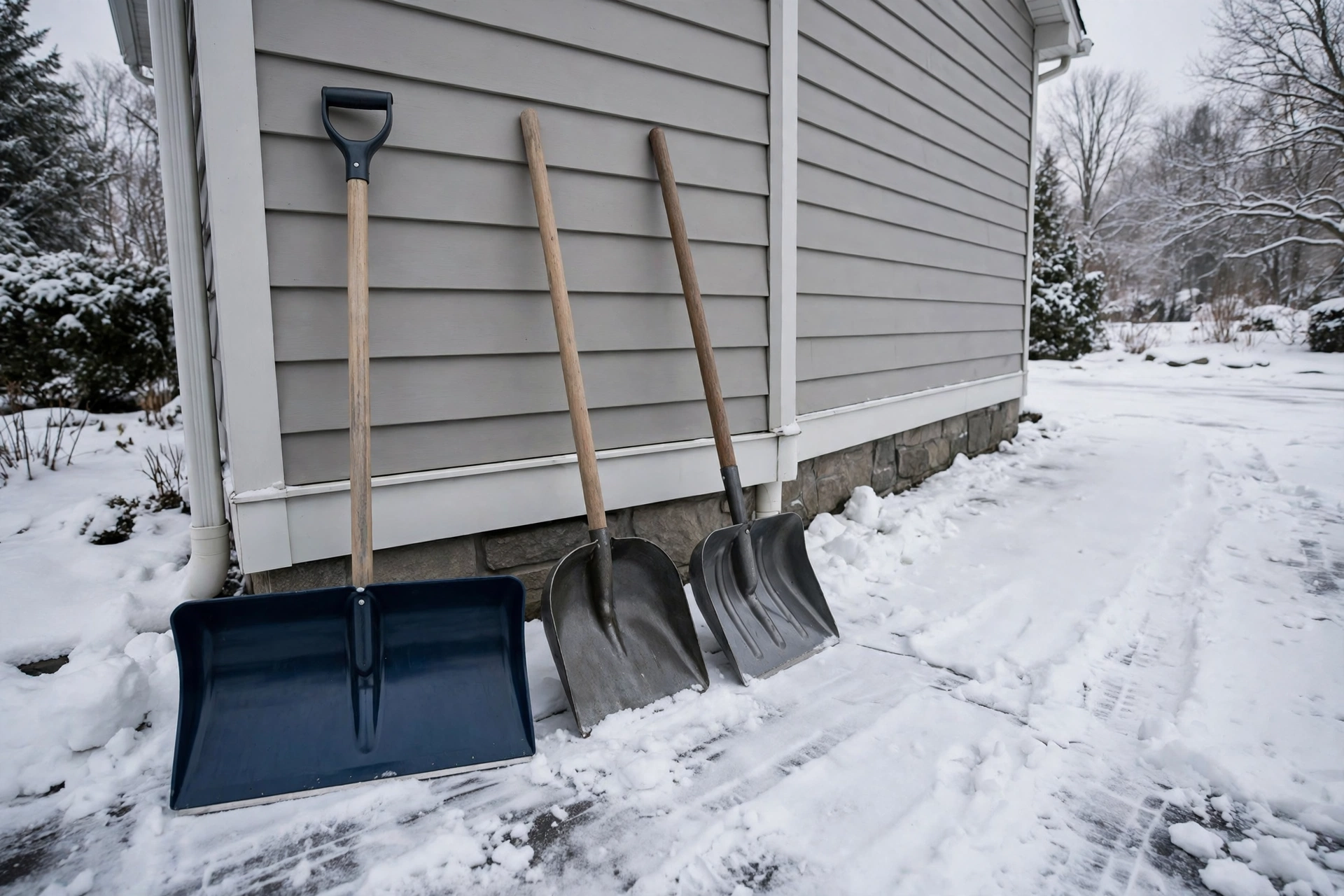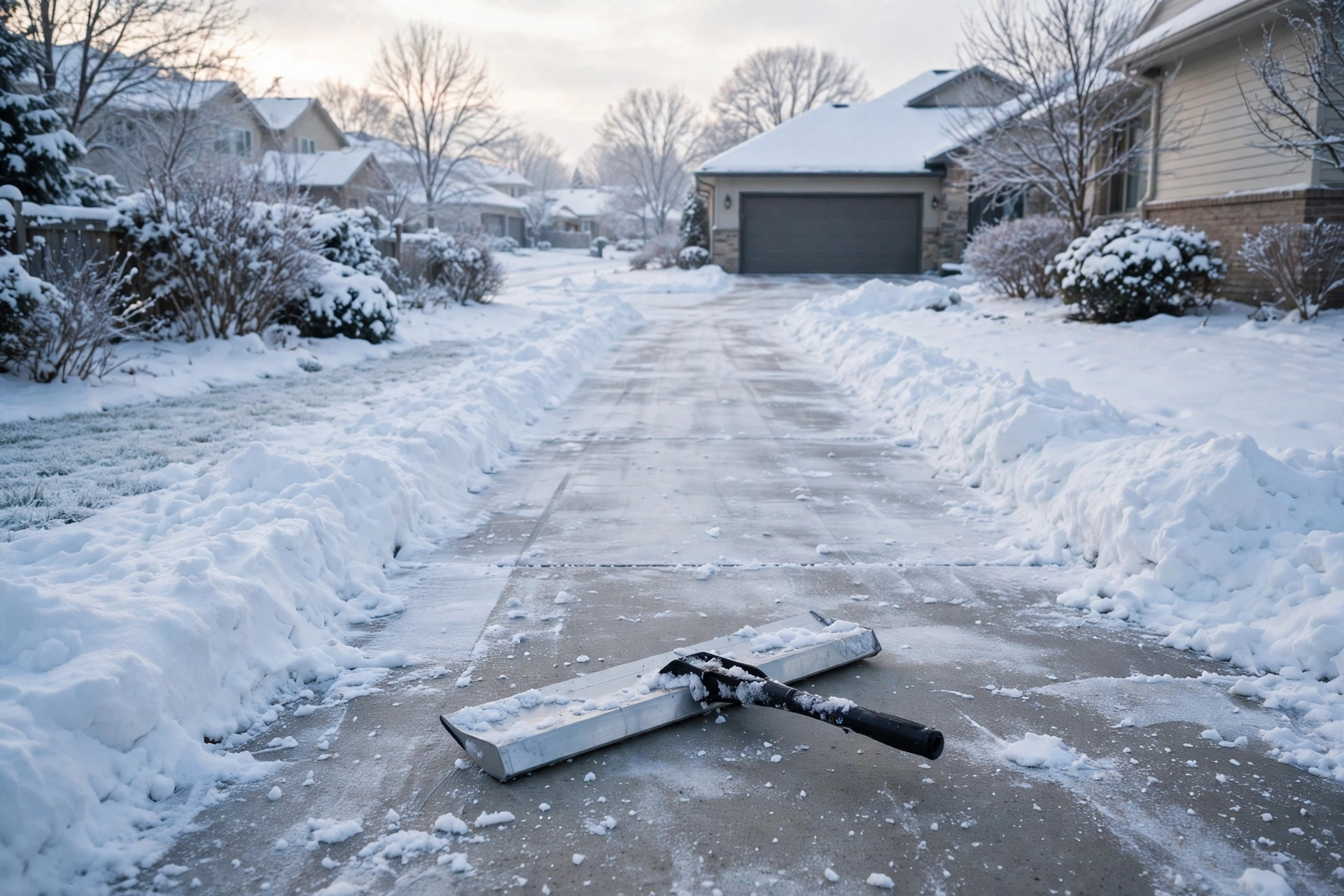
The mistake is buying for the worst storm you remember instead of the driveway you actually own.
That is how a narrow scoop ends up clearing a wide, flat driveway one 18-inch strip at a time, or how a wide pusher ends up useless against the plow berm at the end of the drive. The verdict is simple: the pusher wins on wide, flat driveways in light-to-moderate snow, and the scoop wins for deep snow, steps, and lifting snow over banks. Here is how to tell which driveway you have.
The Verdict in One Pass
It comes down to width. A 32-inch pusher like the Sno go covers nearly twice the ground per pass as an 18-inch scoop, so a two-car driveway takes roughly half the passes. That is not a small difference when the snow is still falling and you are on your third trip down the drive.
But width only helps when you can push. The moment the snow is deep enough to lift, or the ground rises into steps, or the pile has to go over a bank, the pusher has nothing to offer and the scoop does the whole job. Buy for the snow you clear most often, not the snow you fear most.
When the Pusher Wins
A pusher wins on a wide, flat driveway with light-to-moderate snow — the ordinary snowfall, not the blizzard. You walk forward, the blade slides, and the snow rolls off to the side. No lifting, no throwing, no sore shoulders by the second pass.
The pusher also wins on time. Fewer passes mean fewer trips down the driveway, and on a long drive that adds up to real minutes. At 6 pounds, a 32-inch poly pusher stays light enough to steer with one hand when the snow is shallow.
Where it falls short: a pusher cannot lift. Wet, heavy snow stops it cold, and a deep drift just piles up in front of the blade until you are pushing a wall. Narrow walks and steps are out too — the blade is wider than the path.
When the Scoop Wins
A scoop wins anywhere the snow has to go up and over something. Deep snow, the plow berm at the curb, steps to the front door, and the pile you have already built at the edge of the drive — all of it needs lifting, and only a scoop lifts.
The scoop also wins on control. An 18-inch blade fits between cars, along the garage door, and down a walkway without catching the edges. And an aluminum scoop scrapes down to bare pavement, which matters when the thin layer left behind refreezes overnight into ice.
Where it falls short: speed. Clearing a wide driveway 18 inches at a time is slow, and every load is a lift. On a big, flat drive in light snow, a scoop is the wrong tool for the main job — keep it for the edges and the berm.
The Snow Itself Decides
The same driveway can favor a different tool from one storm to the next, because the snow changes. Light, fluffy snow at twenty degrees pushes like feathers — that is pusher weather, and a wide blade will fly through it. Wet, heavy snow near freezing is a different job entirely. It sticks to the blade, doubles the weight of every load, and stops a pusher in its tracks.
Depth matters as much as weight. Up to about four inches, a pusher handles almost anything that falls. Past six inches, the blade starts riding up over the snow instead of cutting under it, and you end up pushing a ridge that spills back behind you. That is the point where the scoop takes over, even on a wide, flat driveway.
The practical move is to match the tool to the storm, not just the driveway. Clear light snow with the pusher while it is still falling, in two short sessions, and you will never face the deep drift that demands a scoop. Wait until six inches have piled up, and the pusher stays in the garage.
Pushing Technique That Makes the Pusher Work
A pusher only saves time if you push it right. Angle the blade slightly to one side so the snow rolls off in a windrow instead of building up in front of you. Push in straight runs down the driveway, then come back along the edge to clear the windrow you just made.
Work with the wind when you can, and plan where the snow goes before you start — pushing it all to one side means a smaller pile to deal with later. On a two-car driveway, clear the middle first in two passes, then push each half outward. The pusher does the wide work; the scoop cleans up the edges the blade cannot reach.
What Most Driveways Actually Need
Most driveways are not one thing. They are a wide, flat apron plus a set of steps, a walkway, and a plow berm. That is why the honest answer for a lot of homeowners is both: a pusher for the open driveway and a scoop for everything the pusher cannot reach.
If you can only buy one, choose by the shape of your driveway. Wide and flat with mostly light snow? Start with the pusher — our best snow shovels for driveways roundup names the 32-inch Sno go as the pick. Narrow, sloped, or step-heavy? Start with the scoop. And if you want an even wider push, the Vevor 36-inch snow pusher covers a 36-inch blade and how it handles on a long drive.
The Bottom Line
Buy the pusher first if your driveway is wide and flat and your snow is usually light — it will cut your clearing time nearly in half. Buy the scoop first if your driveway has steps, a slope, or deep snow to lift over a bank. And if your driveway has both, which most do, get the pusher for the open ground and keep a scoop by the door for the rest.