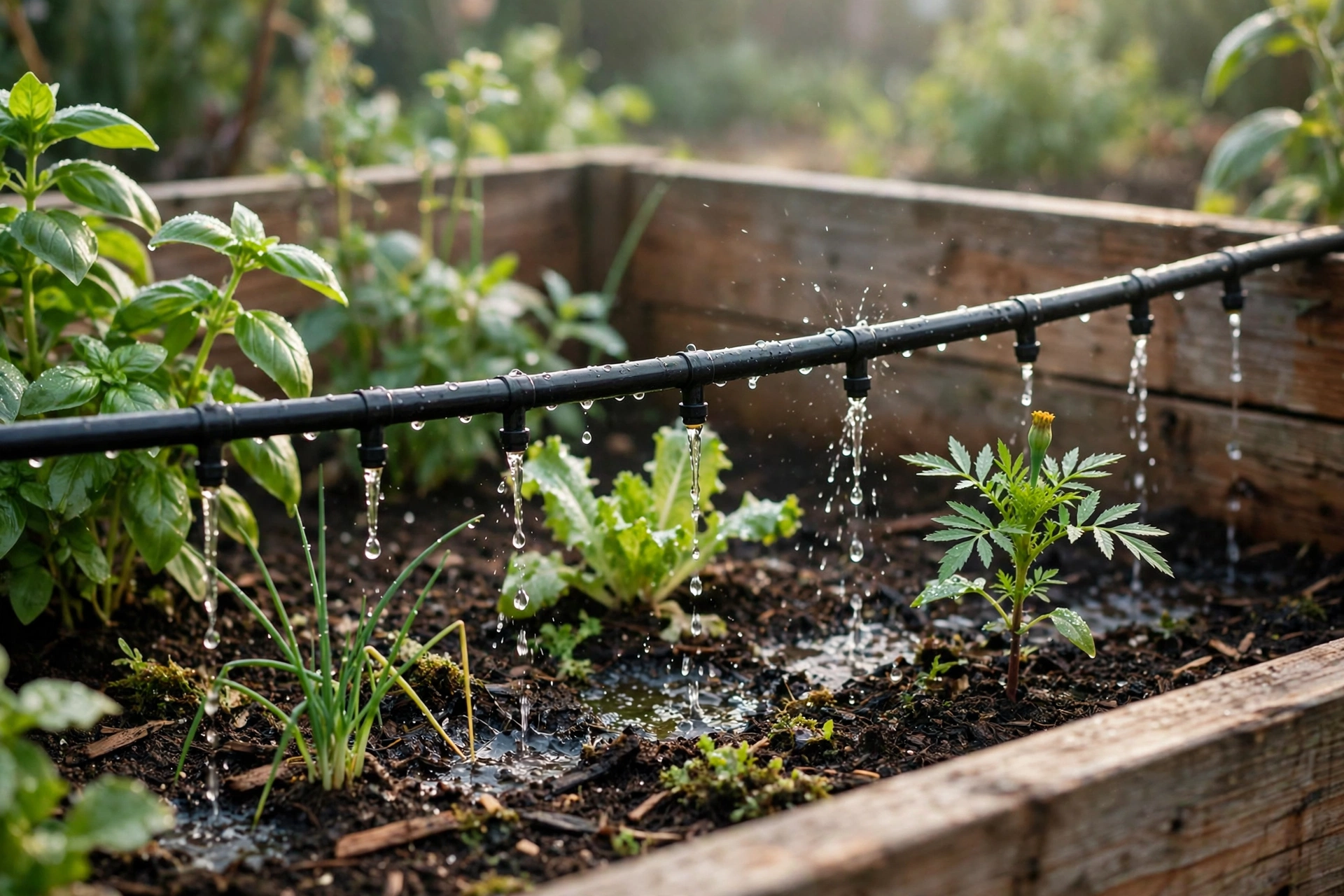
Your drip timer says 30 minutes because 30 minutes is what it has always said, while the tree at the end of the line looks thirsty and the bed near the tap looks soaked. The timer is not lying — it just never knew how much water your emitters actually deliver.
This calculator tells you how long to run a drip zone so each plant gets the water it needs. Type in how much water the plant needs, or how many inches a bed needs, and the calculator works backward from your emitters to your minutes.
Drip irrigation runtime calculator
Pick the one that matches what you know. You can switch and type different numbers.
Use this for the first choice above. For a tree, the worked example below shows where a gallons figure comes from.
Use this for inches, and for tape beds the calculator works the area out from tape length and bed width instead.
Vegetable crops generally need 1 to 1.5 inches of water a week. Type 1 if you are not sure.
Count the emitters that water this plant or zone, not the whole system.
This is printed on the emitter package — common sizes are 0.5, 1, 2, and 4 gallons per hour. Type what yours say, do not guess.
This rating is printed on the tape roll or its package.
The calculator splits the total time across these days, so each watering is shorter.
Optional check: time how long a 5-gallon bucket takes to fill, then divide 5 by the seconds and multiply by 3,600. If your emitters together need more than your supply gives, the calculator will tell you to split the zone.
Without JavaScript, the tables and worked examples below give the same answers by hand.
What to type in
Start with the choice at the top, because it decides which numbers matter. If someone has told you a tree needs about 11 gallons, use gallons. If you are watering a vegetable bed, use inches — 1 inch a week is the usual starting point — and let the calculator turn inches into gallons for your bed size.
Emitter count and emitter flow rate do the rest of the work for ordinary drip lines. A plant with five emitters that each deliver 2 gallons per hour is getting 10 gallons per hour in total, and that total is what turns gallons needed into minutes on the timer.
What the answer means
The calculator shows your total emitter flow, the gallons needed, and the runtime in minutes, with the same total in hours and minutes when it runs long. When the total is a weekly figure, it also splits that time across the days a week you chose, because three shorter waterings are usually better than one very long one.
If one watering comes out longer than about three hours, the calculator suggests more watering days or more emitters. Soil can only hold so much water in one go, and a very long single run wastes water below the roots instead of helping the plant.
How many emitters does a plant need?
Bigger plants need more emitters, spread around the root zone rather than clustered at the trunk. Use this guide as a starting point, then count what your plant actually has before you calculate.
| Plant | Emitters | Flow per emitter |
|---|---|---|
| Flowers and small shrubs, 1–3 ft across | 1 | 1 gallon per hour |
| Large shrubs, 4–6 ft across | 2 | 2 gallons per hour |
| Small trees, 7–10 ft across | 3 | 2 gallons per hour |
| Large trees, 11–14 ft across | 4–6 | 2–4 gallons per hour |
| Trees 15–20 ft across | 6–12 | 2–4 gallons per hour |
| Trees over 21 ft across | 12 or more | 4 gallons per hour |
Add emitters as a plant grows, and place new ones out near the edge of the canopy, where the active roots are. A tree that keeps the two emitters it was planted with is a common reason a young tree does well for a few years and then struggles.
How the math works
The calculator adds up your emitters first: emitters times their flow rate gives the total gallons per hour. Then it divides the gallons your plant needs by that total and multiplies by 60, which gives minutes.
When you start from inches, it turns inches into gallons first. One inch of water over one square foot is 0.623 gallons, so a 32-square-foot bed at 1 inch needs about 19.9 gallons. For tape, it turns the tape rating into gallons per hour, then does the same division.
Worked examples
A shade tree. A mature shade tree with a 10-foot canopy needs about 10.9 gallons a day in hot weather. With 5 emitters at 2 gallons per hour, the total flow is 10 gallons per hour, and 10.9 divided by 10 times 60 is 65.4 minutes — about 65 minutes per watering.
A vegetable bed on tape. A high-flow tape rated at 0.45 gallons per minute per 100 feet, watering 30-inch beds, takes about 5.8 hours to apply 1 inch of water. That is a weekly total to split into separate waterings, not one long soak.
A small bed on emitters. A 4-by-8-foot bed is 32 square feet, so 1 inch is 19.9 gallons. With 16 emitters at 0.5 gallons per hour, the total flow is 8 gallons per hour, and the runtime is about 149 minutes a week — roughly 50 minutes a watering if you water three days a week.
As a check on inline drip lines, where emitters are built into the line: a 0.9-gallon-per-hour emitter, spaced 12 inches apart in lines 18 inches apart, applies water at 0.96 inches per hour. That rate comes from multiplying the emitter flow by 231.1 and dividing by the spacing multiplied by the line spacing.
How long tape takes to apply 1 inch
| Tape flow | Spacing | Hours for 1 inch on 30-inch beds |
|---|---|---|
| Low flow, 0.22 gallons per minute per 100 ft | 12 inches | 11.8 hours |
| Medium flow, 0.51 gallons per minute per 100 ft | 8 inches | 5.1 hours |
| High flow, 0.45 gallons per minute per 100 ft | 12 inches | 5.8 hours |
| High flow, 1.34 gallons per minute per 100 ft | 4 inches | 1.9 hours |
Working out gallons for a tree
For trees and large shrubs, gallons per plant can be worked out from the canopy. Measure the canopy across, in feet, multiply that number by itself and then by 0.7854 to get the plant area in square feet, then multiply by 0.623, by a plant factor, and by the daily water need in inches, and divide by how efficient the system is, at 85 to 90 percent.
| Plant type | Plant factor |
|---|---|
| Ground covers, flower beds, evergreens, small shrubs under 4 ft | 1.00 |
| Apples, cherries, walnuts | 0.85 |
| Mature shade trees | 0.80 |
| Pecans, peaches, plums, pears, apricots, almonds | 0.75 |
| Native plants in dry areas, large shrubs over 4 ft | 0.70 |
| Established low-water native plants | 0.40 |
Worked through: a 10-foot shade tree has a plant area of 78.54 square feet. At a factor of 0.80, a daily need of 0.25 inches, and 90 percent efficiency, that is 0.623 times 78.54 times 0.80 times 0.25, divided by 0.90 — about 10.9 gallons a day. Those daily-need figures are Utah figures, so outside Utah, type your gallons or inches directly instead of using this table to invent a local figure.
This calculator tells you how long to run one zone to deliver a set amount of water. It does not tell you how often your soil and weather call for watering, and it does not subtract rain — on open ground, reduce the inches you type in by the rain that fell; under plastic mulch, the full amount still applies.
For the sprinkler side of the same question, our sprinkler catch-can calculator measures how fast sprinklers put water down, and our drip posts cover setting a system up in a vegetable garden.
Sources
Utah State University Extension, “The Do-It-Yourself Guide to Backyard Drip Irrigation” (June 2025), fetched Nov 7, 2026: https://extension.usu.edu/yardandgarden/research/the-do-it-yourself-guide-to-backyard-drip-irrigation
Utah State University Extension, “Drip Irrigation for Trees” (Mike Kuhns), fetched Nov 7, 2026: https://extension.usu.edu/forestry/trees-cities-towns/tree-care/drip-irrigation
Penn State Extension, “Determining How Long to Run Drip Irrigation Systems for Vegetables”, fetched Nov 7, 2026: https://extension.psu.edu/determining-how-long-to-run-drip-irrigation-systems-for-vegetables