Disclosure: This post contains affiliate links. If you buy through them, Landscape & Leisure may earn a commission at no extra cost to you.
The most common mistake with a patio umbrella base is buying the lightest base that fits the pole, then watching a 9-foot umbrella tip in the first real gust.
The base is not an accessory you size by pole diameter alone. Canopy size and exposure set the weight you need, and a base that is adequate on a sheltered deck can be far too light on an open patio.
This post settles four bases by job: a wheeled fillable base for a market umbrella, a pre-filled concrete base with nothing to fill, a plate set for a cantilever umbrella, and a heavy steel fillable base. The umbrellas themselves are covered in the best cantilever patio umbrellas roundup and the guide to small patio umbrellas for balconies and small patios.
The Picks at a Glance
| Base | Working weight | Size | Type | Best for |
|---|---|---|---|---|
| QZER Umbrella Base with Wheels | Up to 100 lb filled | 20 x 20 x 7 in | Fillable, wheeled | Market umbrellas you move often |
| JOINHOM 42 lb Patio Umbrella Base | 42 lb, pre-filled concrete | See listing | Pre-filled, wheeled | Nothing to fill or drain |
| Sunnyglade 4-Piece Cantilever Base | 176 lb total filled | 19.7 x 19.7 x 3 in per plate | Fillable plates, set of 4 | Cantilever umbrellas |
| AOSTD Heavy-Duty Umbrella Base with Wheels | Up to 150 lb filled | See listing | Steel, fillable, wheeled | Large market umbrellas in open sites |
Best Overall: QZER Umbrella Base with Wheels
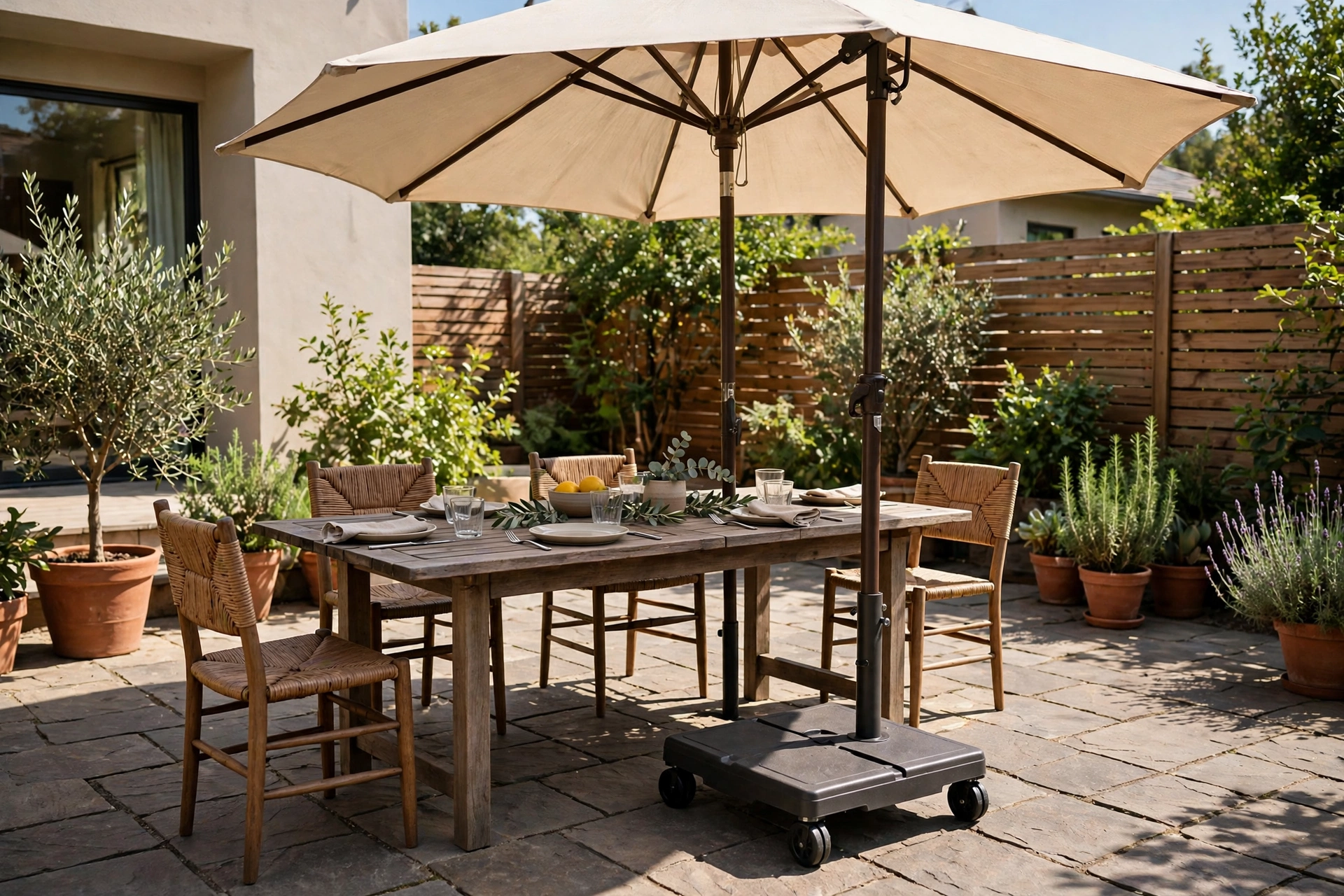
QZER Umbrella Base with Wheels, Fillable Umbrella Stand
Fillable to a 100-pound working weight at 20 by 20 by 7 inches, on wheels, for patio, deck, and poolside market umbrellas.
One hundred pounds is the right working weight for a 9-foot market umbrella on an ordinary patio, and this base reaches it without asking you to move a solid 100-pound block.
You fill it where it will stand, and the wheels let you shift it when the shade needs to move with the sun. That combination is why it leads: heavy in use, manageable between uses.
The trade-off is the fill step itself. An unfilled or half-filled fillable base is a light base, so fill it fully before the umbrella goes up, not after the first windy afternoon.
Pros
- 100-pound filled weight suits a 9-foot canopy
- Wheels make repositioning a one-person job
- Ships light and fills on site with water or sand
Cons
- Must be filled fully to reach its rated weight
- Water-filled bases need draining before freezing weather
- Square 20-inch footprint needs a flat surface to sit level
Best Pre-Filled: JOINHOM 42 lb Patio Umbrella Base with Wheels
JOINHOM 42 lb Patio Umbrella Base with Wheels, Pre-Filled Concrete
42 pounds of pre-filled concrete with wheels, listed for 6- to 12-foot umbrellas, with no sand or water to add.
Some readers do not want a fill cap, a hose, or a bag of sand in the purchase. This base arrives at its working weight, and the wheels are already under it.
Be clear about what 42 pounds can hold. It suits a smaller canopy on a sheltered deck or balcony, especially where the umbrella also passes through a table, and it is not enough weight for a large canopy standing alone in open wind.
Pros
- Pre-filled concrete — no filling, draining, or sand to buy
- Wheels included for moving a solid base
- Good fit for smaller umbrellas in sheltered spots
Cons
- 42 pounds is light for a large freestanding canopy
- Ships at full weight, unlike fillable bases
- Best with table support in breezy locations
Best for Cantilever Umbrellas: Sunnyglade 4-Piece Base
Sunnyglade 4-Piece 176 lb Cantilever Umbrella Base
Four fillable plates at 19.7 by 19.7 by 3 inches each, 176 pounds total when filled with water or sand, with a U-locking design for offset umbrellas.
A cantilever umbrella hangs its canopy off to one side, so the load pulls sideways as well as down. A single center-pole base cannot hold that shape, which is why cantilever models use a cross base weighted by plates.
Each of these four plates fills to roughly 33 to 44 pounds depending on fill, and the set reaches 176 pounds in total. Sand gives you the heavier end of that range and does not need draining before winter.
Note what is in the box: the plates and a manual. The umbrella and its cross base are not included, so confirm your umbrella’s cross base is present before you order plates for it.
Pros
- 176-pound total filled weight for offset canopies
- Plates fill individually, so no single piece is too heavy to place
- Sand fill avoids a winter drain-down
Cons
- Cross base and umbrella are not included
- Four plates take up a large square of patio floor
- Filling four plates takes longer than filling one base
Best Heavy Option: AOSTD Heavy-Duty Umbrella Base with Wheels
AOSTD Heavy-Duty Umbrella Base with Wheels, 150 lb Fillable Steel Stand
Steel fillable base rated to a 150-pound working weight, with wheels, a handle, and anti-collapse pads, for large market umbrellas.
For a large market umbrella on an open patio, weight is the whole decision, and 150 pounds filled is the most on this list for a center-pole umbrella.
The handle and wheels matter at this weight. A 150-pound base without them would stay wherever it was first filled, including the spot that turns out to be wrong at 4 p.m. in August.
If your patio is part of a larger furniture plan, the best outdoor furniture sets under $2,000 roundup is where the full sets these umbrellas shade are compared.
Pros
- 150-pound filled capacity, the heaviest center-pole option here
- Steel construction with wheels and a handle
- Anti-collapse pads included
Cons
- Overkill for a small balcony umbrella
- Needs full filling to reach its working weight
- Steel needs a rinse and dry routine in coastal air
How Much Base Weight Do You Actually Need?
Use about 10 pounds of base weight per foot of canopy diameter as your starting figure. A 7.5-foot umbrella starts near 75 pounds, and a 9-foot umbrella starts near 90 pounds.
Add weight for exposure. An open patio, a rooftop, or a coastal site catches gusts that a fenced, sheltered deck never sees, so step up one class rather than trusting the starting figure.
A table changes the math in your favor. An umbrella pole that passes through a patio table gets lateral support from the table, while the same umbrella standing alone needs the base to do all of the work.
Close the umbrella when you are not under it. No residential base on this list is a substitute for closing a canopy in a storm, and most tipped umbrellas were left open and unattended.
One Base Set to Buy Carefully
The Abba Patio 4-piece offset base plate set has been listed as currently unavailable, and its cross base is not included. A plate set without an available listing and without the cross piece it weights down is a purchase to make only after you have confirmed both the stock and the parts your umbrella already has.
The Sunnyglade set above covers the same cantilever job with its parts and fill weights stated plainly, so it is the safer order today.
Final Thoughts
Buy the QZER wheeled base first for a standard market umbrella: 100 pounds filled is the right weight for a 9-foot canopy, and the wheels keep that weight movable. Step up to the AOSTD for a large umbrella in an open site, use the Sunnyglade plates for any cantilever umbrella, and take the JOINHOM only for a smaller umbrella in a sheltered spot where skipping the fill step matters most.