24 inches. That is the clearance a dining chair needs to slide back from a table edge and stay on the rug, and it is the number most outdoor rug purchases get wrong.
The mistake costs real money, because rugs are priced by the square foot and a size too small cannot be stretched. A rug that ends under the front legs of a pulled-out chair catches the back legs every time someone leaves the table.
Three standard sizes cover nearly every patio setup. Measure the furniture, add the clearance the setup needs, and the size picks itself.
| Rug size | Fits | Furniture on the rug | Watch out for |
|---|---|---|---|
| 5 x 7 ft | Small seating: loveseat or two chairs plus a coffee table | Front legs of seating, full coffee table | Too small for any dining table |
| 8 x 10 ft | Four to six chairs around a coffee table, or a 4-person dining set | All seating legs; dining chairs pulled out | Measure the patio first — it fills most of a 10 x 12 ft slab |
| 9 x 12 ft | Six-person dining or a full sectional grouping | Every leg, with border to spare | Leave 12 to 18 in. of bare floor at the patio edge |
Start with the furniture footprint, not the patio
Patios are bigger than the furniture groups on them, and sizing to the slab is how a rug ends up swallowing the whole surface. Tape the outline of the seating or dining group on the ground first.
Add clearance only where the setup moves. Chairs at a table move; a sofa does not, which is why dining demands the larger allowance and seating can run tighter.
The front-legs rule for seating areas
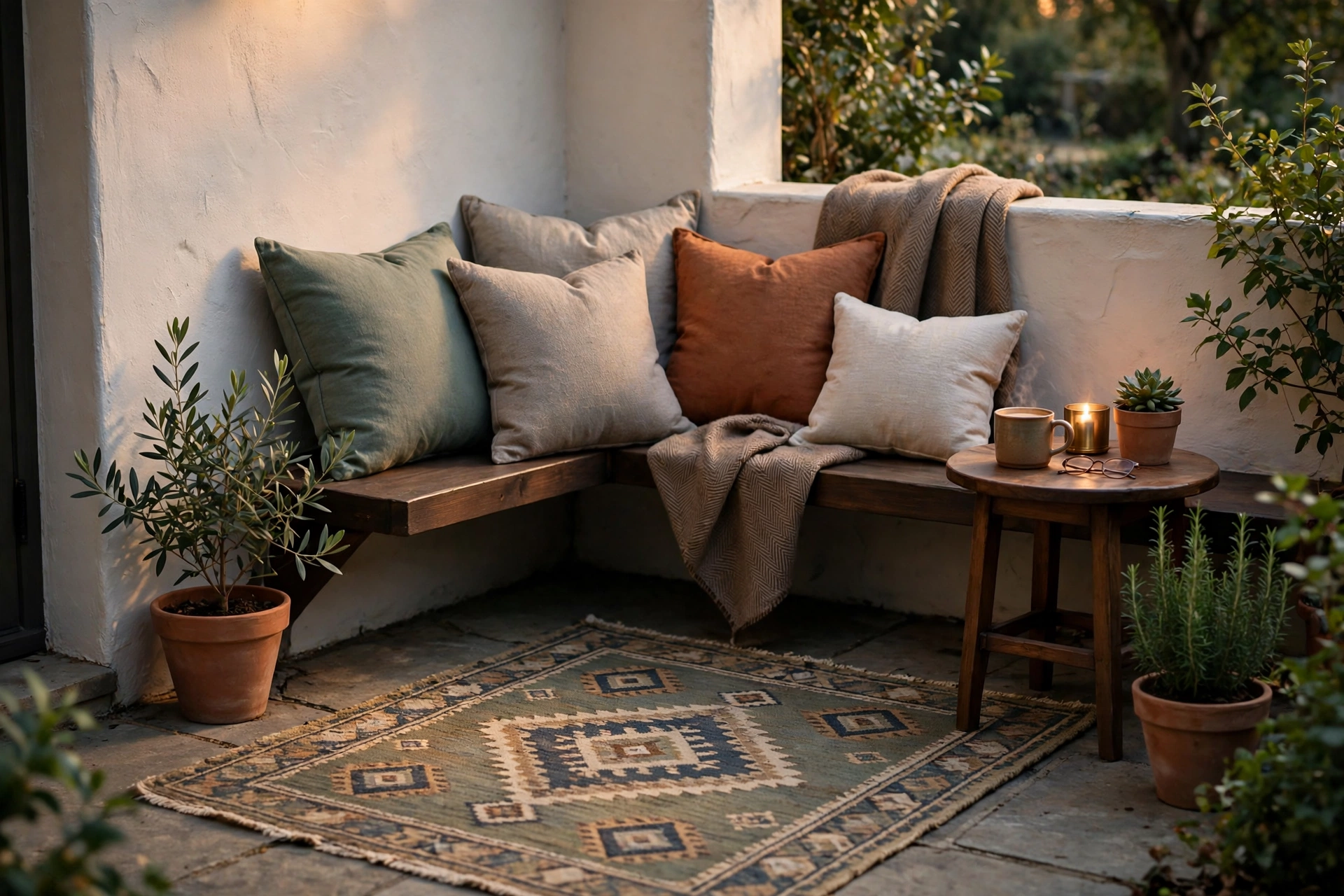
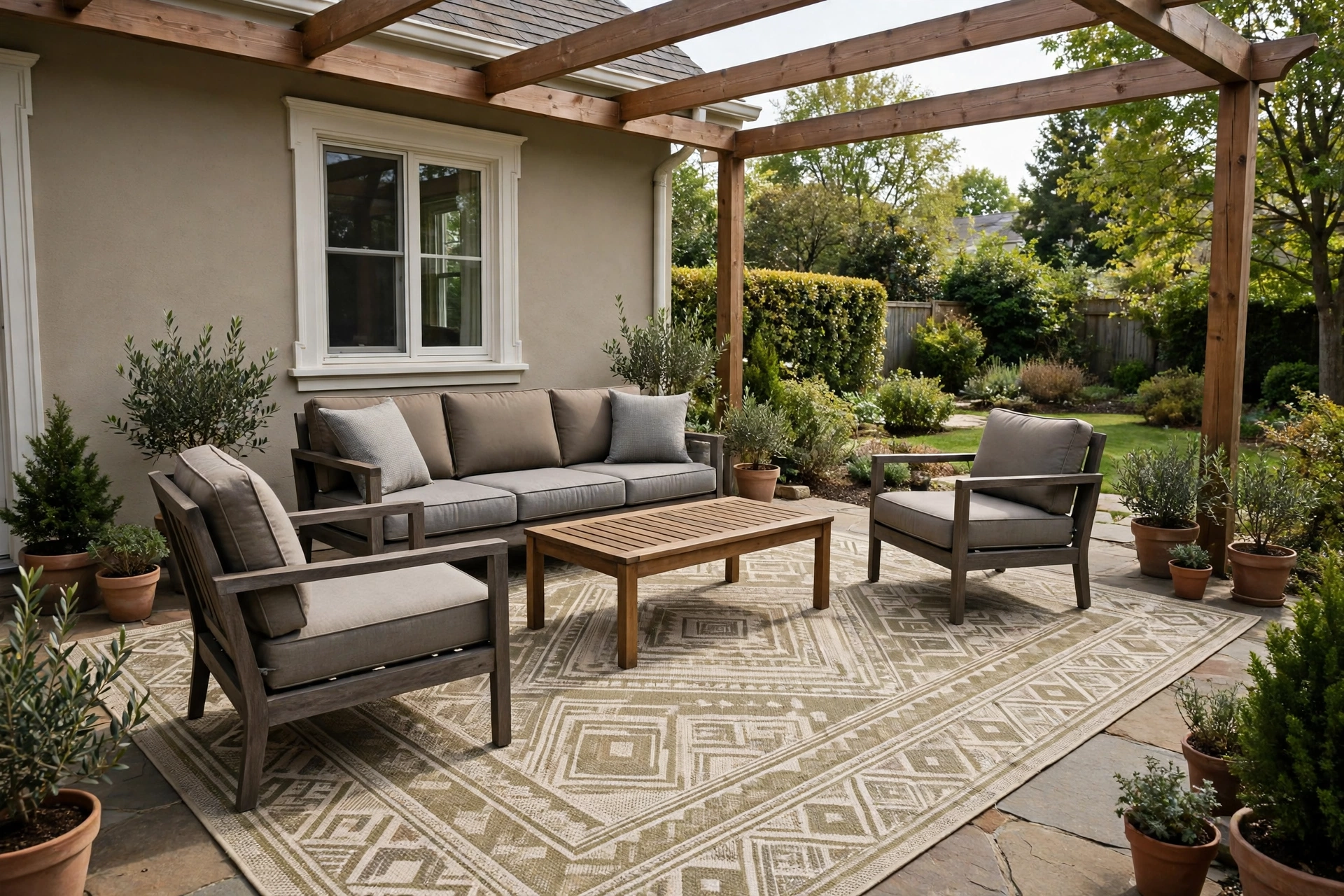
Front legs on, back legs off. That arrangement anchors a sofa or chair to the rug visually while letting a smaller rug do the job, and it is the standard compromise on a mid-size patio.
Every leg on is cleaner when the budget allows it, because chairs stop rocking across the rug edge. Every leg off, with the rug floating in front of the furniture, reads as a bath mat that wandered outside.
A coffee table always sits fully on the rug. Half-on is the one arrangement that never looks deliberate.
Dining needs the pull-out measurement
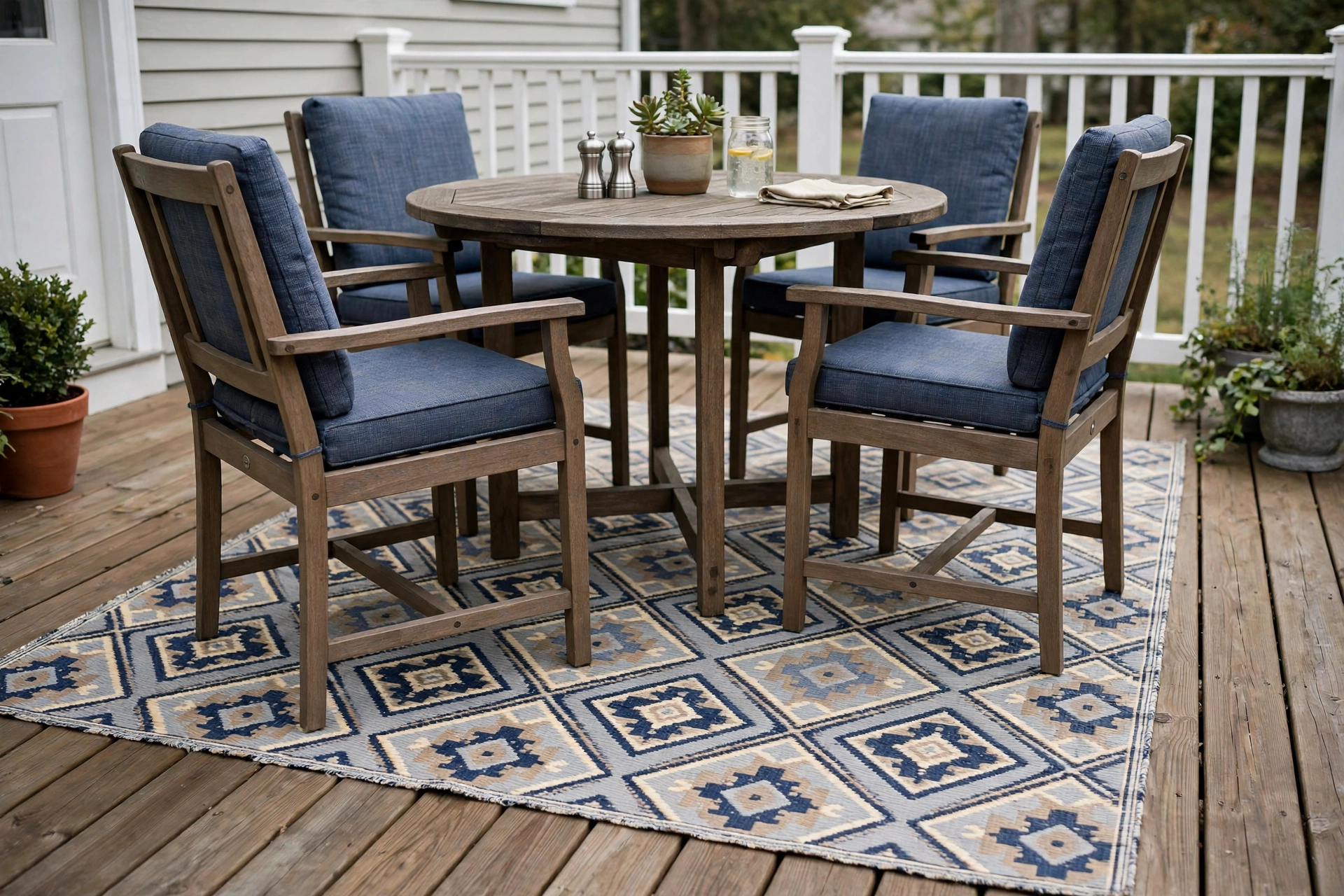
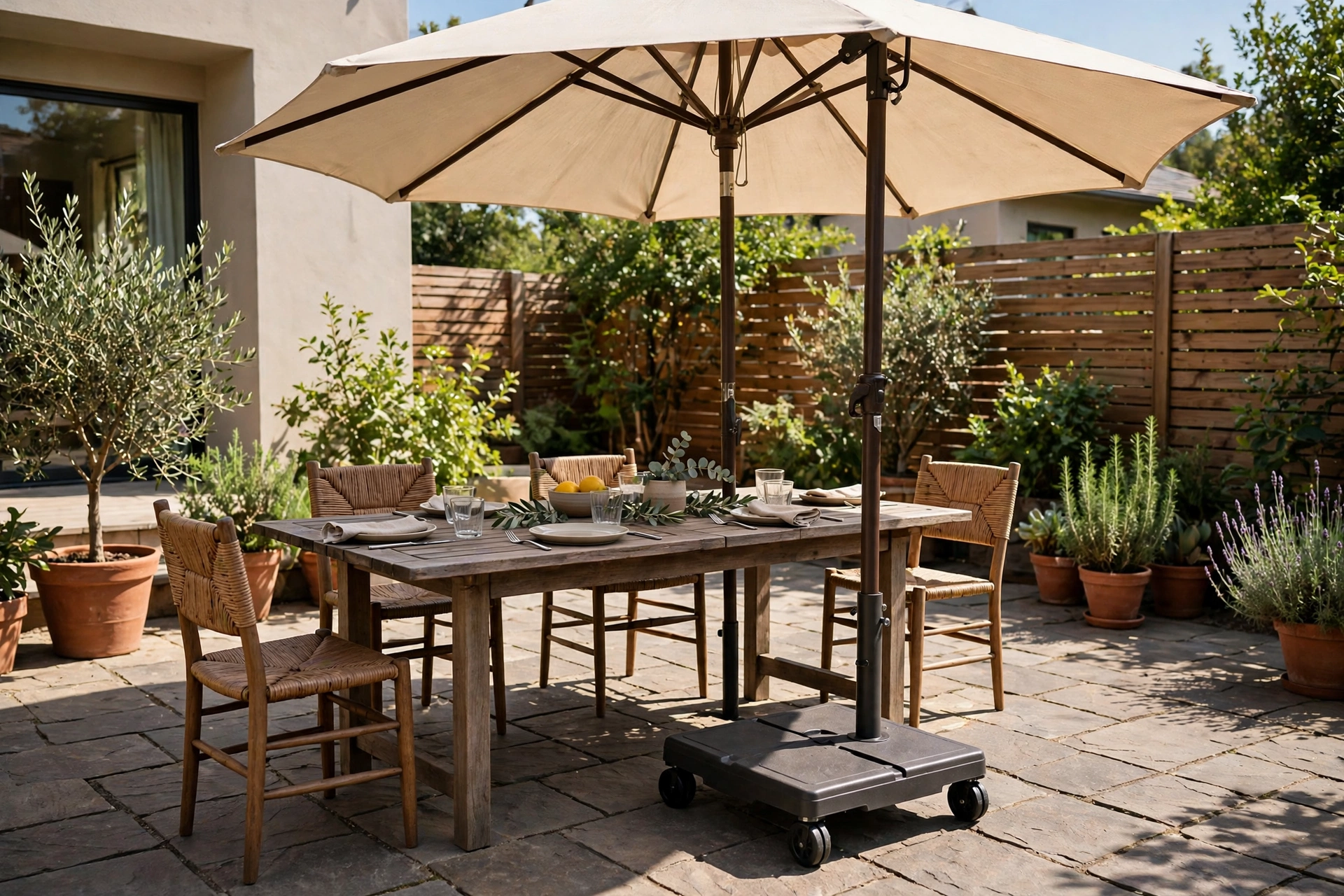
Chairs at a table travel about 24 to 36 inches backward between sitting down and standing up. The rug has to extend at least 24 inches past the table edge on every side where a chair sits, or the back legs drop off the edge mid-meal.
Run the arithmetic once. A 60-inch table needs a rug at least 108 inches wide — 60 plus 24 plus 24 — which lands on the 8 by 10 or 9 by 12, never the 5 by 7.
Round tables soften the requirement slightly at the corners, since no chair pulls straight back from a corner. The 24-inch minimum at each seat still holds.
Leave a border of bare floor
Twelve to eighteen inches of exposed patio around the rug keeps the arrangement from looking wall-to-wall. On a small slab, 8 inches of border still reads as intentional.
The border does practical work too. Rain runs off the patio edge instead of wicking under the rug, and the exposed strip gives you somewhere to stand while you roll the rug up for cleaning.
Small patios and balconies
Balcony furniture is shallower than patio furniture, so the front-legs rule carries most small spaces on a 5 by 7. Two chairs and a side table fit with the table fully on and the chair fronts anchored.
A runner is the honest answer for a long, narrow balcony where no rectangle fits. Forcing a cut-down rug into a space shaped like a hallway leaves curled edges and a tripping corner.
When two rugs beat one large rug
Separate zones take separate rugs. A dining set and a seating group on one long patio look settled with a rug under each, and the arrangement in Patio Furniture Layout shows the spacing that keeps the two groups from crowding.
Two smaller rugs also cost less than one 9 by 12 in most lines, and each one is light enough to hang over a railing to dry. The picks in Best Outdoor Rugs for Patios and Decks are listed in the sizes this guide calls for, and they scale up to the furniture in Best Outdoor Furniture Sets Under $2,000 without a custom order.
Shape and door clearance change the answer
Round tables take round or square rugs better than rectangles. A round rug under a round table keeps the pull-out distance even at every seat, while a rectangle leaves the corner seats short on one side.
Doors set a thickness limit that size charts ignore. A rug that has to pass under a swinging patio door needs a low profile — a flat weave around 0.25 inches clears most thresholds, and a thick mat under the swing path gets kicked up daily.
Runners earn their place along a grill station or a narrow side patio. A 2.5 by 8 foot runner covers the standing zone in front of a grill without pretending to anchor furniture it cannot reach.
Measure twice, in tape on the ground
Painter’s tape settles arguments that a tape measure alone does not. Mark the rug outline, set the furniture inside it, pull the dining chairs out, and sit down.
If a chair leg lands on tape, go up a size. That five-minute test is the whole method, and it is cheaper than a return.