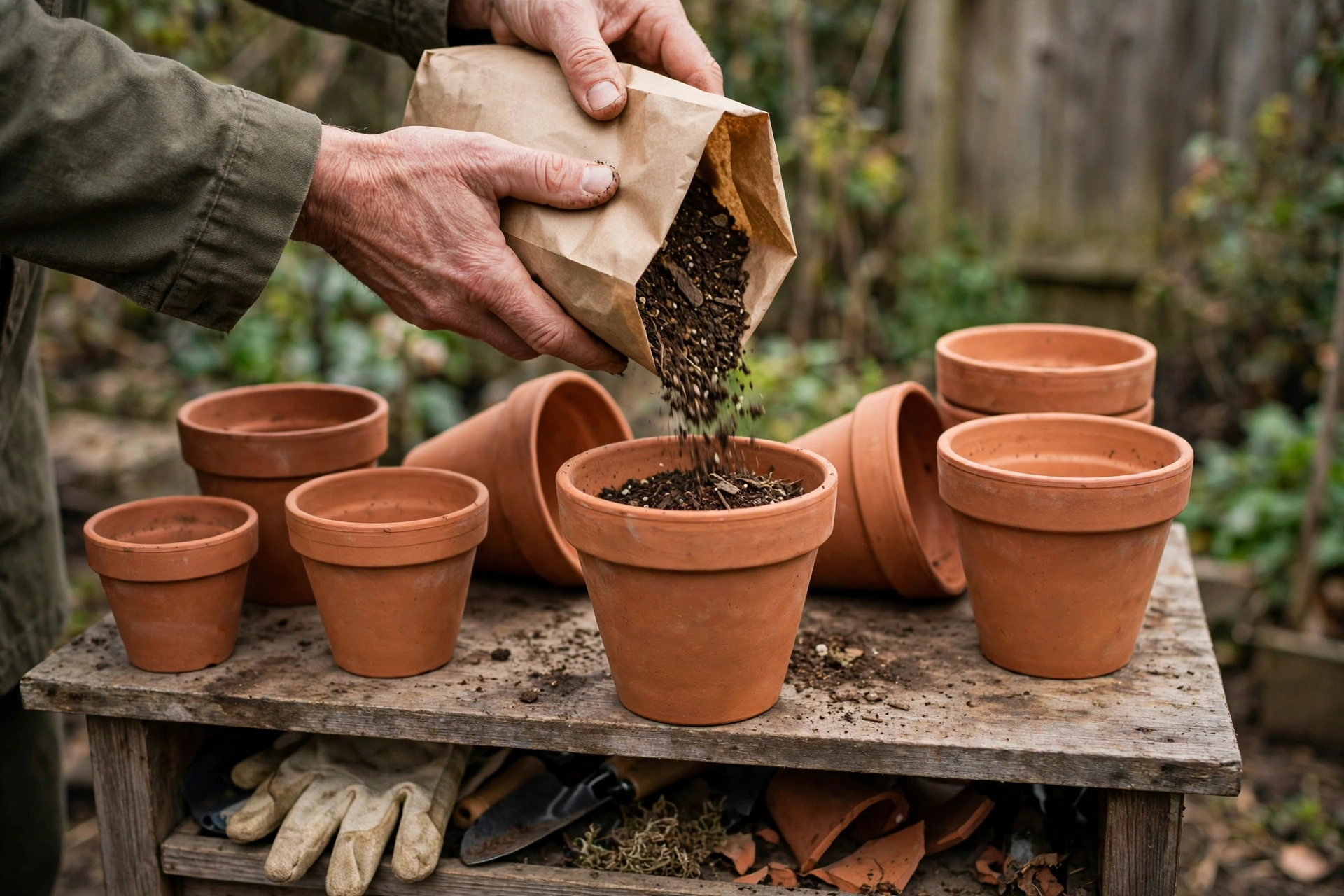
0.65 cubic feet. That is what a standard 12-inch pot actually holds once you leave room at the top for watering, and it is less than most people guess standing in the potting-mix aisle.
Guess wrong and the cost runs both ways. Too little mix means a second trip with a half-filled pot waiting at home, and too much means a torn bag going stale in the garage.
This calculator works out how much potting mix your pots hold — tapered pots included — so you buy the right bag the first time.
Container soil volume calculator
Measure across the inside of the rim.
Measure across the inside of the base. Tapered pots are narrower at the bottom.
Leave 1 to 2 inches empty at the top so water soaks in instead of running over the side. The calculator fills to that line, not to the rim.
Your result will appear here.
What do I type in?
Measure the inside of the pot, not the outside. A tape across the rim and one across the base takes ten seconds, and those two numbers are what make a tapered pot come out right.
Most flowerpots taper, so the tapered shape is the one to start with. If the sides run straight up and down, pick the straight-sided shape and skip the bottom measurement.
What does the number mean?
The result is the volume of mix the pot holds up to your fill line, given per pot and for the whole set. It also converts that volume to gallons and liters, because pot sizes are often sold by the gallon while mix is bagged by the cubic foot.
The bag count always rounds up. A pot that needs 0.65 cubic feet still takes a whole 1.5-cubic-foot bag off the shelf, and the leftover is what tops up the next pot.
How the math works
For a straight-sided round pot, the calculator multiplies the circle’s area by the fill depth. For a tapered pot, it averages the wide top and the narrow bottom the way the shape actually narrows, so a tapered pot comes out smaller than a straight pot with the same rim.
For a rectangular planter, it multiplies length by width by fill depth. Every result starts as cubic inches and divides by 1,728 to get cubic feet.
Common pot sizes, worked out
| Pot | Fill depth | Mix it holds |
|---|---|---|
| 8-inch round, straight sides | 8 inches | 0.23 cu ft |
| 12-inch round, straight sides | 10 inches | 0.65 cu ft |
| 20-inch round, tapered (14-inch base) | 16 inches | 2.12 cu ft |
| 24 × 12-inch rectangular planter | 10 inches | 1.67 cu ft |
Worked examples
A 12-inch pot filled to 10 inches holds 0.65 cubic feet of mix. One 1.5-cubic-foot bag fills it with plenty to spare, and the same bag covers a second pot the same size.
Six of those pots hold 3.93 cubic feet in total. That is 3 bags at 1.5 cubic feet each, with the third bag opened only partway.
A big 20-inch tapered pot with a 14-inch base, filled to 16 inches, holds 2.12 cubic feet. One 2-cubic-foot bag leaves it short, so plan on a second bag or a 1.5-cubic-foot bag plus an 8-quart bag.
What this calculator does not do
It tells you how much mix a pot holds, not which mix to buy or how often to water. Fill with a soilless potting mix made for containers rather than garden soil, which packs too dense in a pot, and leave that 1 to 2 inches below the rim whatever size the pot is.
For beds rather than pots, the raised-bed soil volume calculator runs the same kind of math on bed dimensions, and the mulch volume calculator covers the layer that goes on top.
Sources
University of Maryland Extension, “Growing Vegetables in Containers and Salad Tables” — container sizing, drainage, and soilless potting mix guidance. https://www.extension.umd.edu/resource/growing-vegetables-containers-and-salad-tables (fetched November 22, 2026).
University of Maryland Extension, “Containers and Potting Soil for Indoor Seed Starting” — soilless growing media; garden soil is too dense for containers. https://www.extension.umd.edu/resource/containers-and-growing-medium-seed-starting (fetched November 22, 2026).
Washington State University Extension, King County Master Gardener Tip Sheet #6, “Container Gardening” — fill so the settled mix sits about an inch below the rim to leave room for watering. https://extension.wsu.edu/king/mg-home/gardening-resources/tip-sheets/tip-sheet-6 (fetched November 22, 2026).
Volume formulas are standard geometry: a cylinder is its circle’s area times its depth; a tapered pot is a frustum, which averages the top and bottom circles along the depth; a box is length times width times depth. Conversions: 1 cubic foot = 7.48 gallons = 28.32 liters; 1 cubic foot = 25.7 dry quarts.