300 gallons an hour is the number your faucet has to beat
That is what a 5-gallon bucket filled in 60 seconds means: your faucet can deliver 300 gallons an hour. Add up what every emitter on one drip zone asks for, and you know before you dig whether that zone fits your water supply or needs to be split in two.
The calculator
JavaScript is off, so the calculator cannot run — the worked examples and table below do the same math by hand.
What do I type?
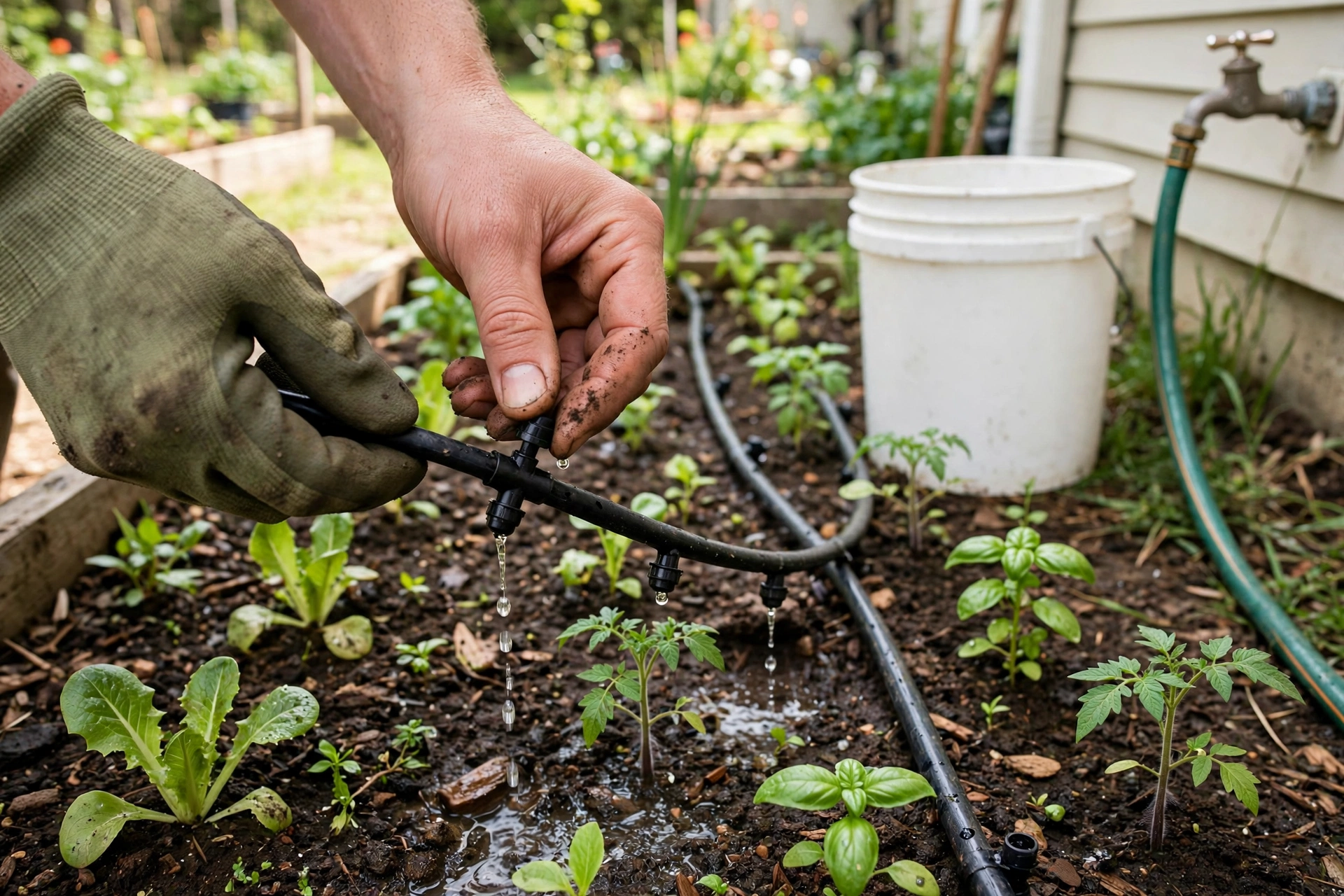
Count the emitters on one zone — one valve, one run of tubing. Pick the flow printed on the emitter package. Then time a 5-gallon bucket at the faucet with nothing else running, or type a supply figure you already know.
What does the number mean?
The calculator adds up your zone: emitters times flow per emitter. It compares that total with your supply, tells you how many emitters of that size your supply can support, and, if the zone is too big, how many zones to split it into.
One caution rides along: on standard 1/2-inch mainline tubing, keep a single run at or under 200 gallons per hour, and design comfortably under that limit rather than right at it.
Worked examples
Bucket test: a 5-gallon bucket fills in 60 seconds. Five gallons divided by 60 seconds, times 3,600 seconds in an hour, gives 300 gallons per hour of supply.
Zone check: 100 emitters at 1 gallon per hour each need 100 gallons per hour. That fits a 300-gallon-per-hour supply, which could support 300 of those emitters in total.
Over supply: 200 emitters at 2 gallons per hour need 400 gallons per hour. Against a 300-gallon supply that zone must split into two, because the supply supports only 150 emitters at that rate.
Zone flow at a glance
| Emitters | At 0.5 GPH | At 1 GPH | At 2 GPH |
|---|---|---|---|
| 25 emitters | 12.5 GPH | 25 GPH | 50 GPH |
| 50 emitters | 25 GPH | 50 GPH | 100 GPH |
| 100 emitters | 50 GPH | 100 GPH | 200 GPH |
| 150 emitters | 75 GPH | 150 GPH | 300 GPH |
| 200 emitters | 100 GPH | 200 GPH | 400 GPH |
What this calculator does not do
This tells you whether one zone fits your supply — not how long to run it, and it does not figure pressure loss over long runs or uphill ground. The bucket test measures what comes out of the open faucet, which is the honest starting number for a home system. A well-designed drip system also aims to wet about half to three-fifths of each plant’s root zone, not the whole bed.
Sources
Utah State University Extension, “The Do-It-Yourself Guide to Backyard Drip Irrigation” — https://extension.usu.edu/yardandgarden/research/the-do-it-yourself-guide-to-backyard-drip-irrigation (fetched November 24, 2026). University of California Agriculture and Natural Resources, “Functional Irrigation” training materials — ucanr.edu (fetched November 24, 2026).