This post contains affiliate links. If you buy through them, Landscape & Leisure may earn a commission at no extra cost to you.
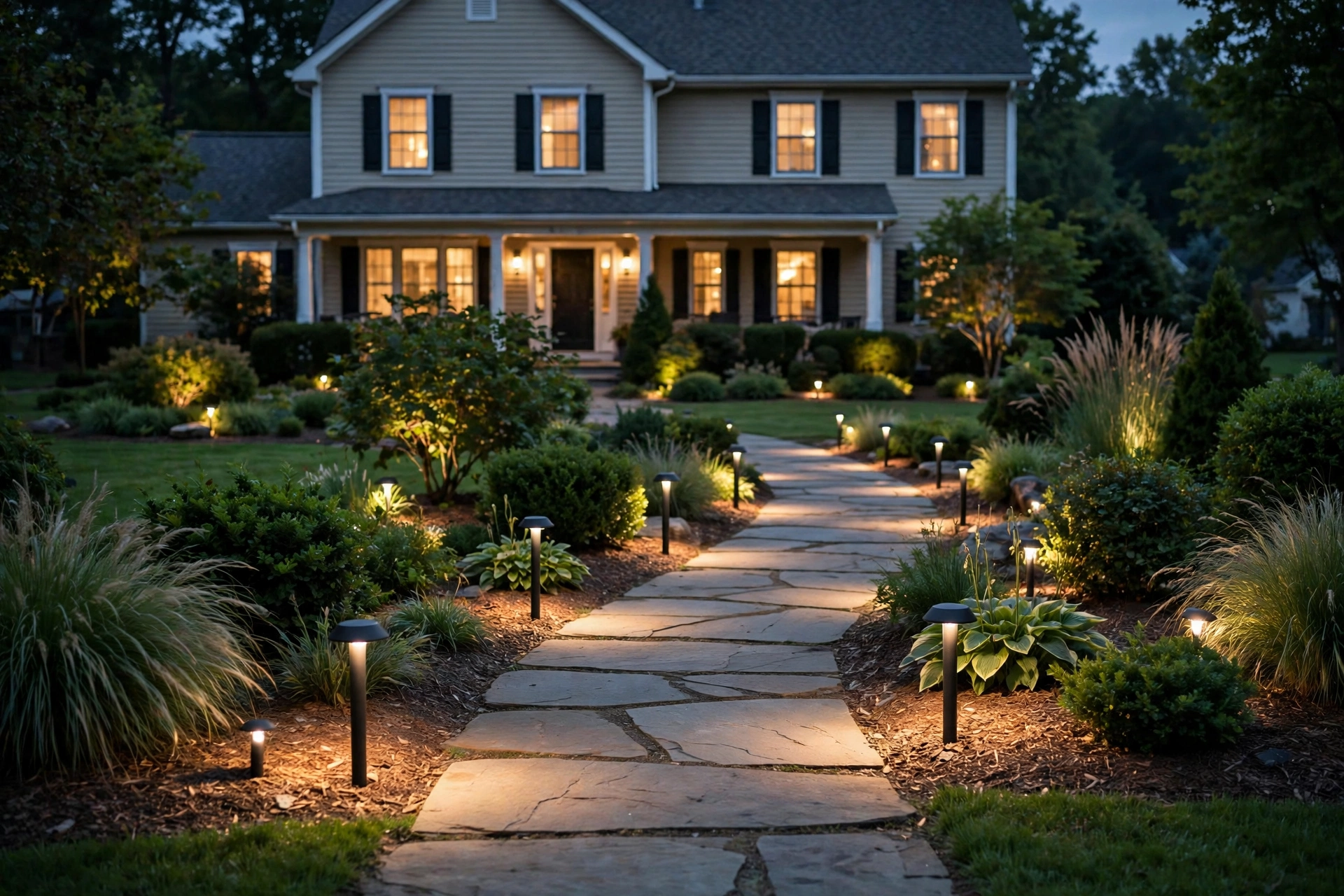
A dark front walk is a trip hazard with good landscaping around it. One bad step on an unlit edge costs more than any lighting kit on this page, and the fix takes a single weekend.
Buy the SUNVIE All-in-One 12-pack first. It is the only kit here that ships with the transformer, a full 100 feet of cable, and the connectors in one box, so nothing stops the install halfway through a Saturday.
The VOLT brass kit is the stronger hardware, with solid brass fixtures and a 150-watt transformer, and it is the right buy for a large yard you plan to light once and leave alone for a decade. Most front walks and foundation beds are smaller than that, and for those yards the SUNVIE kit covers the job at a fraction of the VOLT price.
The three kits, side by side
| Kit | Fixtures | Transformer | Cable included | Rating |
|---|---|---|---|---|
| SUNVIE All-in-One Pathway Kit, 12-Pack | 12 path lights, 3W each, 3000K | 60W, ETL listed | 100 ft | Waterproof, aluminum |
| ZUCKEO All-in-One RGBW Kit, 8-Pack | 8 spotlights, 5W each | 60W with photocell and timer | 80 ft | IP66 |
| SUNVIE 12-Pack Spotlights with 300W Transformer | 12 spotlights | 300W with photocell and timer | None | IP65 |
Best overall: SUNVIE All-in-One Pathway Kit, 12-Pack
Twelve 3-watt path lights draw 36 watts against a 60-watt transformer, which leaves 24 watts of headroom for two or three added fixtures later. That headroom is the number most buyers never check, and it is why this kit still works after the bed along the driveway gets lights of its own.
The 100 feet of included cable matches the transformer placement most houses allow: an outdoor outlet on the front wall, a run down one side of the walk, and a return up the other side. Owners consistently praise the complete-in-one-box setup, and the recurring complaint is that 150 lumens per path light is a guide light, not a work light.
That complaint is fair. These fixtures mark an edge clearly from the street and from the front door, but they will not light a grill station or a set of steps the way a spotlight will, which is the trade-off for the price.
SUNVIE All-in-One LED Pathway Lighting Kit, 12-Pack
Transformer, 100 feet of cable, and connectors in one box, with headroom to expand.
Runner-up: ZUCKEO All-in-One RGBW Kit, 8-Pack
Eight 5-watt spotlights draw 40 watts on the same 60-watt transformer size, and the IP66 rating is one step above the SUNVIE path kit for fixtures that sit in open beds taking direct rain. Spotlights do a different job than path lights: they wash a foundation wall, pick out a small tree, and throw light across a bed instead of pooling it at your feet.
The color-changing modes are the reason to pick this kit and the reason to skip it. Sixteen colors and four effects suit holiday displays, and owners who want plain warm white every night report the remote becomes one more thing to keep track of by the back door.
ZUCKEO All-in-One RGBW Landscape Lighting Kit, 8-Pack
IP66 spotlights with warm white and color modes, transformer and 80 feet of wire included.
Not recommended: SUNVIE 12-Pack Spotlights with 300W Transformer
The box carries no cable at all. Twelve spotlights and a 300-watt transformer arrive ready to work, and then the install stops until a separate cable order shows up, in the right gauge, at the right length.
The 300-watt transformer is also far more capacity than twelve spotlights can use, so the premium buys wattage that sits idle. A complete kit at a lower total cost beats a powerful half-kit, and that is the whole objection.
Transformer sizing, in plain numbers
Add up the wattage of every fixture on the run, then choose a transformer rated at least 25 percent above that total. Twelve 3-watt path lights total 36 watts, so a 60-watt transformer runs at 60 percent of capacity, which leaves the transformer cool and the last light on the run as bright as the first.
Run a transformer at its limit and the far fixtures dim first. Voltage drops along the cable as load rises, and the light at the end of a 100-foot run shows it before any other does.
Cable gauge decides how far the light carries
For runs under 100 feet with a load under 100 watts, 16/2 cable handles the job. Longer runs, or loads above that, call for 14/2 or 12/2, because thicker copper loses less voltage along the way.
The cable hums along at ankle height in most installs, buried two or three inches under mulch where a spade finds it during spring bed work. Mark the run on a phone photo before the mulch goes down, and future digging stays guess-free.
If the choice is between wired and solar for the same walk, our comparison of solar vs. wired path lights covers which one is actually brighter after a cloudy week.
Path lights and spotlights do different jobs
A path light throws a pool of light about 8 to 10 feet across at ground level, which marks an edge and shows a guest where the walk turns. A spotlight throws a beam 15 to 25 feet, which washes a wall, lifts a small tree out of the dark, and shows the shape of the house rather than the shape of the path.
Most front yards need both, in that order. Light the walk first, because that is the safety problem, then add two or three spotlights for the house and the planting, because that is the curb-appeal problem.
Mixing the two on one transformer run is normal. The wattage math does not care which fixture type draws the power, only that the total stays under the transformer’s comfortable working load.
What an install actually involves
Mount the transformer beside an outdoor outlet, lay the cable along the planned run on top of the mulch, and connect each fixture with the push-on connectors before anything gets buried. Test the full run at dusk, move the two fixtures that always land wrong, and only then tuck the cable under the mulch edge.
The whole job runs two to three hours for a 12-light front yard, most of it spent on placement rather than wiring. Low voltage means the cable carries 12 volts, so a nicked wire is a dead light, not a hazard, and corrections cost minutes instead of an electrician.
One placement rule saves most rework: keep path lights 6 to 8 feet apart and set them back from the walk edge far enough that a mower wheel and a snow shovel pass without clipping a fixture.
Set the transformer timer on the first night and leave it alone for a week. A photocell setting, on at dusk and off after a set number of hours, matches how the yard is actually used better than a fixed clock time through the changing seasons.
Bottom line
Order the SUNVIE 12-pack pathway kit for a front walk or foundation bed, and order it once. Add the ZUCKEO spotlights later, on the same low-voltage plan, when a tree or a wall needs light of its own.