How far apart should privacy trees actually go?
Close enough to close the gaps in three years, far enough that the trees are not fighting each other at year ten — that balance is the whole question, and the answer is a number per species, not a guess at the nursery.
Spacing by tree
| Tree | Single row | Staggered double row | Mature width |
|---|---|---|---|
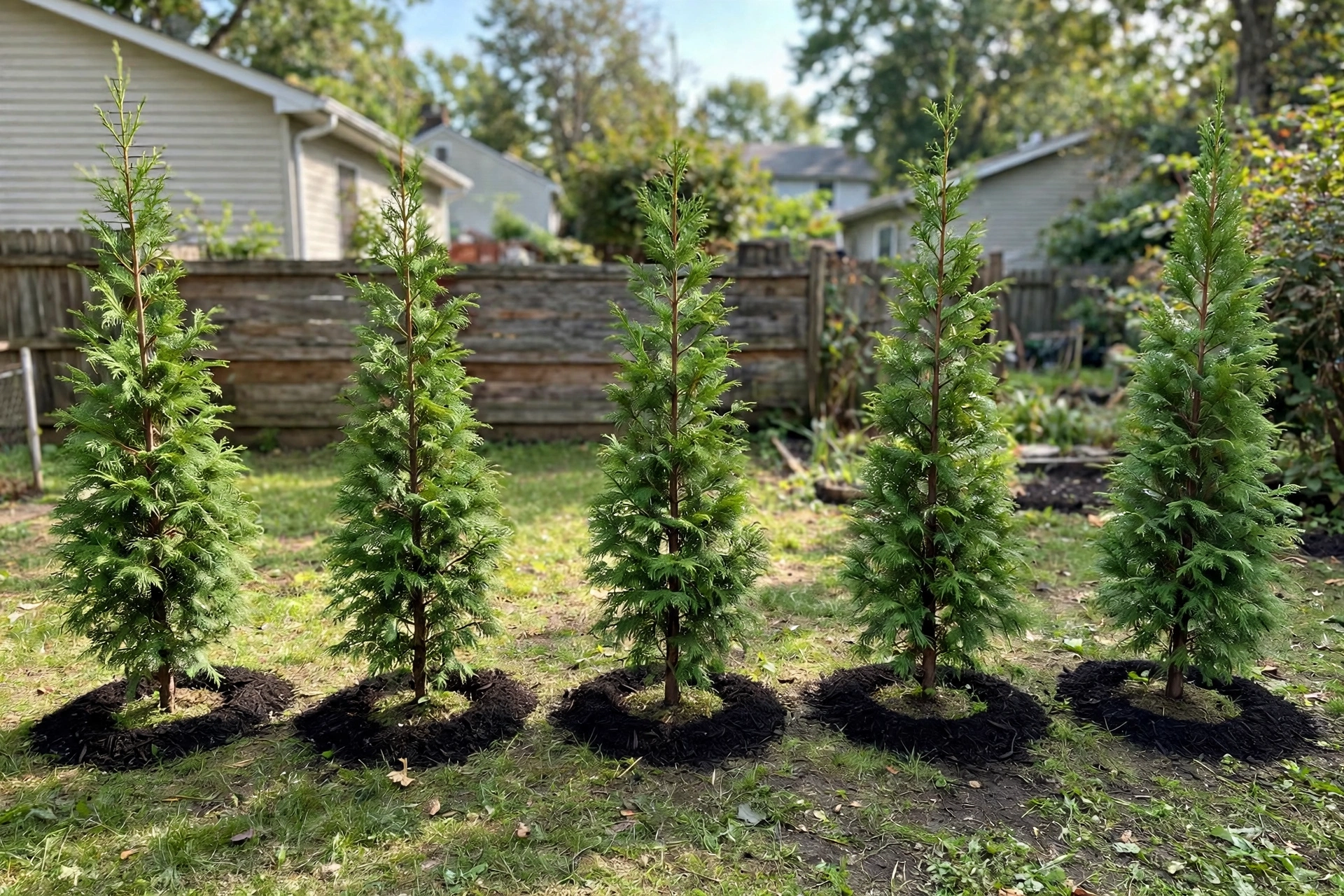
| Green Giant arborvitae | 5-6 ft | 6 ft, rows 4 ft apart | 12-18 ft |
| Leyland cypress | 6-8 ft | 8 ft, rows 5 ft apart | 15-25 ft |
| Emerald Green arborvitae | 3-4 ft | 4 ft, rows 3 ft apart | 3-4 ft |
| Eastern white pine | 10-12 ft | Not recommended | 20-40 ft |
Why the staggered row closes faster
Two rows offset by half a spacing put a trunk behind every gap in the front row, so the screen reads solid a full season sooner. It costs more trees and about four extra feet of bed depth, which is why small yards usually stay with one row — see privacy trees for small yards.
Measure from the fence, not to it
Set the row at least half the mature width back from the property line. A Green Giant centered 3 feet from the fence will hang 6 feet over the neighbor’s yard at maturity, and the trimming argument that follows is not worth the extra foot of lawn.
Bottom line
Green Giant at 5 to 6 feet, Leyland at 6 to 8, Emerald Green at 3 to 4. When in doubt, go wider — a gap fills in, but crowding never reverses. The tree picks are in best fast-growing privacy trees.