75 foot-candles. That is the line where a low-light houseplant stops just holding on and starts to grow, and most rooms that feel bright to you are nowhere near it.
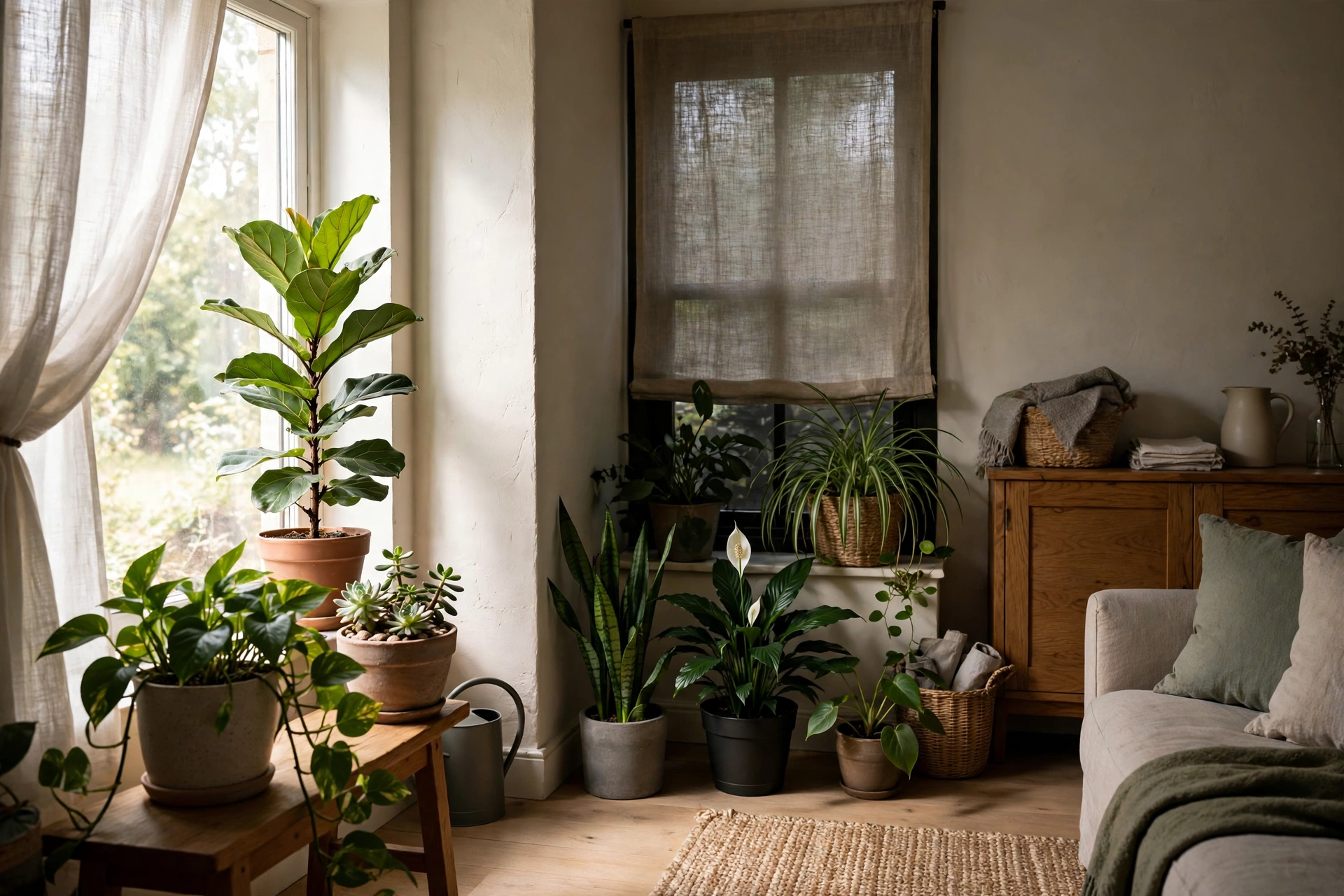
That gap is why a plant can sit in a sunny-looking living room and still stretch, pale, and drop its leaves. Your eyes adjust to the room as you walk through it; the plant sits in one spot and takes whatever that spot delivers. Twelve common houseplants are grouped here by the light that keeps them growing, with the window direction that delivers it in a Northern Hemisphere home.
Houseplant light requirements by plant
Light intensity is measured in foot-candles (fc), the light a candle casts on a surface one foot away. Each plant carries two numbers: the lower range keeps it alive and presentable, and the grow range is where it puts on new leaves. Place the pot for the grow range. If your meter or phone app reads lux, divide by 10.76 to get foot-candles.
| Plant | Light level | Foot-candles to maintain | Foot-candles to grow | Window equivalent | Source |
|---|---|---|---|---|---|
| Cast iron plant | Low | 25–74 fc | 75–300 fc | North window, or more than 8 feet from a brighter window | NC State Extension |
| Chinese evergreen | Low | 25–74 fc | 75–300 fc | North window, or a dim corner well back from the glass | NC State Extension |
| Pothos | Low | 25–74 fc | 75–300 fc | North window, or well back from an east or west window | NC State Extension |
| Monstera | Medium | 75–149 fc | 150–1,500 fc | East or west window, or 4 to 8 feet back from a south window | NC State Extension |
| Rubber plant | Medium | 75–149 fc | 150–1,500 fc | East or west window | NC State Extension |
| Calathea | Medium | 75–149 fc | 150–1,500 fc | East or west window | NC State Extension |
| Peace lily | Medium | 75–149 fc | 150–1,500 fc | East or west window | NC State Extension |
| Anthurium | Medium | 75–149 fc | 150–1,500 fc | East or west window | NC State Extension |
| Bird’s nest fern | Medium | 75–149 fc | 150–1,500 fc | East or west window | NC State Extension |
| Aloe vera | High | 150–999 fc | 1,000–3,000+ fc | South window, within 4 feet of the glass | NC State Extension |
| Jade plant | High | 150–999 fc | 1,000–3,000+ fc | South window, within 4 feet of the glass | NC State Extension |
| Croton | High | 150–999 fc | 1,000–3,000+ fc | South window, within 4 feet of the glass; it needs 2 to 3 hours of direct sun to hold its leaf color | NC State Extension; University of Maryland Extension |
What those numbers look like in a real room
An office sits at about 50 foot-candles, and a supermarket at about 100. Light shining into a window runs 100 to 5,000 foot-candles depending on the window and the sun, while an overcast day outdoors is about 1,000 and full sun is about 10,000.
Distance does quiet damage here. A spot more than 8 feet from a window counts as low light even in a room that reads bright at the doorway, and a fluorescent tube that gives 120 foot-candles at 1 foot gives only 75 at 2 feet. Two steps back from the glass can move a plant down a whole category while the room looks exactly the same to you.
Reading a plant that is already struggling
Too little light shows up as pale leaves that never reach full size, long bare stretches of stem between leaves, and a spindly plant leaning toward the window. Flowering stops, and leaves drop because the plant is not making enough food to keep them.
Too much light burns instead: leaves yellow, new leaves come in smaller, and large brown patches of dead tissue appear on the side facing the glass. Move a plant into stronger light gradually, a step at a time, so it can adjust.
When a spot is almost bright enough, small changes close the gap. Cleaning the window glass and removing screens can raise the light reaching a plant by as much as 30 percent, and rotating plants monthly between a brighter and a dimmer spot lets a low-light plant rebuild its reserves. A plant held in low light also needs less of everything else: water only enough to keep it from wilting, and go easy on fertilizer, since feeding cannot make up for light — the feeding schedule that fits a growing plant is in How Often to Fertilize Houseplants.
Place for the grow range, not the maintain range. A plant parked at its survival number will look like it is surviving — thin, pale, and reaching — so give the high-light plants the south glass, let the low-light plants have the north wall, and the middle of the room sorts itself out.
Sources
- NC State Extension, Extension Gardener Handbook, Chapter 18, “Plants Grown in Containers” (Tables 18–10, 18–11, and 18–13) — https://content.ces.ncsu.edu/extension-gardener-handbook/18-plants-grown-in-containers — fetched November 26, 2026.
- University of Missouri Extension, G6515, “Lighting Indoor Houseplants” — https://extension.missouri.edu/media/wysiwyg/Extensiondata/Pub/pdf/agguides/hort/g06515.pdf — fetched November 26, 2026.
- University of Maryland Extension, “Selecting Indoor Plants” — https://extension.umd.edu/resource/selecting-indoor-plants — fetched November 26, 2026.