Hydrangeas are among the most beloved flowering shrubs in North America. Their massive blooms, long flowering season, and ability to thrive in many landscapes make them a staple of foundation plantings and garden beds. Yet every year, countless homeowners ask the same frustrating question:
“Why is my hydrangea full of leaves but not flowers?”
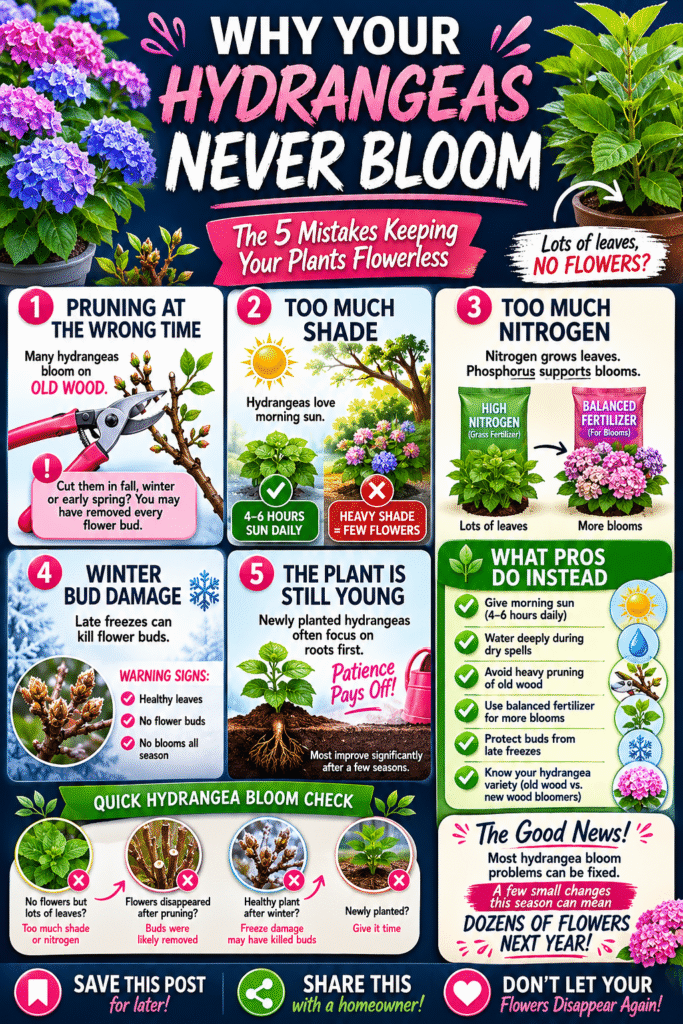
While poor growing conditions can sometimes be responsible, one simple mistake accounts for a surprisingly large percentage of bloom failures: improper pruning.
The Hidden Reason Hydrangeas Fail to Flower
Many gardeners assume that cutting back a shrub encourages more flowers. With hydrangeas, however, timing is everything.
Several popular hydrangea species—including many bigleaf hydrangeas (Hydrangea macrophylla)—produce flower buds on what gardeners call “old wood.” That means the buds that bloom next summer actually begin forming during the previous growing season.
If those stems are removed during fall cleanup, winter pruning, or early spring maintenance, the flower buds are removed as well.
The plant survives. The leaves return. But the flowers never appear.
Not All Hydrangeas Follow the Same Rules
One reason hydrangeas create so much confusion is that different varieties bloom differently.
Hydrangeas That Bloom on Old Wood
These varieties generally set flower buds during the previous season:
- Bigleaf hydrangeas
- Lacecap hydrangeas
- Oakleaf hydrangeas
- Mountain hydrangeas
Heavy pruning can eliminate an entire year’s worth of flowers.
Hydrangeas That Bloom on New Wood
These varieties produce flower buds on current-season growth:
- Panicle hydrangeas
- Smooth hydrangeas, including many ‘Annabelle’ types
These plants are generally more forgiving and can often be pruned in late winter or early spring.
Other Reasons Hydrangeas May Not Bloom
While pruning mistakes top the list, several other issues can reduce flowering.
Late Spring Frosts
A warm spell followed by a hard freeze can damage developing flower buds before they open.
Excess Nitrogen
Too much lawn fertilizer near hydrangeas can encourage vigorous leaf growth at the expense of flowers.
Insufficient Sunlight
Most hydrangeas prefer morning sun and afternoon shade. Deep shade often results in fewer blooms.
Deer Damage
In many regions, deer browse hydrangea stems during winter, removing flower buds before spring arrives.
How to Get More Flowers Next Year
If your hydrangea disappointed this season, don’t panic.
Start by identifying the specific variety you have. Once you know whether it blooms on old wood or new wood, you can develop an appropriate pruning schedule.
Avoid unnecessary pruning, protect plants from late frosts when possible, and provide consistent moisture throughout the growing season.
In many cases, the solution isn’t adding fertilizer or replacing the plant. It’s simply putting down the pruning shears at the right time.
Sometimes the reason a hydrangea won’t bloom isn’t what you failed to do—it’s what you did too well.