
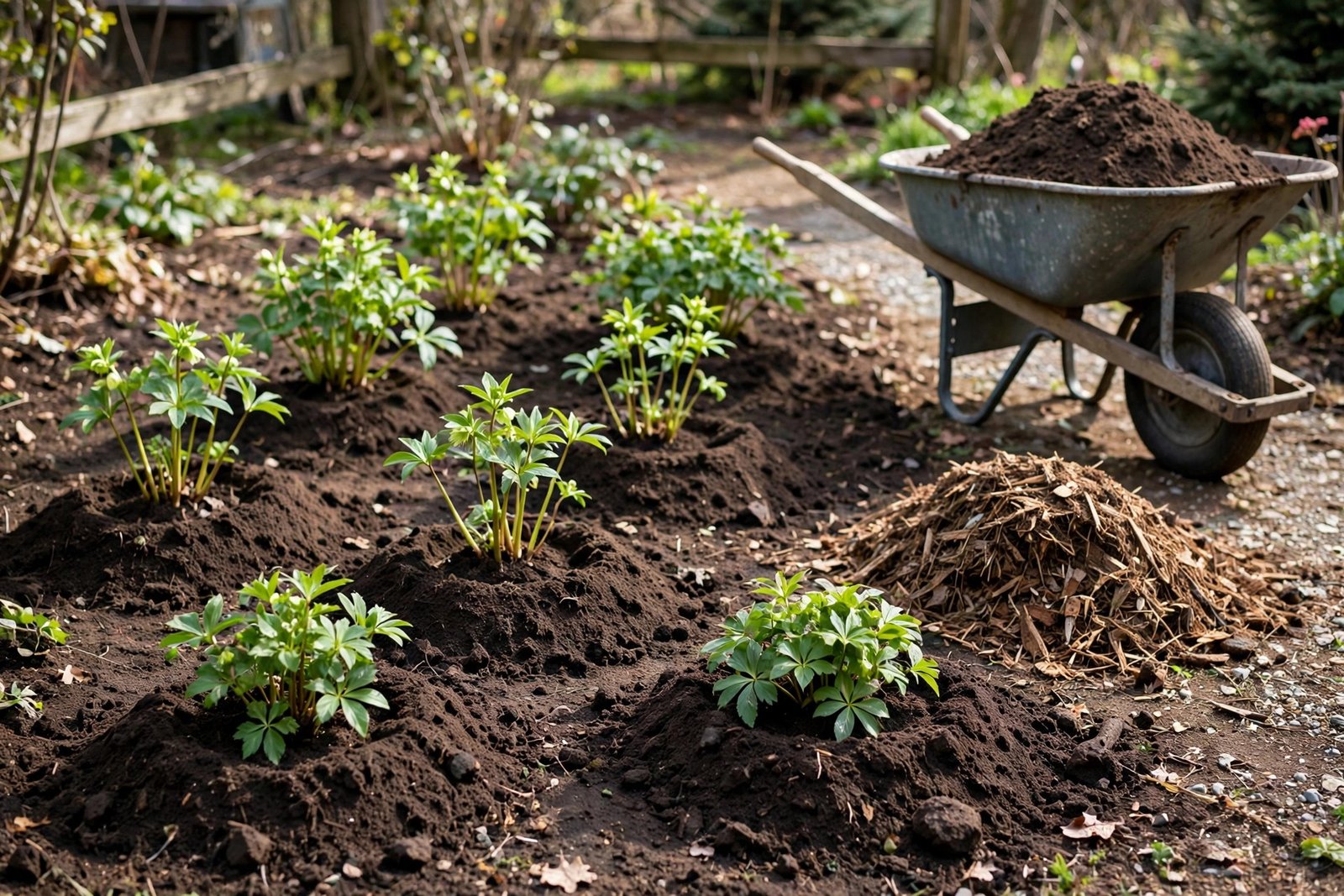
Divisions fail more often from what happens after planting than from the dividing itself. A division set into a hole of pure compost, buried too deep, or mulched up to its crown will rot or stall while its neighbor — planted in plain soil with a drink — takes off. The aftercare is unglamorous and it decides the outcome: right depth, honest backfill, deep water, and mulch kept where it helps.
For the tools that make the divisions, see best tools for dividing perennials.
Backfill: mostly native soil
The most common mistake is filling the hole with rich bagged mix while the surrounding ground is ordinary garden soil. Roots grow happily in the rich pocket and then stop at the boundary, circling instead of spreading — the same container effect that stunts pot-bound plants. University extension guidance consistently says the same thing: backfill with the soil you dug out, loosened, with only a modest amount of compost worked in — roughly one part compost to three parts native soil. If the native soil is heavy clay, the fix is broader loosening of the whole bed, not a richer hole.
Depth: crown at grade, no exceptions
Set the division so its crown — where stems meet roots — sits at the same level it grew before, level with the surrounding soil. Too deep and the crown rots, especially for hostas, daylilies, and coneflowers; too shallow and the roots dry out between waterings. After backfilling, press the soil gently with your hands, not your boots — compacted soil holds less air and water — and water immediately to settle it, then check the level again, because soil always settles lower than it looks.
Water: deep and infrequent beats daily sprinkles
Water the division deeply at planting, enough to soak the root zone, then water when the top inch of soil dries rather than on a calendar. Daily light sprinkles keep the surface wet and the roots shallow; a deep soak every few days pulls roots downward. In fall divisions, keep watering until the ground freezes — fall planting fails most often from dry roots, not cold. In spring divisions, expect to water through the first dry spell; a division’s root system is a fraction of the parent clump’s, and it cannot reach deep moisture yet.
Mulch: 2 to 3 inches, kept off the crown
Mulch with 2 to 3 inches of shredded bark, leaf mold, or clean straw, pulled back 2 to 3 inches from the crown itself. Mulch against the crown traps moisture and invites rot — the classic “volcano mulching” error, scaled down to perennial size. Shredded bark stays put better than wood chips on a slope; straw works well for fall divisions because it insulates without matting, but it must be seed-free or you will plant a weed crop. Skip landscape fabric under perennial mulch: it blocks the soil life that feeds the plants and eventually strangles spreading crowns.
First-year expectations
A fall division should root before winter and grow normally in spring; a spring division may bloom lightly the first year and properly the second. Do not fertilize at planting — fertilizer pushes soft top growth before roots can support it. Wait until you see active new growth, then feed at half the label rate if the plants look pale. If a division wilts in the first week despite wet soil, it is usually transplant shock, not thirst: shade it with a bucket or board for a few days rather than drowning it.
Quick checklist
- Backfill: native soil with a little compost, not pure bagged mix.
- Depth: crown at grade, rechecked after the first watering.
- Water: deep soaks when the top inch dries, until the ground freezes for fall divisions.
- Mulch: 2 to 3 inches, kept clear of the crown.
- No fertilizer until active new growth appears.