
As an Amazon Associate, Landscape & Leisure earns from qualifying purchases made through links on this page.
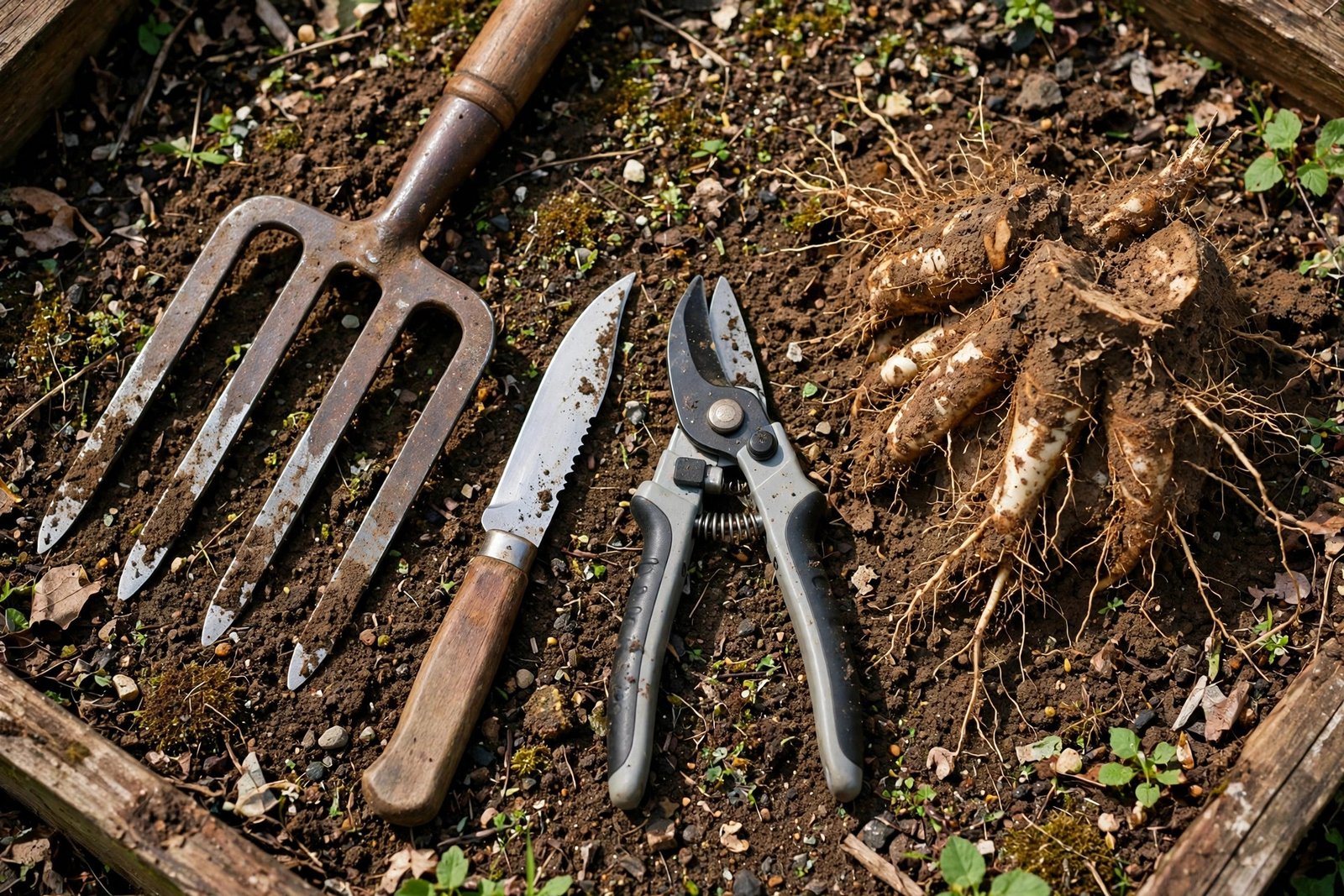
Dividing perennials is mostly a tool problem. The wrong tool tears roots, crushes crowns, and turns a ten-minute job into a wrestling match; the right tool cuts cleanly and the divisions recover in weeks instead of sulking for a season. The rule is simple: lift with a fork, cut with a knife or saw, and never pry with a spade. This guide matches each tool to the plant it suits, with manufacturer specifications and aggregated owner feedback, not hands-on testing claims.
For what happens after the divisions are in the ground, see what soil and mulch to use after dividing perennials.
Dividing tools compared
| Tool | Best for | Key spec |
|---|---|---|
| Spading fork | Lifting clumps intact | Flat tines slide under roots |
| Nisaku NJP650 hori hori | Cutting small to medium divisions | 7.25 in. blade, depth marks |
| Root Slayer Perennial 23311 | Sawing through root masses | Serrated carbon-steel blade |
| Root Slayer 22011 | Large grasses and woody crowns | 13 in. blade, 5 lb |
Start with a spading fork, not a spade
A spading fork’s flat tines slide between roots instead of slicing through them, so you can lift a hosta or daylily clump with most of its root system attached. Work the fork in from two or three sides, lever gently, and lift the whole clump onto a tarp. A flat spade has its place — cutting a straight edge around the clump before lifting — but using it as the lifting tool shears the fine roots that do the actual drinking in the first weeks after transplanting.
Best cutting knife: Nisaku NJP650 hori hori
The hori hori is the dividing knife against which others are measured: a 7.25-inch Japanese stainless blade, straight edge on one side and serrated on the other, with inch and millimeter depth marks along the blade. The straight edge makes clean cuts through hosta and daylily crowns; the serrated edge saws through fibrous grass roots without tearing. At about 10 ounces it is light enough for an hour of dividing, and it ships with a sheath — use it, because a hori hori left blade-up in a bucket is an emergency waiting for a hand.
Pros: two edges in one tool; depth marks double for bulb planting; proven pattern copied by every other maker.
Cons: not a full-tang design, so avoid heavy prying in rocky soil; wood handle needs drying after wet work.
Nisaku NJP650 Original Hori Hori (7.25 in. blade)
The standard dividing knife: straight edge for crowns, serrated edge for fibrous roots, depth marks included.
Best value knife: PERWIN hori hori
The PERWIN is the full-tang alternative: a 7-inch stainless blade with a walnut handle, a sheath, and a price well under the Nisaku. Full-tang construction means the blade steel runs through the handle, which matters when you lever a stubborn clump apart — the failure mode of partial-tang knives is the handle snapping at the joint. The trade-off is refinement: the edge and sheath finish are good, not heirloom, and the blade lacks the Nisaku’s depth markings.
Pros: full-tang strength; walnut handle; strong value.
Cons: no depth marks; finish is workmanlike rather than polished.
PERWIN Hori Hori Garden Knife (7 in., full tang)
Full-tang strength for prying divisions apart, at a lower price than the classic Nisaku.
For big root masses: Root Slayer shovels
Ornamental grasses and woody crowns laugh at knives. For those, a serrated shovel is the tool: the Root Slayer Perennial 23311 is the smaller, lighter version with a serrated carbon-steel blade for cutting through root masses, while the full-size Root Slayer 22011 carries a 13-inch blade at 5 pounds for the biggest grass clumps. Use them like a saw, not a shovel — short strokes through the root mass, then lift the sections with the fork. The serrated edge is genuinely sharp; wear gloves and keep the blade away from irrigation lines you have not located.
Radius Garden Root Slayer Perennial Shovel 23311
A lighter serrated shovel that saws through root masses a knife cannot handle.
What not to use
Skip the pruning saw for soft crowns — it tears more than it cuts — and skip the mattock, which turns divisions into confetti. A kitchen knife is tempting and wrong: the blade is too thin, the handle too slick when wet, and the edge will not survive soil contact. And whatever the tool, every division needs at least two or three healthy growing points and a fist-sized root mass; smaller pieces survive, but they spend a year catching up instead of blooming.
Quick kit
Spading fork for lifting, hori hori for cutting, serrated shovel for grasses and woody crowns, tarp for the work surface, and a bucket of water for holding divisions out of the sun. That kit divides everything from hostas to miscanthus without a single specialty purchase beyond the knife.