Landscape & Leisure is reader-supported. When you buy through links on our site, including Botanical Interests seed links, we may earn a commission at no extra cost to you. Prices change, so click through to confirm current pricing.
Basil is the herb that teaches you to watch the thermometer instead of the calendar. Sow it into cold soil and it sits there, sullen, while everything else in the tray comes up. Give it warm soil, warm nights, and a sunny windowsill, and it grows so fast you will be pinching it before you expected to. That is the whole secret, and it is a happy one: basil does not ask for skill so much as for heat at the right time. Get the timing right and the rest — the pinching, the picking, the pesto — falls into place.
Basil is one of the herbs in our roundup of the best culinary herbs to grow from seed. If some of your herbs come back on their own next year, our guide to herbs that reseed themselves explains which ones to welcome and which to keep in bounds.
Why Basil Sulks: It Is a Heat Plant
Basil comes from warm climates, and it has never really made peace with a northern spring. Botanical Interests lists both Genovese and Noga basil as frost sensitive, and the numbers tell the story: direct-sow only when soil temperature is at least 60°F, ideally 65° to 85°F, and transplant only when nighttime temperatures stay above 50°F. A seedling set out on a 45-degree night does not die dramatically. It just stops, and the weeks it loses are weeks it never gets back. If your basil has ever looked pale and stalled while your lettuce thrived, cold soil was almost certainly the reason — lettuce loves the weather basil merely tolerates.
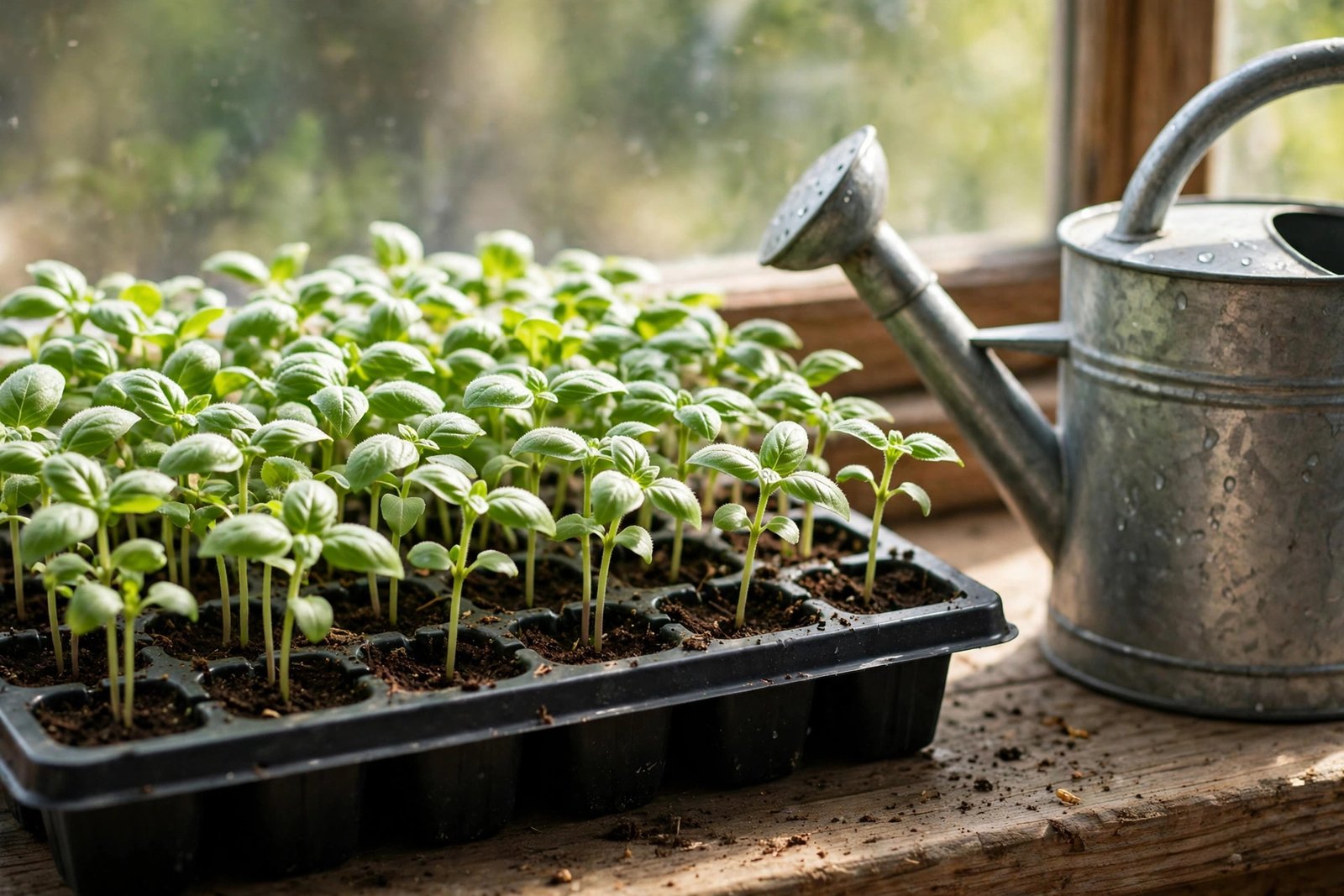
That is why starting indoors is recommended for both varieties below, 4 to 6 weeks before transplanting outside. Indoors you control the warmth. A heat mat under the tray keeps the soil in that 65° to 85°F sweet spot even when the windowsill is cool, and a sunny window or a grow light keeps seedlings stocky instead of stretched. Basil germinates in 5 to 10 days when it is warm. When it is cold, it germinates slowly or not at all, and no amount of encouragement fixes that — only warmth does.
Seed Starting Heat Mat
Warm soil is what basil actually wants — a heat mat keeps a cool windowsill in the 65° to 85°F range basil germinates in.
When to Start Basil
Work backward from your last frost date, and give yourself room. Start seed indoors 4 to 6 weeks before you plan to transplant, and transplant only after nights hold above 50°F. For direct sowing, wait until 1 to 2 weeks after your average last frost date, when the soil has genuinely warmed. In a Zone 4 garden, where the last frost lands around mid-May, that means indoor sowing in late March to early April and transplanting in late May — the same rhythm as tomatoes, for the same reason. Basil and tomatoes are warm-season companions in the garden and in the kitchen, and they share a calendar.
Do not rush it. A basil seedling started two weeks late in warm soil will overtake a seedling started on time in cold soil, because the warm-grown plant never stalls. If the forecast shows a cold snap after transplanting, cover the plants or bring pots in overnight. One cold night will not necessarily kill a plant, but it will set it back, and basil’s season is short enough without setbacks.
Sowing and Thinning: Two Seeds, One Plant
Sow basil shallow — 1/4 inch deep — in full sun to part shade. Botanical Interests recommends a group of 2 seeds every 12 inches, with rows 12 inches apart, then thinning to one plant every 12 inches when seedlings reach 2 inches tall. That spacing sounds generous for a seedling the size of a thumbnail. It is not generous for a plant that will reach 12 to 24 inches tall and wants air around its leaves. Crowded basil stays damp, and damp basil invites the very diseases Noga was bred to resist.
Use a tray with cells big enough to hold a seedling for 4 to 6 weeks without getting root-bound, and bottom-water so the tiny seeds stay where you put them. Once seedlings have their first true leaves, give them the brightest spot you have. A leggy seedling is a light-starved seedling, and basil grown weak indoors rarely recovers its vigor outside. Our beginner’s guide to starting seeds indoors covers lights and watering in more detail, and our hardening-off guide covers the week of outdoor acclimation before transplanting — do not skip it, even for a heat lover.
Epic 6-Cell Seed Starting Trays
Roomy cells that hold a basil seedling for its 4- to 6-week indoor start without getting root-bound.
Pinching: The Habit That Makes the Harvest
Here is where basil rewards a gardener who is willing to be a little ruthless. Once a plant has 3 to 4 sets of leaves, pinch the top to encourage branching — one stem becomes two, two become four, and a single plant turns into a bush instead of a pole. Pinch off flower buds as they appear, because basil flavor is best before the plant flowers, and a plant allowed to bloom puts its energy into seed instead of leaves. Harvest up to a third of the plant at a time, leaving enough growth for it to stay healthy and keep producing. Pick in the morning, when the leaves are at their most fragrant, and pick often: regular harvesting is what keeps a basil plant leafy instead of woody.
Mulching helps retain moisture, but wait until the soil has warmed up before mulching, so you do not slow the very growth you are trying to encourage. And harvest everything worth saving before the first frost — basil is very frost sensitive, and the first cold night will blacken leaves that were perfect the evening before.
Genovese or Noga? Choose by Your Summers
Both basils in this guide grow the same way, on the same calendar, with the same pinching. The choice is about what your summers do to basil. Genovese is the classic: large, dark green, almond-shaped leaves, the true pesto basil from Genoa, rated 4.5 from 72 gardeners. If your basil has always been healthy and you want the benchmark flavor, plant Genovese and do not look back.
Noga is the same Genovese-type flavor — large, glossy, dark green, cupped leaves — with intermediate resistance to downy mildew and Fusarium wilt, and a notably slow habit of bolting that stretches the harvest window. If mildew has ever ended your basil in August, or Fusarium has wilted plants that looked fine in July, Noga is the practical pick. It is a hybrid, so seed saved from Noga plants will not come true to type; buy fresh seed each year. For most northern gardens, planting one of each is the honest answer: Genovese for the benchmark, Noga for insurance, and whichever one is still standing in September tells you what to plant next year.
Italian Genovese Basil Seeds
The true Genoa pesto basil — large, fragrant leaves, best picked before flowering.
Noga Basil Seeds
Genovese flavor, slow to bolt, with resistance to downy mildew and Fusarium wilt.
Sow Again, and Again
One sowing of basil is a summer fling. Botanical Interests recommends 3 or 4 successive sowings, every 3 weeks after the first sowing, and that rhythm is what turns basil from a June novelty into a season-long staple. Sow a small batch, then another three weeks later, then another. By the time the first planting starts to look tired — woody stems, flowers you keep pinching off — the next planting is coming into its prime. In a short northern season, two or three sowings are realistic; in a long one, four is easy. Each sowing is cheap, fast, and warm-soil simple. The only mistake is sowing once, harvesting hard, and wondering in August where the basil went.
Basil Timing at a Glance
| Step | When | Detail |
|---|---|---|
| Start indoors | 4–6 weeks before transplanting | Warm soil, 65°–85°F; germination 5–10 days |
| Transplant | Nights above 50°F | Harden off first; 12-inch spacing |
| Direct sow | 1–2 weeks after last frost | Soil at least 60°F; 1/4-inch depth |
| Pinch | At 3–4 sets of leaves | Pinch top and flower buds; harvest up to 1/3 |
| Sow again | Every 3 weeks | 3–4 successive sowings for a season-long harvest |
What to Watch Next
A basil plant that is branching, fragrant, and putting out new leaves every few days is doing exactly what it should. The signs of trouble are all temperature and light stories: pale, stalled plants after a cold night; leggy stems reaching for a dim window; leaves turning bitter once flowers take over. Fix the warmth, fix the light, pinch the flowers — in that order — and basil is forgiving. Grow it warm, pinch it often, sow it again, and the grocery-store packet will start to feel like a story from another life. For the rest of the herb bed, see our culinary herb roundup.