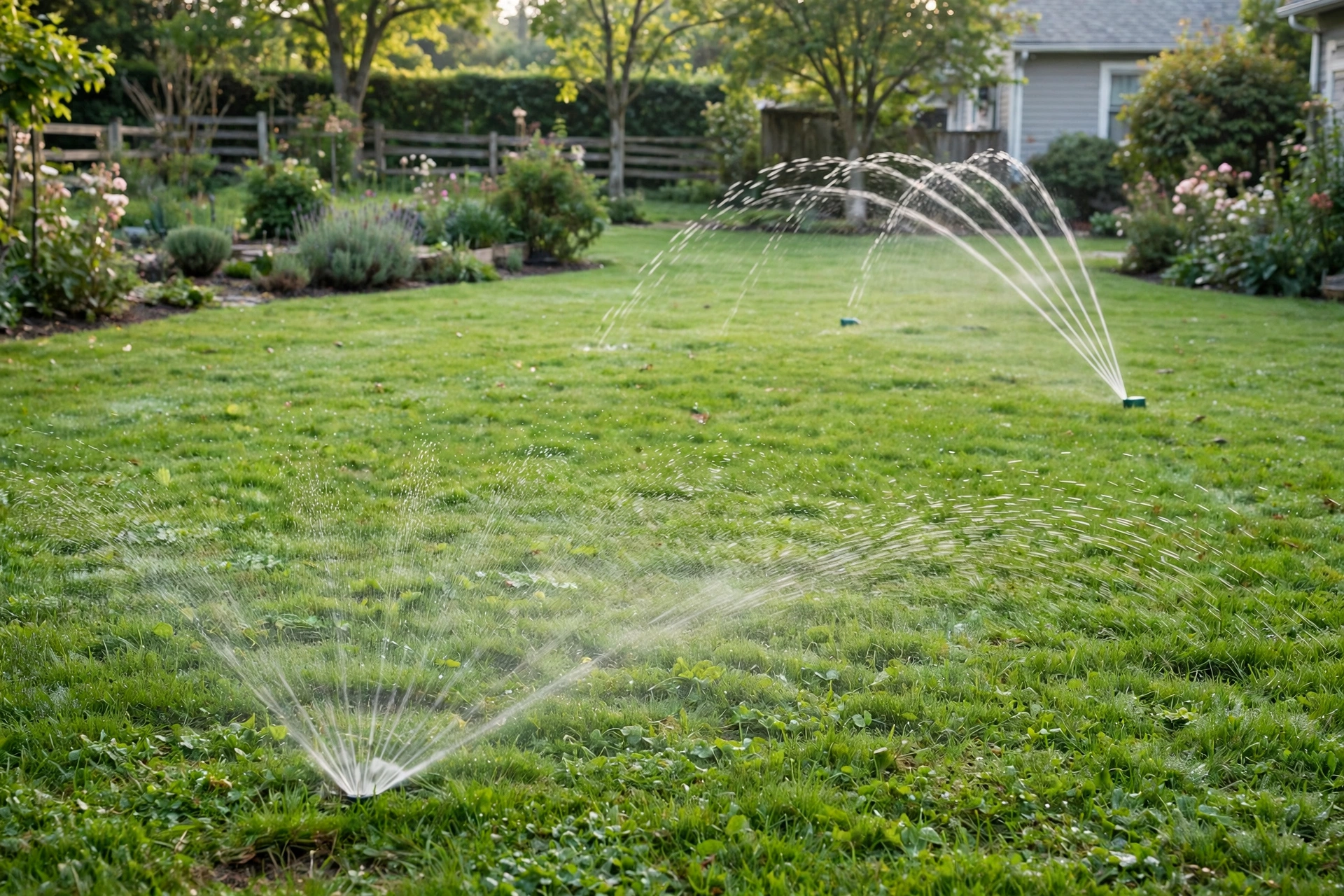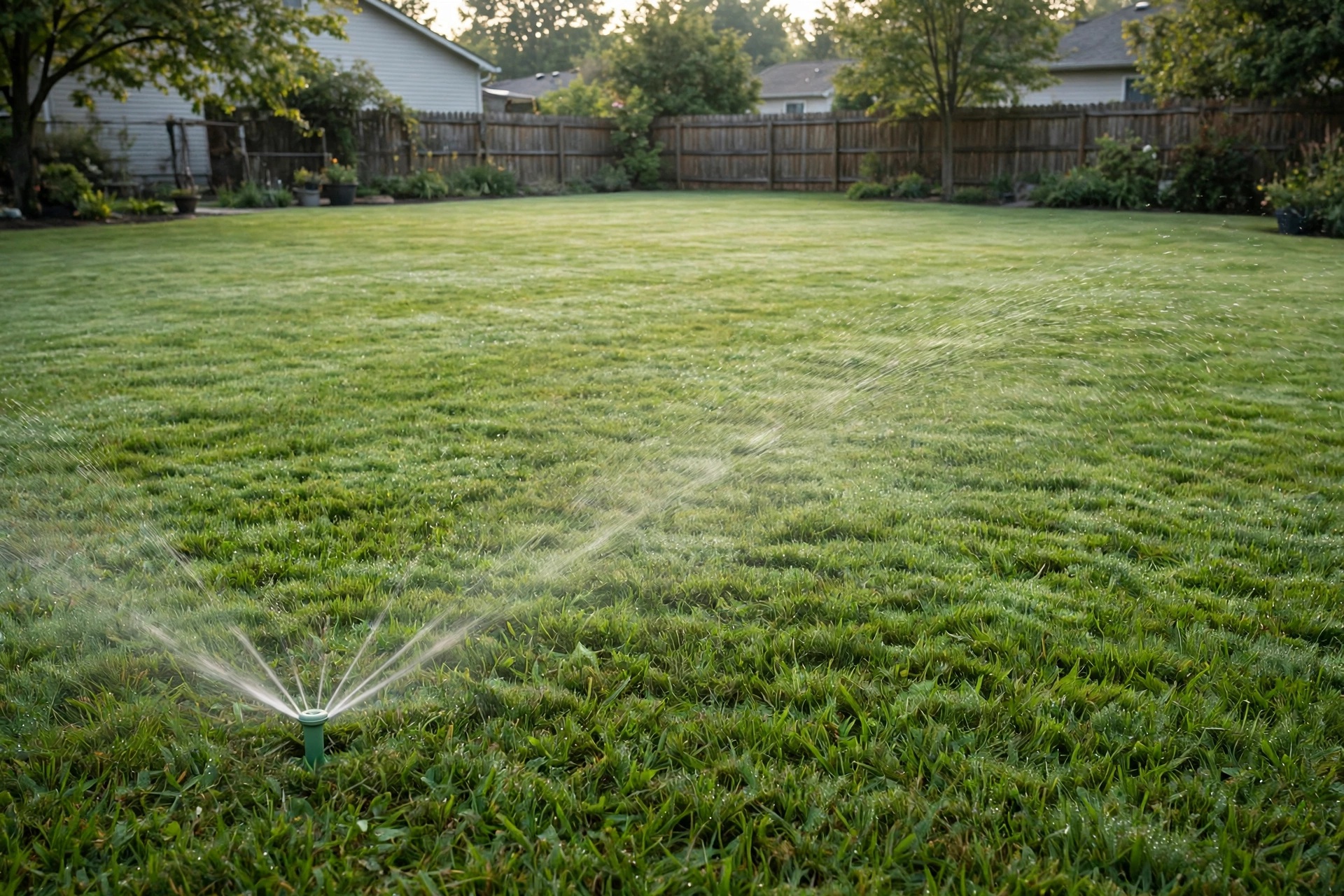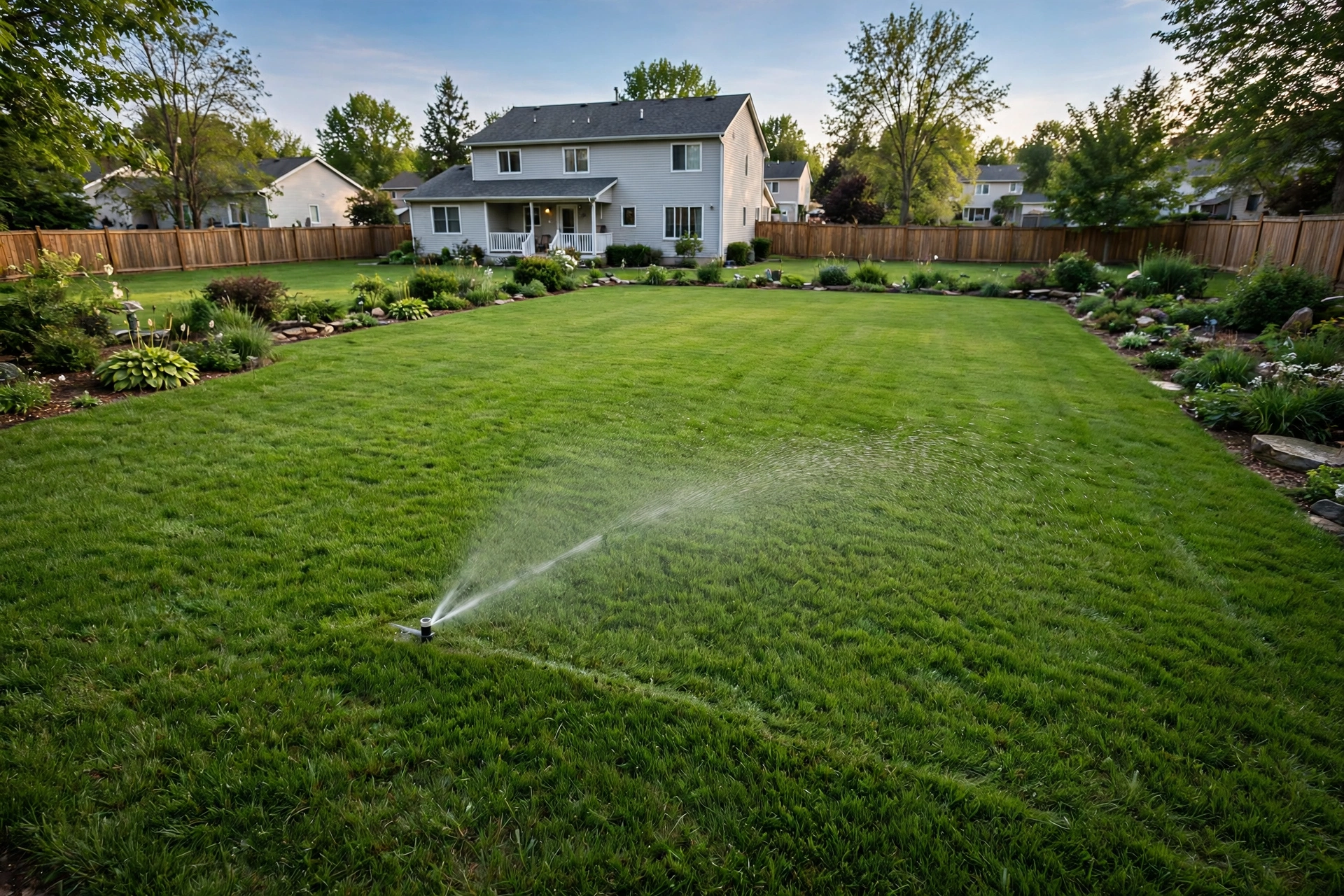
As the watering season winds down, the dry patches show up in the same places every year — and that map is your sprinkler guide. The patches are not random. They are where the sprinkler’s pattern stops short, or where it throws water the lawn never sees.
Choosing a sprinkler starts with two measurements, not a product page. Measure the lawn, then match the pattern to its shape. Everything else — brand, price, nozzle count — comes after.
Step 1: measure the lawn
Walk the lawn with a tape or pace it off. A rectangle is length times width. A lawn with a bed cut out of it is the full rectangle minus the bed. You do not need survey accuracy; being within a few hundred square feet is enough to choose between a 3,600-square-foot head and a 4,500-square-foot one.
Write down two numbers: the total square feet, and the longest straight run. A long, narrow side yard and a square back lawn can have the same area and need completely different sprinklers, because one is ruled by length and the other by width.
Step 2: match the pattern to the shape
A rectangle wants an oscillating fan. A circle wants a rotating head. A lawn shaped like an L wants two set-ups, or one sprinkler moved once — not one sprinkler stretched to cover both arms badly.
Obstacles change the answer, too. A low shrub line blocks a ground-level fan but not a raised tripod head. A garden bed inside the lawn wants a sprinkler you can aim around, or a separate, gentler head for the bed itself. The comparison in Oscillating vs Rotary vs Impact Sprinklers walks through each pattern in detail.
Step 3: size by the numbers
Use the sprinkler’s stated coverage as a ceiling, not a promise. A head rated for 4,500 square feet covers that much on flat ground, in calm air, at full pressure. Low pressure, wind, and a slope all shrink it. If your lawn is close to the rating, step up a size or plan on moving the sprinkler once.
Small lawns, under about 3,000 square feet: a compact oscillator is enough, and a big head will overshoot the edges. Medium lawns, 3,000 to 5,000 square feet: a full-size oscillator, like the Melnor XT Turbo at 4,500 square feet, covers most of it in one set-up. Large lawns, over 5,000 square feet: plan on a rotating head, or two oscillators moved in turn.
Step 4: check the water, not the box
Once the sprinkler is home, set out a few straight-sided cans, run it for ten minutes, and measure. That is the catch-can test, and the Sprinkler Catch-Can Calculator turns those depths into inches per hour. If the cans near the sprinkler are full and the far cans are nearly empty, the head is set too far from the dry ground — move it, or shorten the run.
Water in the morning, before the heat, so the leaves dry and the water soaks instead of evaporating. Deep, infrequent watering builds deeper roots than a daily sprinkle, and a sprinkler sized right makes that schedule easy to keep.
What to watch next
The sign the sizing worked is simple: the lawn greens up evenly, edge to edge, with no soggy strip near the sprinkler and no straw patch at the far end. The one mistake that undoes it is leaving the sprinkler in the same spot all season while the lawn’s dry patches move with the sun. Move the head when the patches move, and re-check with cans once a season.