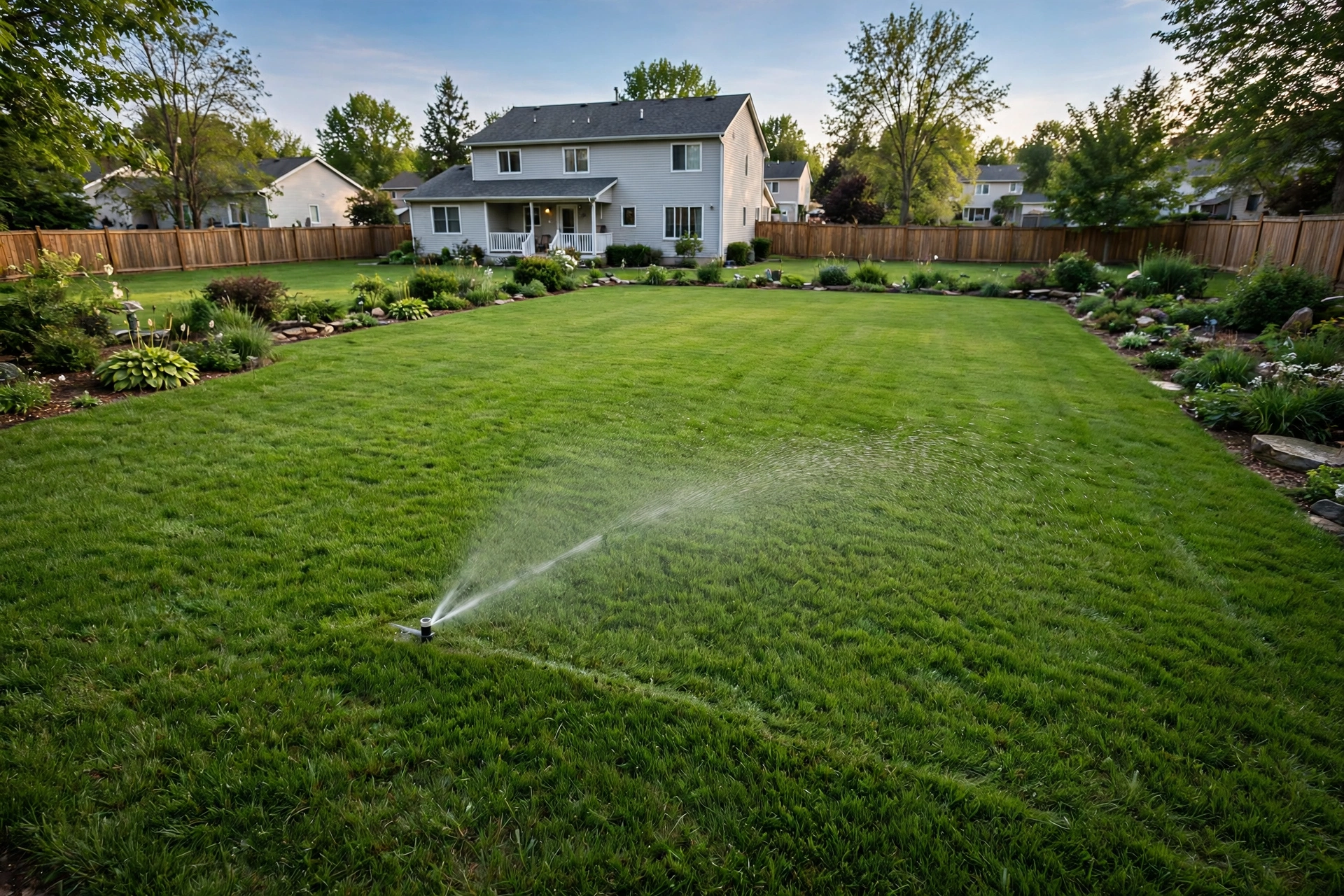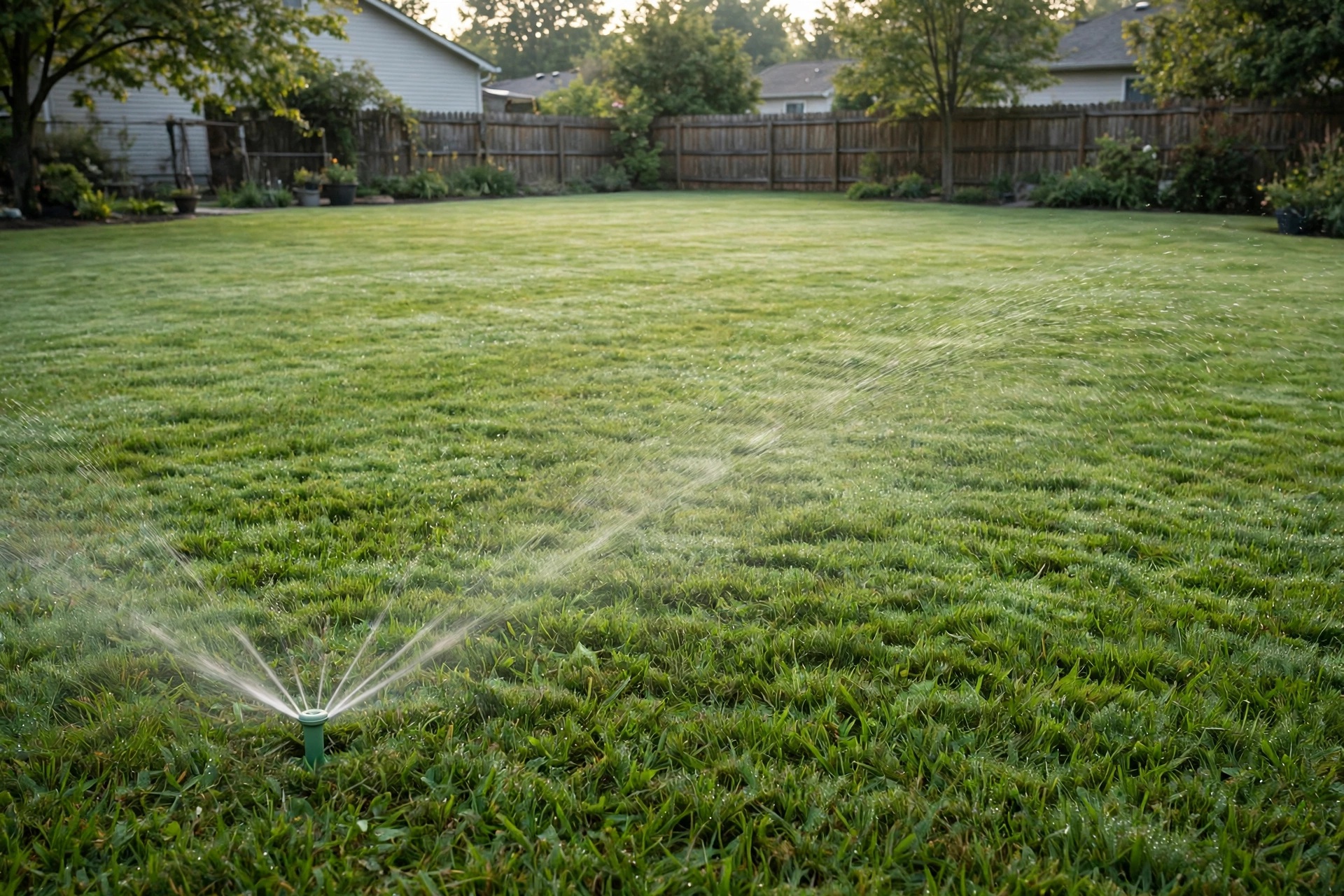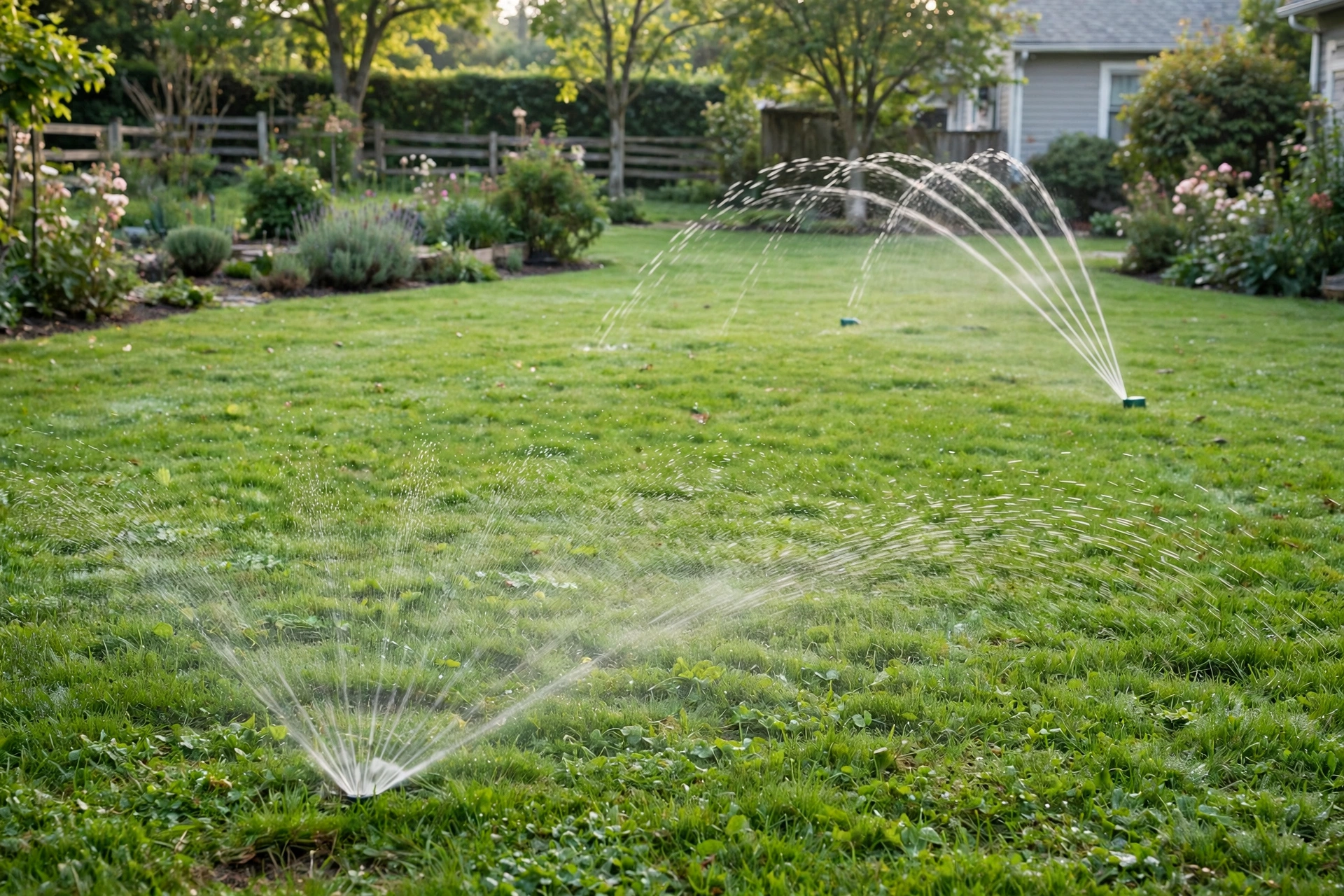
Buying the sprinkler with the biggest coverage number is the easiest way to water the driveway. A 6,000-square-foot circle sounds generous until it lands on a rectangular lawn, where half the spray misses the grass entirely. Shape matters more than square feet, and the three sprinkler types throw three different shapes.
Here is the short version: oscillating sprinklers throw a rectangle, rotary sprinklers throw a circle in a quiet stream, and impact sprinklers throw a circle with a clicking head that reaches farther. Pick the shape that matches your lawn, and the coverage number takes care of itself.
Oscillating: the rectangle thrower
An oscillating sprinkler sweeps a fan of water back and forth, covering a rectangle. That is exactly the shape of most front and back lawns, which is why it is the default pick for a typical yard. The fan is gentle, too — good for new seed and garden beds that a hard jet would wash out.
Its limits are reach and wind. A fan does not throw as far as a rotating jet, and a breeze bends it. On a big lawn you will move it, and on a windy day you will wait for calm or accept uneven coverage.
Rotary: the quiet circle
A rotary sprinkler, sometimes called a gear-drive head, rotates a single stream or several streams in a circle. It is quieter than an impact head, it throws farther than an oscillator, and it handles larger areas without moving. For a big, roughly round lawn, it is the comfortable middle ground.
Its weakness is precision on rectangles. A circle on a rectangle wastes the corners, and a rotary head on a low spike can be blocked by shrubs or tall grass. Raised on a tripod or a tall spike, it does better, but it still wants open ground.
Impact: the long thrower
An impact sprinkler uses a spring-loaded arm that clicks as it rotates, throwing a single powerful stream in a circle. It reaches the farthest of the three — the brass tripod head in our roundup throws up to 90 feet across — and it shrugs off dirty water that would clog a finer nozzle.
What it costs you is quiet and gentleness. The clicking carries, and the hard stream is too much for fresh seed or a delicate bed. It is a lawn tool, not a garden-bed tool.
Side by side
| Type | Pattern | Best yard | Watch out for |
|---|---|---|---|
| Oscillating | Rectangle fan | Rectangular lawns, garden beds | Shorter reach, wind drift |
| Rotary | Rotating circle, quiet | Large, open, roughly round lawns | Wasted corners on rectangles |
| Impact | Rotating circle, long throw | Very large, open lawns | Clicking noise, hard stream |
One more distinction matters: a rotary head and an impact head both throw circles, but they are not the same purchase. Rotary is the quiet, middle-distance choice. Impact is the long-distance, tough-water choice. If your water is clean and your neighbors are close, rotary wins on manners. If your lawn is huge and your water is gritty, impact wins on reach.
The verdict, by yard
Rectangular lawn, most homes: oscillating. The fan fits the lawn, the spray is gentle, and the price is low. Our roundup’s best overall, the Melnor XT Turbo, is an oscillator for exactly that reason.
Large and open: rotary or impact. Choose rotary if quiet matters and the lawn is under about 5,000 square feet per set-up. Choose impact — the Orbit brass tripod in our roundup — if the lawn is bigger than that, or the head needs to clear shrubs from a raised position.
Mixed yard, beds plus lawn: oscillating for the beds and the rectangle, and a second, rotating head for the open stretch. Two cheap sprinklers that each fit their ground beat one expensive sprinkler that fits neither.
What to do next
Sketch your lawn, then measure it. The sizing guide in How to Choose a Lawn Sprinkler for Your Yard Size and Shape turns that sketch into a coverage number, and the Sprinkler Catch-Can Calculator tells you how much water your chosen head actually puts down.
Buy the shape first. The coverage number follows.