Picture a spring morning: the lawn is greening up, the neighbors are out raking, and you are standing there with a soil thermometer wondering whether today is the day for crabgrass preventer — or whether you would be wasting it.
This checker is the tool to have ready for that morning. Pre-emergent — a weed preventer that stops weed seeds from sprouting before they start — goes down in spring, not in November, so bookmark this page, pick up a soil thermometer over the winter, and start taking readings when the ground wakes up. Type in your morning readings and it tells you whether the window is open, nearly open, or already gone.
Use the checker
Take your soil temperature first thing in the morning, two inches deep, in the open lawn. Enter up to five mornings, oldest first and most recent last. One reading is enough to start, but three mornings in a row is what makes the answer firm.
What to type in
Five boxes, one per morning, oldest first. You need at least one reading to get an answer, and three to get a firm one — with one or two readings the answer is marked provisional and tells you how many more mornings to take.
All five readings should be morning readings at two inches deep, taken in the same spot at the same time each morning. A reading taken at 2 p.m. runs warmer than a morning reading, so do not compare an afternoon number to these thresholds.
Tick the box if your readings came on back-to-back mornings. If they did not, the checker reads only your newest one and says so — a gap breaks the run, and guessing across it would be worse than waiting a day.
The two bloom boxes are optional, and they never change your answer. They only add a note. The thermometer decides; the trees just agree or disagree with it.
What your answer means
Too early. Your soil is still cold. Keep measuring each morning — the window has not opened yet.
Almost — keep measuring. You have one or two mornings in the 50 to 55°F band. One more morning in the band confirms it.
In the window — apply now (in spring). Three mornings in a row between 50 and 55°F. Apply in spring, follow the product label, and water it in.
At the edge — apply today (in spring). Your newest reading is at or above 55°F, but you have not had three hot mornings in a row yet. The window is closing — apply today in spring.
Likely too late. Three mornings in a row at 55°F or above means seeds are likely already sprouting, and pre-emergent will do little for them now. Check the product label for what to do next.
If your answer says provisional, it is a nudge, not a verdict: take the mornings it asks for and check again. A single warm morning is not a window.
Why the numbers are a band, not one number
Every university that has measured this agrees on the shape of the answer and differs a little on the exact number. That is because they measured at different depths and in different ways: some took the temperature first thing in the morning, others averaged the whole day, some measured one inch down and others two or four. A morning reading at two inches deep runs cooler than a day-long average at four inches — so the honest answer is a band, 50 to 58°F, not one magic number.
The checker works with that band. Three mornings in a row between 50 and 55°F means apply. Three mornings at 55°F or above means you are likely late. The table below shows each source’s own number, depth, and way of measuring, so you can check the answer yourself.
| Source | Threshold | Depth | Convention | Duration |
|---|---|---|---|---|
| Michigan State (2026) | Apply at 50–55°F; 80% of germination happens at 60–70°F | 0–2 in | Morning readings, held steady; also tracked as 250–500 growing degree days (a running tally of spring warmth, counted from Feb. 15, base 32°F) | Consistently, over several mornings |
| Penn State | Seeds germinate at 55–58°F | Not stated | Soil temperature as stated | Several consecutive days |
| NC State (2024) | About 55°F | Not stated in the 2024 post | 24-hour mean soil temperature | 3–4 consecutive days |
| NC State (2023) | About 53–55°F | 2–4 in | 24-hour mean soil temperature | Several consecutive days |
| Univ. of Minnesota | Apply before 55°F; crabgrass germinates at 60°F | Upper 1–2 in | Soil temperature, held for several days | Several days |
| Kansas State (2026) | Germination begins at 57–64°F; apply when the 1-in average daily temperature reaches 55°F | 1 in | Average daily temperature | Not stated |
| Cornell (2004, research wording) | 55–58°F at daybreak starts germination; mean 62–65°F for germination; over 73°F for heavy emergence | Upper 1 in | Daybreak minimums | 4–5 days |
When that window lands depends on where you live. In colder parts of the country it can run into mid-May; farther south it comes weeks earlier. There is no date worth circling — your soil readings decide, not the calendar.
How to take a morning reading
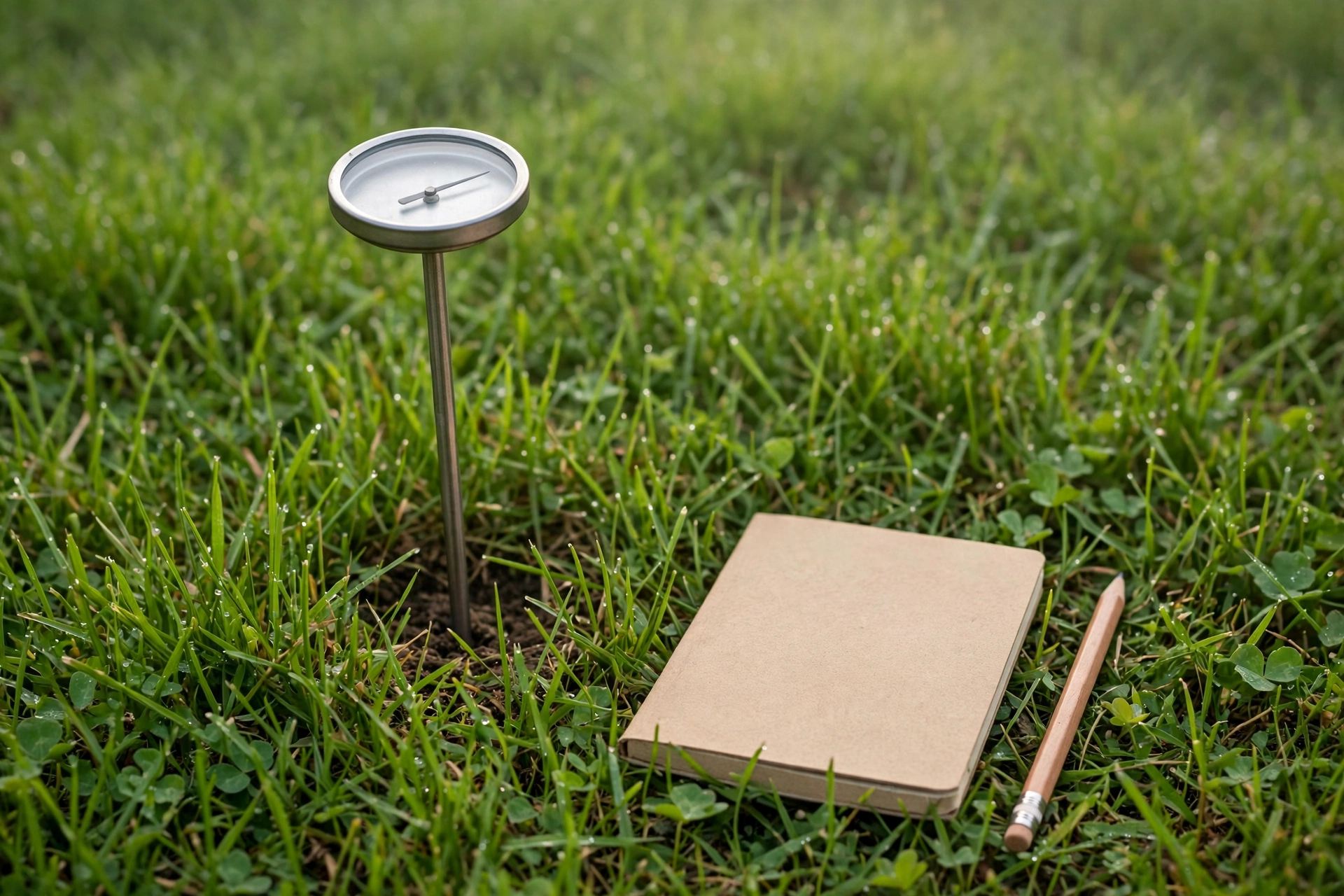
Push a soil thermometer two inches into the ground in the open lawn — not against a driveway or a wall, where the ground runs warm. Same spot, same time, first thing in the morning. Write each reading down with the date. Three mornings in a row is the minimum for a firm answer; five gives you a clearer picture of which way the soil is heading.
Thin turf warms faster than dense turf, so take your readings where the lawn is thinnest if you want the earliest warning — that is a trade-press observation, not a university figure, but it matches what the thermometer will tell you.
Want a second opinion? Michigan State’s free GDDTracker is a handy cross-check: pick the Crabgrass PRE tab, enter your zip code, and it shows whether your area is in the window. It is a check, not a feed — this page takes your own readings, not a weather service.
Worked examples
51, 52, 53°F — in the window. Three mornings in a row between 50 and 55°F. Apply in spring, follow the product label, and water it in.
56, 57, 58°F — likely too late. Three mornings in a row at 55°F or above. Seeds are likely already sprouting, and pre-emergent will do little for them now.
49, 52, 54°F — almost. Two mornings in a row in the band, after a cold one. One more morning between 50 and 55°F confirms it — keep measuring.
52°F, one reading only — provisional almost. One morning in the band is a good sign, not an answer. Take 2 more morning readings to confirm.
60, 61, 62°F — likely too late. Three mornings in a row at 60°F or above. Germination is well underway at those temperatures.
What the trees are telling you
When the redbuds near you hit full bloom, crabgrass is close behind — the bloom lines up with the soil warming to the germination range. When forsythia finishes blooming, crabgrass seed is usually starting to sprout: five to seven warm nights in a row above 50°F, with moist soil, is what it takes, and that stretch usually lands around forsythia’s final bloom.
Use the trees as a backup, not a verdict. A warm winter can leave redbuds with few flowers, so the signal can be faint — and a tree cannot tell you what your soil thermometer can. If the redbuds are blooming but your soil is still cold, trust the thermometer.
If you are seeding this spring
Seed and preventer do not go down together. Pre-emergent stops seeds from sprouting — and it cannot tell crabgrass seed from the grass seed you just spread. If you are spring-seeding, hold the preventer until the new grass has been mowed four to eight times. (One exception: products with siduron can go down at seeding time, and even then they only hold crabgrass back for three or four weeks — check the label.)
If that trade-off has you torn, our starter fertilizer guide for overseeding covers the seeding side of the decision, and the tall fescue seeding rate calculator works out how much seed the job needs.
One limit to know
A spring preventer does not cover the whole summer. Goosegrass — the weed that follows crabgrass — starts sprouting four to six weeks later than crabgrass, and a spring barrier can wear out before it does. If goosegrass shows up in July, it is not that your spring timing was wrong; it is that one spring application was never going to reach that far.
Too early is cheap, too late is expensive
Putting it down early costs you little: cold soil breaks the barrier down slowly, so it is still there when the soil warms. But put it down weeks too early and it can wear out before the season ends. Put it down late and it does almost nothing — once crabgrass seed has sprouted, the preventer cannot stop it. When in doubt, trust the thermometer and lean a few days early.
If you use a combination product that feeds and prevents in one bag, watch the timing twice: the right week for preventer is often too early to fertilize. Our guide to combining fertilizer and crabgrass preventer walks through that clash, and our most common spring lawn mistakes covers the other ways a good spring can go sideways.
What this checker does not do
This checker reads temperature only. It does not know your weather, your soil, or your grass type, and it cannot tell you how often to water or when to fertilize. It says nothing about fall lawn work — it is a spring tool, for spring mornings.
Buy the thermometer this winter. Take your first reading when the ground starts to warm, and let three mornings in the 50s make the call for you. That is the whole trick — and it beats guessing by a calendar every single spring.
Sources
- Michigan State University Extension — Kevin Frank, “Timing crabgrass preemergence applications in spring,” Mar 31, 2026 — fetched in full Nov 6, 2026. https://www.canr.msu.edu/news/timing_crabgrass_pre_emergence_applications
- Penn State Extension — “Weed Management in Turf” — fetched in full Nov 5, 2026. https://extension.psu.edu/weed-management-in-turf
- NC State Extension, TurfFiles — “When to Apply Preemergent Herbicides for Turfgrasses” (2024) — fetched in full Nov 5, 2026. https://www.turffiles.ncsu.edu/news/when-to-apply-preemergent-herbicides-for-turfgrasses/
- NC State Extension, TurfFiles — “Timing of Preemergent (PRE) Herbicide Applications for 2023” — fetched in full Nov 5, 2026. https://www.turffiles.ncsu.edu/2021/01/timing-of-preemergent-pre-herbicide-applications-for-2020-apply-earlier/?src=rss
- University of Minnesota Turfgrass Science — Sam Bauer, “Spring Preemergent Applications for Crabgrass” — fetched in full Nov 5, 2026. https://turf.umn.edu/news/spring-preemergent-applications-crabgrass
- University of Minnesota Turfgrass Science — Sam Bauer, “It’s time for preemergent applications” — fetched in full Nov 5, 2026. https://turf.umn.edu/news/it%E2%80%99s-time-preemergent-applications
- Kansas State Extension — Matthew McKernan, “Eastern Redbud blooms signal key time for lawn care,” Apr 10, 2026 — fetched in full Nov 5, 2026. https://extension.k-state.edu/news-and-publications/news/stories/2026/04/horticulture-spring-weed-control.html
- Cornell University Turfgrass Times, Spring 2004, Vol. 15 No. 1 (Frank S. Rossi, ed.) — fetched in full Nov 5, 2026. https://cutt.lib.msu.edu/article/2004twocv.pdf
- MSU Extension archive bulletin — Michael Barrett, “Crabgrass Control” (older bulletin; herbicide list dated; used for the germination-condition figure and the forsythia cue only) — fetched in full Nov 5, 2026. https://archive.lib.msu.edu/tic/msufd/article/19826.pdf
- Purdue Extension AY-20-W — Reicher & Throssell, “Seeding a Turf Area in the Spring” (1998; seeding-collision note only) — fetched in full Nov 5, 2026. https://www.extension.purdue.edu/extmedia/ay/ay-20-w.pdf
- Cross-check (link only, no feed): Michigan State GDDTracker, Crabgrass PRE model — https://gddtracker.msu.edu/