This site contains product affiliate links. We may receive a commission if you make a purchase after clicking on one of these links.
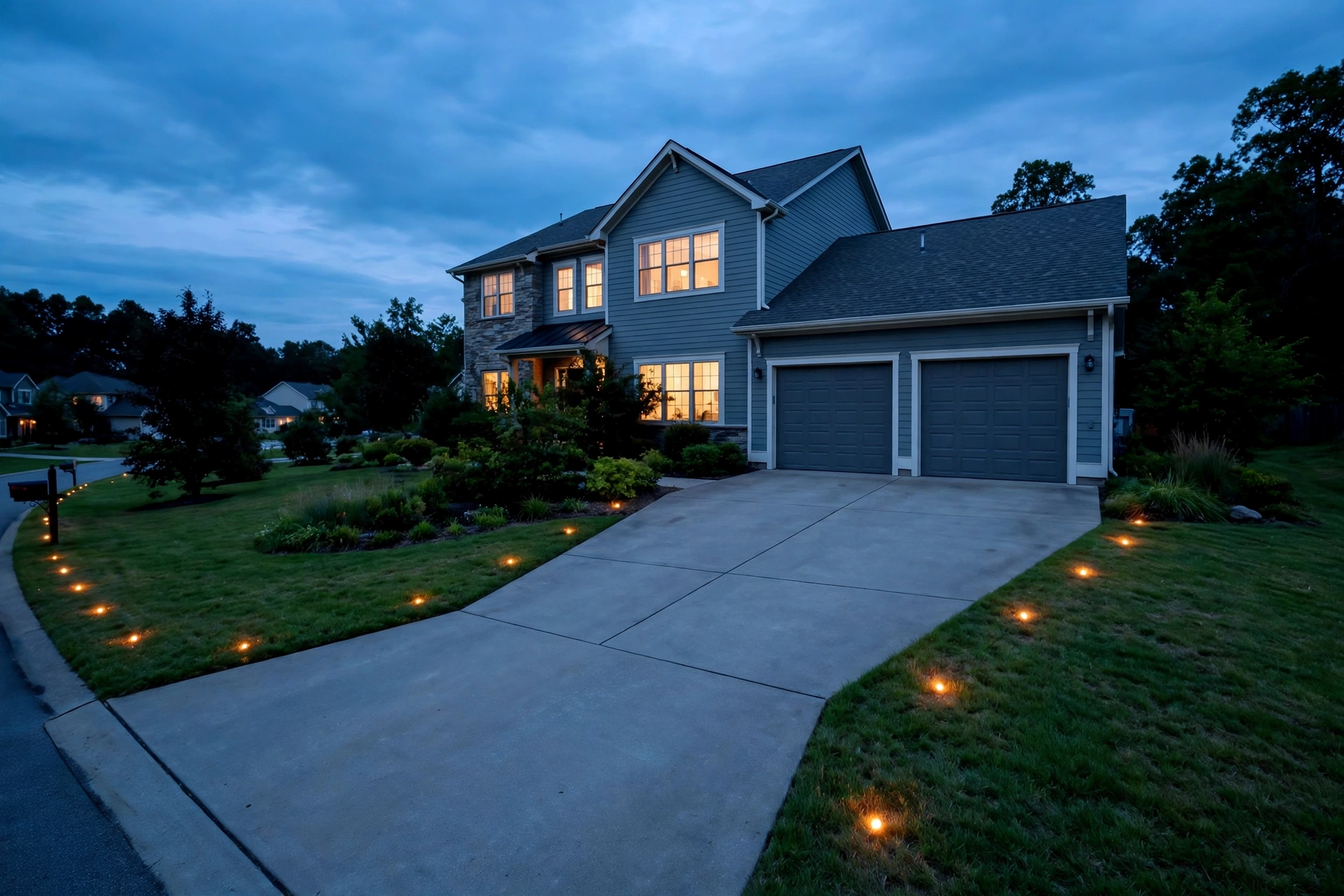
You pull in after dark, and the edge of the driveway has simply vanished. The concrete is there somewhere under the headlights, but the grass line is a guess, and the one time you drifted wide you found the soft shoulder and the flower bed in the same evening. A line of small lights would fix it — if only someone would run the wire.
Vevor’s solar driveway lights are the version where nobody runs the wire. Twenty-four low discs, each with its own solar panel and battery, screw down along the edge of the driveway, the path, or the dock, charge all day, and switch themselves on after dark. Here is the verdict up front: at $144.90 for the pack, they are an affordable, honest way to light a driveway edge without an electrician, and they are built to take a car driving over them. Fifty-three reviews cover this exact 24-pack, averaging 4.0 out of 5 — a solid score with a real tail of unhappy owners, which is exactly what you want to know before you drill twenty-four holes in your concrete.
One owner, Howard L., reviewing this same 24-pack on Vevor’s site, put it simply: “Well made. These appear to be built to last. Very decent price.” That is the short version of the whole review. The long version is about where they shine, where they do not, and the one decision — where the sun actually falls — that decides whether you love them.
What you are actually buying
Each light is a flat disc, about four and three-quarter inches across and just over an inch tall, in a die-cast aluminum shell. On top sits a small mono-crystalline solar panel; inside is a rechargeable nickel-metal-hydride battery; around the edge are six white LEDs. The whole thing is sealed to IP68, which is the rating that means it can sit under water and keep working — rain, snow, and a flooded spring driveway are all within its job description.
The box holds 24 lights and 48 screws, two per light, and the install is as simple as the box suggests: mark your line, drill, and screw each disc down through its two holes. A screwdriver is the only tool you need, and one person can do a driveway in an afternoon. The screws are the whole commitment, and they are worth thinking about before you start — these are not lights you move on a whim. Pick your line, walk it at night with a flashlight first, and only then drill.
| Vevor solar driveway lights, 24-pack | |
|---|---|
| Size | 4.72 × 4.33 × 1.1 in per light |
| LEDs | 6 white LEDs per light, 400–500 lux |
| Solar panel | Mono-crystalline, 2.5 V / 120 mA |
| Battery | 1.2 V / 1200 mAh NiMH, rechargeable |
| Waterproofing | IP68, die-cast aluminum shell |
| Working temperature | −20°C to 80°C |
| In the box | 24 lights, 48 screws |
The lights are rated to handle vehicles driving over them, which is the number that matters most for a driveway light — a pretty disc that cracks under a tire is a pothole with a battery in it. The aluminum shell is the reason to believe it: this is not a plastic garden stake dressed up as driveway hardware. Vevor lists a working life of three to five years, which is the honest horizon for a solar light that lives outside in every season. Plan on them as a durable consumable with a three-to-five-year horizon.
The sun decides everything
Here is the part that decides whether these lights delight you or disappoint you, and it has nothing to do with the lights themselves: they only charge where the sun actually falls. A driveway edge under a big maple, or the north side of the house in December, will give you dim lights and short nights. A south-facing edge with open sky will give you bright lights that run all night. Before you order, stand at the spot where the lights will go at noon and ask whether the sun reaches it. If the answer is mostly shade, no solar light will save you — and that is a property problem, not a product problem.
That same sun logic is why these lights make sense on a driveway and a dock, and less sense tucked under a porch roof. They want open sky the way a garden wants it. Put them where the sun is, space them evenly — twenty-four lights covers a generous driveway edge with room to spare — and they do their job without you thinking about them again. They switch on at dusk, switch off at dawn, and ask nothing of you in between.
Winter is the real test, and it is a fair one to name. Short days and low sun mean less charging, and snow piled over a light means no charging at all until you clear it. In a northern winter, these are December-through-February lights that earn their keep in the other nine months and do their best in the dark months. Clear the snow off them the way you clear the walk, and they will keep working. Bury them and forget them, and they will go dark on you.
What they do well, and where they fall short
The case for them is simple and it holds up: no wiring, no transformer, no electrician, no trench, no permit conversation. A wired low-voltage system is a project; this is an afternoon. The lights are bright enough to mark an edge — six LEDs each at 400 to 500 lux is a real glow, not a firefly — and the IP68 seal means you can stop worrying about rain and snow the moment they are screwed down. Owners keep coming back to two things: they are easy to install, and they stay lit all night. One owner on Vevor’s site wrote that this was her third purchase of Vevor lights, that she had lined her driveway with them for years, and that the white ones she switched to stayed lit all night. Repeat buyers are the most honest review a product gets.
The honest other side is the 15 percent of owners who gave this pack one star. Across the 53 reviews on this exact 24-pack, the recurring complaints are the ones that follow any sealed solar light: a unit that dims over time, a lens that clouds, and the occasional light that simply stops working. With twenty-four lights in the box, the odds say you may meet one of those — and that is worth knowing before you drill. A dead unit in a screwed-down line is a small job to replace, but it is a job, and it means keeping a spare or two in the garage rather than using every last light on day one.
Across the wider driveway-light range, 449 reviews average 4.6 out of 5 — but that number covers every size and color in the family, so it is not this pack’s score. This pack’s score is 4.0 out of 5 on 53 reviews, and that is the number to shop by — a good score with a real failure tail behind it. Buy it knowing that, and you will not be surprised. Buy it expecting perfection from a six-dollar light, and you will be one of the one-star reviews.
Solar or wired? The real question
These lights answer one question — how do I light the driveway edge without running wire — and they answer it well. Wired lighting answers a different question, and the choice is worth thirty seconds of thought. Our path vs spot vs well lights guide sorts out which kind of landscape light belongs where, and the short version is this: solar markers like these are for edges and guidance, the kind of light that marks the driveway edge rather than showing off the garden. If you want real illumination — a path you can read by, a garden worth looking at after dark — you want a wired low-voltage system, and our low-voltage lighting kits guide is the place to start. Wired systems need a transformer sized to the load, which is why our transformer sizing guide exists — and why solar looks so good by comparison when the job is just marking an edge.
The two approaches are not rivals. Plenty of yards end up with both: wired lights where the garden deserves them, solar markers where the driveway just needs an edge. If your whole plan is the driveway, the dock, or the steps, start here and save the wiring for another year.
Who should buy them, and who should not
Buy these solar driveway lights if you have a driveway, path, dock, or set of steps whose edge disappears after dark, if the spot gets real sun during the day, and if you want the job done in an afternoon with a screwdriver instead of a trench. At $144.90 for twenty-four lights — about six dollars a light — they are an affordable, honest way to make a driveway edge visible at night, and the aluminum shell and IP68 seal mean they are built for the job rather than dressed up for it.
Do not buy them if the spot sits in shade most of the day, if you need light bright enough to read by, or if you want a fixture that will still be there in ten years. Solar markers are a durable consumable with a three-to-five-year horizon, and a shaded spot will starve them no matter how good the battery is.
For everyone else, the verdict is simple: walk the line at night, mark where the sun falls by day, and screw them down. The first evening you pull in and the edge of the driveway glows back at you, you will wonder why you spent so many dark winters guessing where the concrete ends.
VEVOR Solar Driveway Lights, 24-Pack
A screw-down solar marker that lights your driveway edge with no wiring at all — aluminum shell, IP68 seal, and a 4.0-star owner verdict on 53 reviews.