Landscape & Leisure is reader-supported. When you buy through links on our site, including Botanical Interests seed links, we may earn a commission at no extra cost to you. Prices change, so click through to confirm current pricing.
You buy a bag of onion sets in April, plant them with confidence, and by August you have a row of golf balls. The sets did not fail you — the variety did. Onions are not one plant with one rule. A sweet onion grown in the wrong daylight never sizes up, and a storage onion eaten fresh in July tastes like it is picking a fight. The fix is to choose by day length first and flavor second.
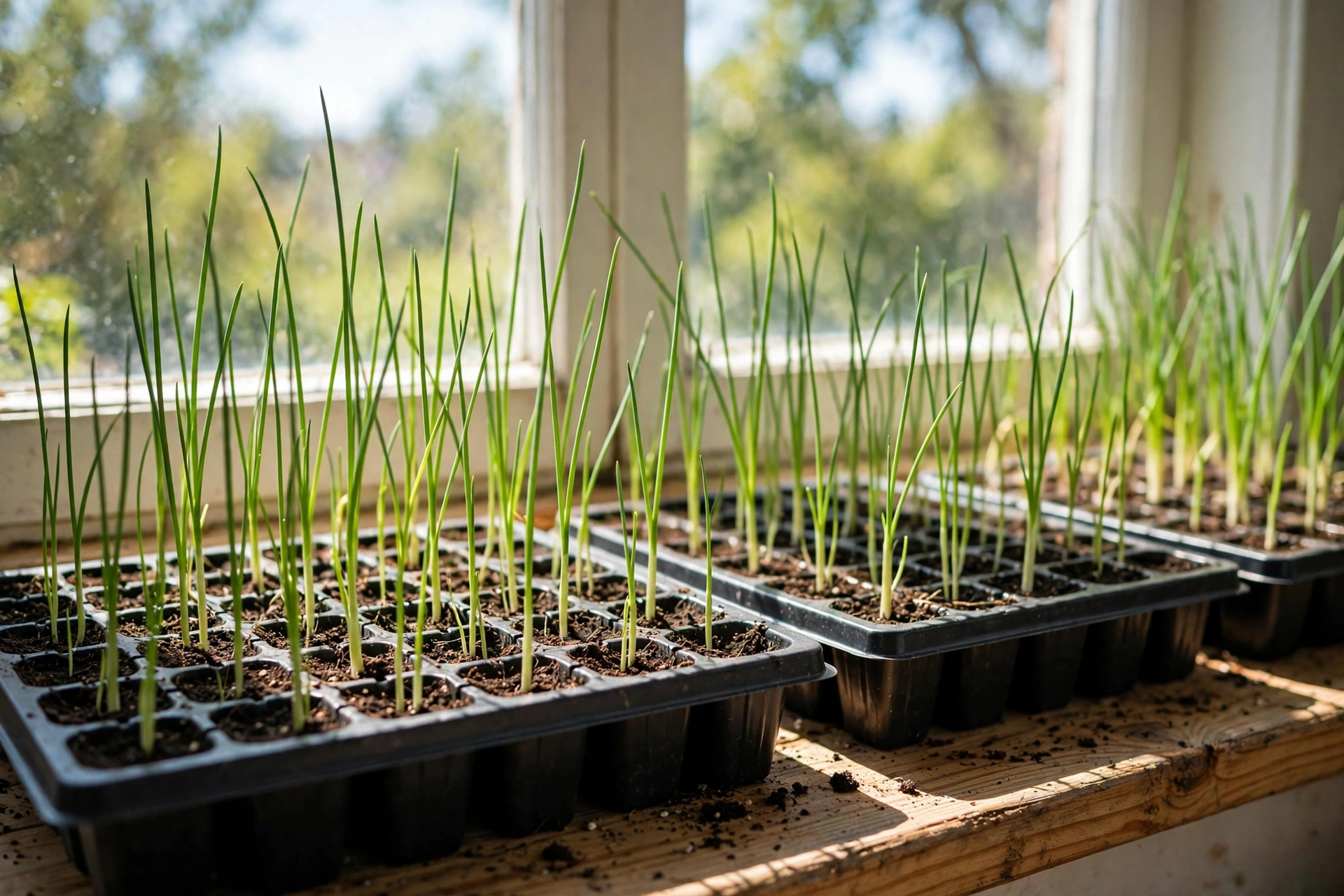
The seven varieties below cover the whole range: a sweet giant for the north, a red one for the middle latitudes, a short-day sweet for the South, a storage onion that keeps till spring, a flat Italian roaster, and a bunching onion for the cutting board. For how to start whichever you pick, see our guide to starting onions from seed indoors. For the sweet-versus-storage decision in full, see our sweet vs. storage onions comparison. And if you like growing your own alliums generally, our garlic roundup pairs with this one.
First, Match the Day Length
Onions form bulbs when the days reach a certain length, and that length is baked into the variety. Long-day onions need 14 or more hours of daylight to bulb, so they belong north of roughly the 37th parallel. Intermediate-day onions bulb at 12 to 14 hours and fit the middle of the country, about latitudes 32 to 42. Short-day onions bulb at 10 to 12 hours and belong in the South, below about the 35th parallel. Plant a short-day onion in Minnesota and it bulbs before it has grown enough leaves to feed a big bulb. Plant a long-day onion in Texas and it waits for a long summer day that never comes.
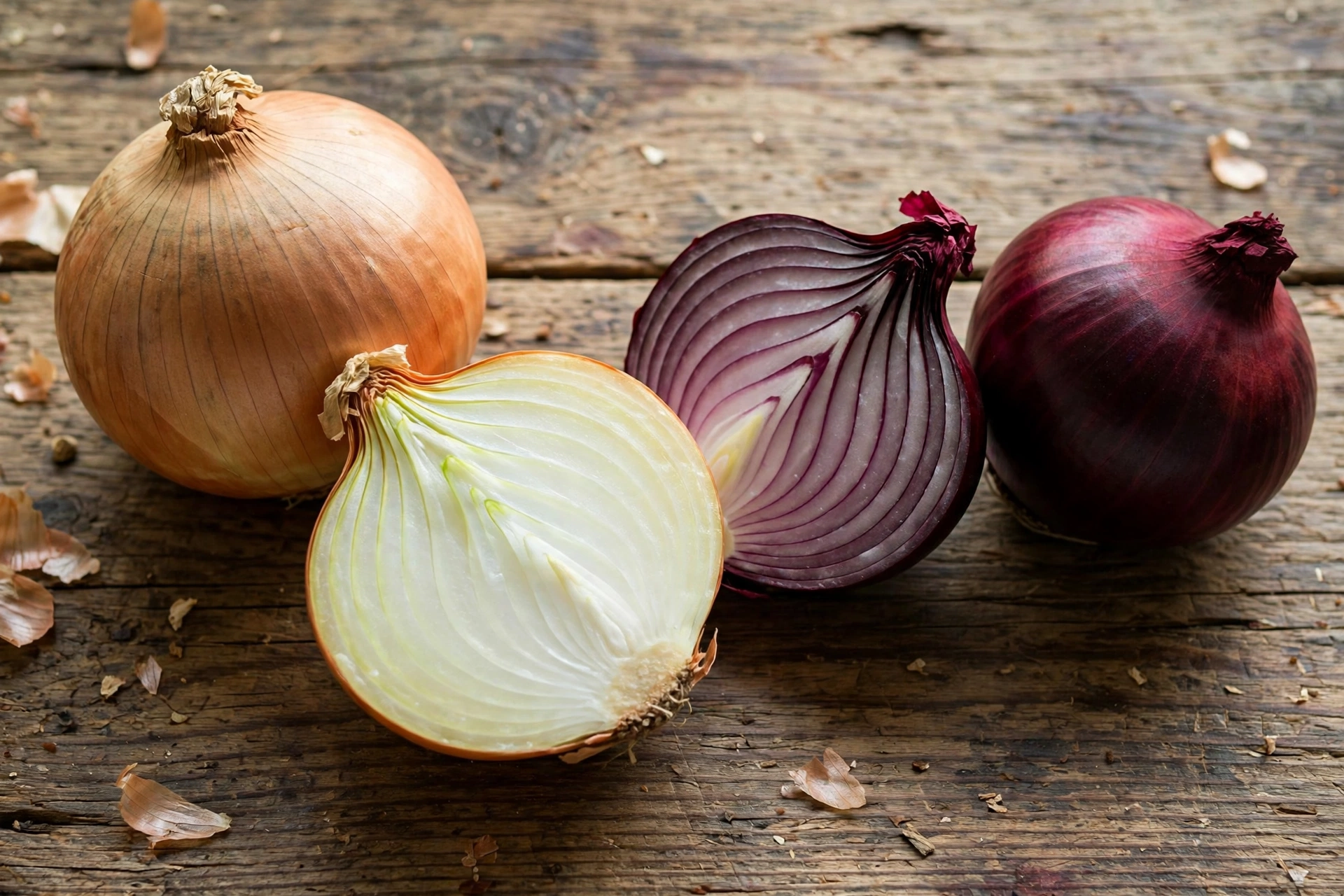
The photo below shows the difference a variety makes before you ever taste one: a deep red globe beside a pale yellow one, both full size, both grown from seed in the same season.

Best Overall: Walla Walla
Walla Walla is the onion people mean when they say an onion can be sweet enough to eat like an apple. The bulbs grow 4 to 6 inches across and weigh around 2 pounds, with dry papery skin and a juicy, mild flesh that is famous for it. It traveled from the coast of Italy to Walla Walla, Washington, and it is a long-day onion — but it matures early enough that it can also be grown as an intermediate-day onion. Gardeners rate it 4.7 from 15 reviews, the strongest track record of any bulb onion here.
The trade-off is storage. Walla Walla has a short storage period, so it is an eat-it-now onion, not a fill-the-pantry one. Grow it for the summer table, and grow a storage variety beside it for winter.
Pros: enormous sweet bulbs, up to 2 pounds; famous mild flavor, great fresh; high yield; matures early for a long-day onion.
Cons: short storage period — use it soon after harvest; needs long days to reach full size.
Walla Walla Bulb Onion Seeds
Sweet bulbs up to 2 pounds, famous for eating fresh — the onion that makes the summer table.
Runner-Up: Red Amposta
Red Amposta is the red onion for gardeners who live in the middle of the map. It is an intermediate-day onion, best across latitudes 32 to 42, and it produces large reddish-purple globe-shaped onions with pretty red and white rings inside and a snappy, sweet flavor. It is the onion for sandwiches and hamburgers, salads and relishes — anywhere a red onion earns its color. Gardeners rate it 4.4 from 12 reviews.
The trade-off is latitude. Outside the intermediate band it will not bulb the way it should, so if you garden well north or well south, pick the variety matched to your daylight instead of forcing this one.
Pros: large red globes with sweet flavor; fits the middle latitudes most gardeners live in; pretty red-and-white rings.
Cons: needs intermediate days — wrong for far north or deep south gardens.
Red Amposta Bulb Onion Seeds
Large reddish-purple globes with snappy, sweet flavor — the red onion for the middle of the country.
Best Value: Yellow Sweet Spanish Utah
Yellow Sweet Spanish Utah is the long-day classic that has been in American gardens since at least 1916, and Utah liked it enough to name it the state vegetable in 2002. The bulbs are large 3- to 6-inch globes with an amazingly mild, sweet flavor, and it is a long-day variety that grows best north of the 37th parallel. It is also the cheapest bulb onion in this roundup. Gardeners rate it 4.2 from 17 reviews.
The trade-off is that a classic is not a storage onion. Like Walla Walla, it is at its best eaten fresh and cooked soon after harvest, so plan it as your summer sweet onion and let a keeper variety handle winter.
Pros: large mild globes at the lowest packet price here; a century-old proven variety; Utah’s state vegetable.
Cons: not a long keeper; long-day only, so southern gardeners should look elsewhere.
Yellow Sweet Spanish Utah Bulb Onion Seeds
Big mild globes from a variety grown in the U.S. since 1916 — the cheapest bulb onion here.
Best for the South: Texas Early Grano
Texas Early Grano is the sweet onion for gardeners the long-day varieties leave behind. Selected from Spain and released by Texas A&M University in 1944, it is a short-day onion that grows best from fall to spring in the southern states, south of the 35th parallel. The bulbs are large — softball-sized, up to a pound each — with white flesh, straw-colored skin, and a sweet flavor that shines cooked or fresh. Gardeners rate it 3.8 from 15 reviews.
The trade-off is geography, stated plainly on the packet: it is not recommended for cold-climate areas unless greenhouse grown. Northern gardeners should not buy it hoping for an exception. It also has a short to moderate storage period, so it is a seasonal onion, not a winter one.
Pros: softball-sized sweet bulbs for southern gardens; released by Texas A&M in 1944; good disease resistance.
Cons: short-day only — not for cold climates; the lowest gardener rating here; short to moderate storage.
Texas Early Grano Bulb Onion Seeds
Softball-sized sweet bulbs up to a pound, bred for southern gardens since 1944.
Best for Storage: Monastrell
Monastrell is the onion you plant in spring and still slice in February. It is a late-season, intermediate-day onion, best in latitudes 32 to 42, producing remarkably uniform, slightly flattened red globes 3½ to 4 inches across. The bulbs hold well in the garden and store for up to 6 months, with strong resistance to sunscald and a high percentage of single-centered bulbs. Gardeners rate it 4.8 from 5 reviews — the highest rating in this roundup.
The trade-off is the thin track record. Five reviews is the smallest count here, so the perfect score carries less weight than Walla Walla’s fifteen. It also takes 106 to 110 days to mature, so it needs the full season to earn its keep.
Pros: stores up to 6 months; uniform red globes; sunscald resistant; the highest gardener rating here.
Cons: only 5 gardener reviews so far; 106 to 110 days to mature — needs a full season.
Monastrell Bulb Onion Seeds
Uniform red globes that store up to 6 months — the onion for the winter pantry.
Best for Roasting: Flat of Italy Cipollini
Flat of Italy is the onion for the grill and the roasting pan. This Italian heirloom has been available to gardeners since the late 1800s, and it is hard to find in stores — which is exactly why you grow it. The wine-colored, flattened globes are about an inch high and 2 to 3 inches across, with a sweet flavor that is delicious fresh or cooked, perfect for roasting and grilled kebabs. It matures in about 70 days. Gardeners rate it 3.9 from 16 reviews.
The trade-off is size. A cipollini is a small onion by design, so it will never fill a pantry shelf the way Walla Walla does. Grow it as a specialty crop for the grill, not as your main onion.
Pros: sweet, flat globes made for roasting and kebabs; matures in about 70 days; a rare Italian heirloom.
Cons: small bulbs by design; the lowest rating of the bulb picks here.
Flat of Italy Bulb Cipollini Onion Seeds
Wine-colored flat globes, sweet and made for the roasting pan — a rare Italian heirloom.
Best Bunching: Tokyo Long White
Tokyo Long White is the onion you grow when you want green onions all summer instead of one big harvest. These Japanese scallions are long, slender, and mild, with sweet flesh and juicy bluish-green tops for salads, soups, stews, and stir-fry. The plants are heat tolerant and can be blanched in the garden or a container for 16- to 18-inch-long white, leek-like stalks, and they resist pink root and smut. They are ready in about 65 days. Gardeners rate it 4.5 from 26 reviews.
The trade-off is that a bunching onion never becomes a bulb onion. If you let it keep growing it stays a scallion, so plant it for the cutting board and let the bulb varieties handle the pantry.
Pros: mild scallions ready in about 65 days; heat tolerant; disease resistant to pink root and smut; blanches to long white stalks.
Cons: never forms a bulb — a scallion only, not a storage crop.
Tokyo Long White Bunching/Scallion Onion Seeds
Mild Japanese scallions in about 65 days, with stalks that blanch to 16 inches of white.
The One to Skip: Yellow Granex PRR
Yellow Granex PRR would have belonged in this roundup on merit. It is a hybrid cross between a round Grano onion and a flat Bermuda onion, rated 4.8 from 13 reviews, and it is said to be the sweetest of the super sweet onions — one of the few varieties approved to be sold as a Vidalia onion when grown in approved areas near Vidalia, Georgia. But it is sold out right now, and a variety you cannot buy is not a recommendation. Check back later in the season, or plant Texas Early Grano above — it covers the same southern sweet ground and it is in stock.
What About Shallots and Scallions?
Two more types round out the onion shelf. Zebrune shallot is a large, easy-to-peel banana-type shallot with a sweet, mild flavor, popular with chefs — but it is a long-day shallot, so it belongs in northern gardens. White Lisbon is the classic spring onion, grown since the 1700s, mild and juicy with tender green tops. Either one earns a row if you cook with shallots or scallions often.
Side-by-Side Comparison
| Variety | Type | Day length | Bulb | Best for | Rating |
|---|---|---|---|---|---|
| Walla Walla | Bulb, sweet | Long | 4–6 in, ~2 lb | Eating fresh | 4.7 (15) |
| Red Amposta | Bulb, red | Intermediate, lat 32–42 | Large globe | Salads, sandwiches | 4.4 (12) |
| Yellow Sweet Spanish Utah | Bulb, sweet | Long, north of 37th parallel | 3–6 in globe | Value, fresh eating | 4.2 (17) |
| Texas Early Grano | Bulb, sweet | Short, south of 35th parallel | Up to 1 lb | Southern gardens | 3.8 (15) |
| Monastrell | Bulb, storage | Intermediate, lat 32–42 | 3½–4 in red globe | Winter storage | 4.8 (5) |
| Flat of Italy Cipollini | Bulb, cipollini | — | 2–3 in wide, flat | Roasting, kebabs | 3.9 (16) |
| Tokyo Long White | Bunching/scallion | — | 16–18 in stalks | Scallions all summer | 4.5 (26) |
Final Thoughts
Plant Walla Walla first. It is the onion most likely to make you wonder why you ever bought sets, and the one your neighbors will ask about when the bulbs come out of the ground. Then add Red Amposta for the salads and Monastrell for the pantry — and if you grill, a row of Flat of Italy earns its space twice over. Read our indoor-starting guide before you sow, because the one mistake that ruins an onion season is starting too late and finding out in July.