April has a sound, and it is not a good one: you turn the key, the starter gives one tired click, and then nothing. The battery did not die in April. It died slowly, all winter, in a cold garage — losing charge week by week while nobody was watching. A battery stored right comes out of winter ready to work. A battery left in the mower comes out flat, and sometimes it never comes back.
Storing a battery is a small job with a strict order: take it out, clean it, charge it fully, put it somewhere cool and dry, and check on it once a month. Skip any one of those steps and you are gambling on a spring start. Here is the order that works.
Step 1: take the battery out of the mower
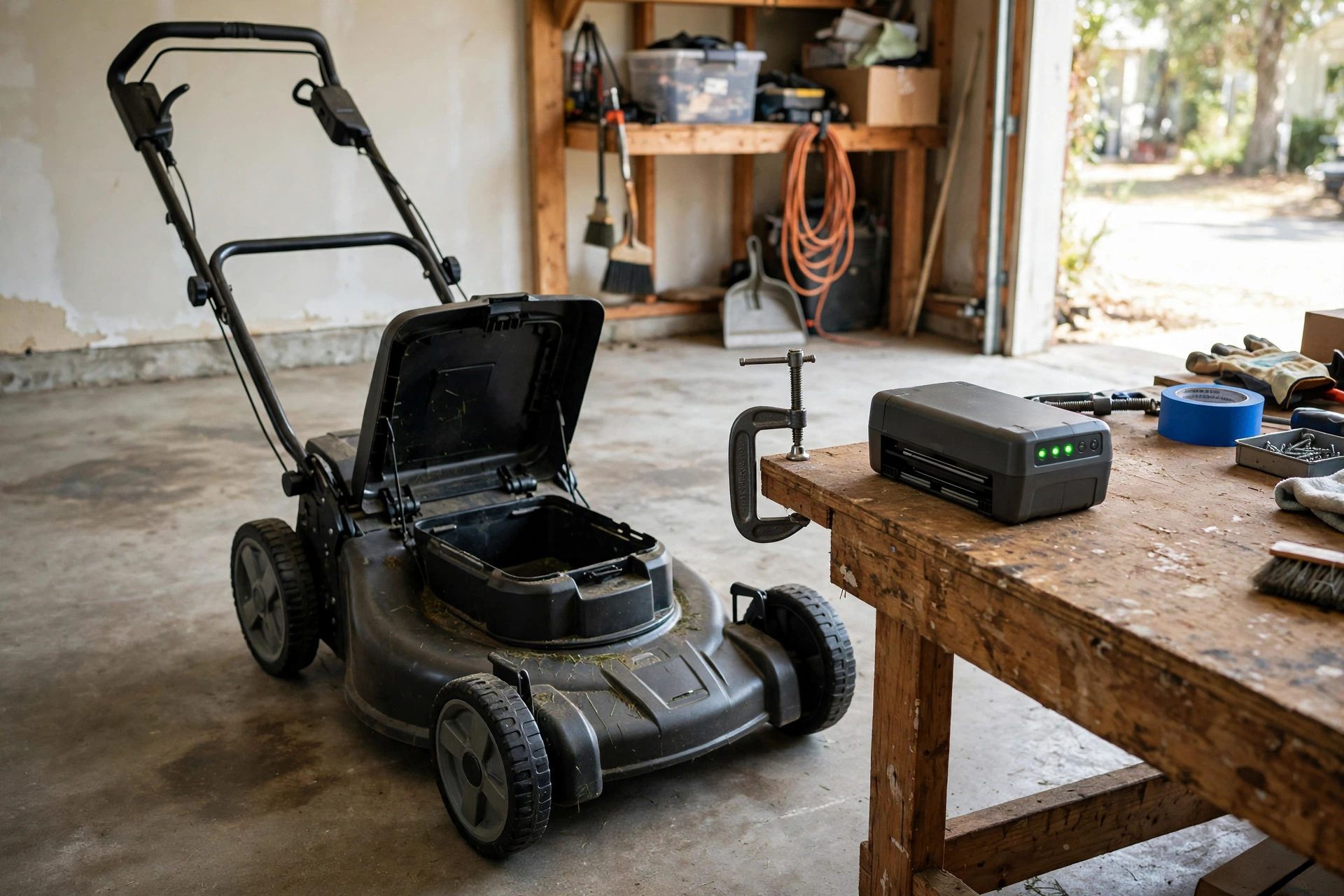
Do not leave the battery in the mower over winter. Even with the key off, a mower’s electrical system can draw a tiny current, and cold makes a weak battery weaker. On a riding mower, the battery is usually under the seat or under the hood — lift the seat or the hood, and you will see it. On a battery walk-behind, the pack slides out of its slot, usually with a release button.
Disconnect the negative cable first, then the positive. That order matters: if your wrench slips and touches metal while you are working on the negative cable, nothing happens. Do it the other way around and you can short the battery. Wear gloves and eye protection — battery acid is not something you want on your skin or in your eyes, and a cracked case can leak without you noticing.
Step 2: clean the terminals and the case
A dirty battery is a battery that discharges itself. Corrosion on the terminals — the white or greenish crust that builds up around the posts — creates a slow drain between them, and a film of dirt and grease on the case does the same thing across the top.
Mix a spoonful of baking soda into a cup of warm water, and scrub the terminals and the top of the case with an old toothbrush or a wire brush. Rinse with clean water and dry it thoroughly. Check the case while you are at it: a cracked case, a swollen side, or a terminal that wiggles is a battery that should be replaced, not stored. If the terminals are badly corroded, clean them until the metal is bright — a dull, crusty terminal is a weak connection, and a weak connection is a slow start even on a fully charged battery.
Step 3: charge it fully before you put it away
This is the step that decides whether the battery survives the winter. A battery put away half-charged will be flat by spring, and a lead-acid battery left flat for months can lose capacity permanently — the plates sulfate, and no amount of charging brings back what sulfation takes.
Put the battery on a charger and leave it until it is fully charged. On a 12-volt riding mower battery, a voltmeter should read about 12.6 volts or higher when it is full. If you do not own a voltmeter, most chargers have an indicator light or a gauge that shows when the battery is done. Do not guess: a battery that feels done after an hour may only be partway there. Let the charger finish the job.
Step 4: store it cool, dry, and indoors
The right place for a battery in winter is a shelf in a basement or a heated garage — cool, dry, and out of the way. Cool is good: a battery self-discharges more slowly in cool temperatures than in warm ones. Freezing is not: a fully charged battery handles cold well, but a discharged battery can freeze, and a frozen battery is a ruined battery. That is another reason the full charge in step 3 matters.
Set the battery on a board or a shelf, keep it upright, and keep it away from anything metal that could bridge the terminals. Do not stack anything on top of it. And do not leave it sitting in the mower, on the mower, or next to the mower — take it out, put it on its shelf, and forget about it until the monthly check.
Step 5: top up the charge once a month
A stored battery loses charge on its own, even disconnected and sitting on a shelf. Left alone for five months, that slow drain adds up to a flat battery in spring. Check it once a month: put it on the charger, top it up, and put it back. That is the whole job, and it takes ten minutes.
If monthly checks sound like a chore you will forget, use a battery maintainer instead. A maintainer is a small charger that watches the battery and tops it up only when it needs it, then shuts off — it is designed to stay connected for months, which a standard charger is not. Do not leave a standard charger connected all winter: it can overcharge the battery just as surely as neglect can drain it.
The concrete floor story
You may have heard that a battery stored on a concrete floor will go flat. It is a myth — for modern batteries, anyway. The rule dates back to the days of wood battery cases, which could absorb moisture from concrete and discharge through it. Modern batteries have plastic cases, and a plastic case does not conduct. A battery on a concrete floor discharges at the same rate as a battery on a wooden shelf.
That does not mean the garage floor is a good storage spot. A concrete floor in an unheated garage is cold, damp, and easy to knock a battery off — and a battery that freezes while discharged is done for. Store it on a shelf indoors, not because the concrete will drain it, but because a shelf is dry, stable, and out of the way.
Spring: test it before you need it
Before the first mow, put the battery on the charger one last time and confirm it is fully charged — about 12.6 volts or higher on a 12-volt battery. Reinstall it, positive cable first this time, then negative, and tighten the terminals until they do not wiggle. Turn the key. If it cranks strong, you are done. If it cranks slowly or clicks, charge it again and test it once more before you buy a replacement — a battery that spent the winter properly stored and still will not hold a charge was probably at the end of its life already.
One last check: if the mower itself still needs winterizing — fuel, deck, tires — do it now, while the battery is out and the machine is easy to work on. Our guide to how to winterize a lawn mower walks through the whole job. A battery stored right, in a mower winterized right, is a spring that starts on the first turn of the key.