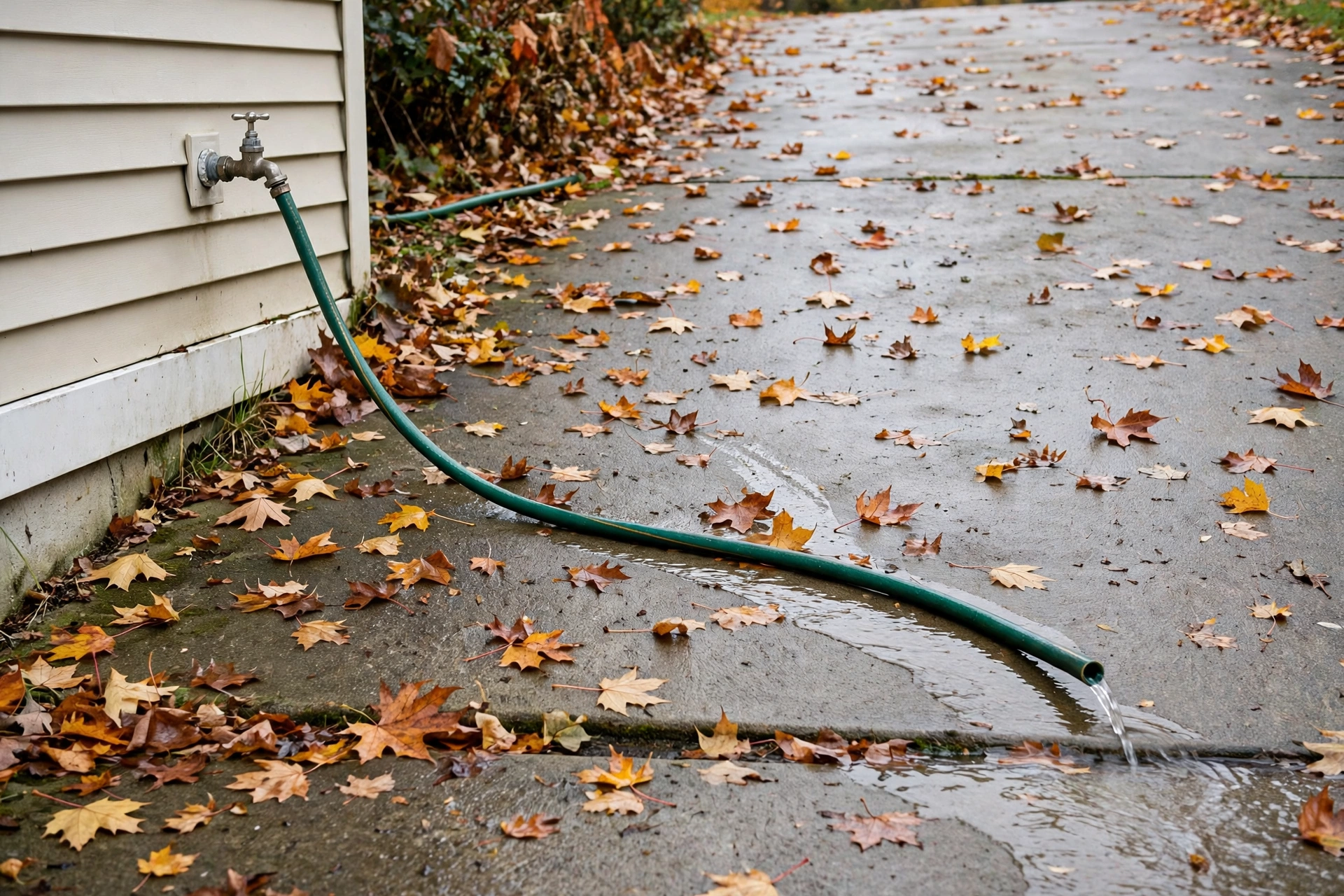
The first hard freeze is on its way, and the hose still draped across the yard is quietly full of water.
That water is the problem. A hose left full through a freeze splits from the inside, and the damage does not stop at the hose — water trapped against the spigot can back up into the faucet and crack it too. Draining the hose takes about ten minutes, and the window to do it is now, before the first hard freeze, not after.
Why a Full Hose Breaks
Water expands when it freezes. Inside a hose, that expansion has nowhere to go, so it pushes outward against the hose walls until the rubber or vinyl gives way. The split usually shows up as a pinhole leak or a lengthwise crack, and you will not find it until spring, when you turn the water on and the hose sprays from the middle instead of the end.
The faucet is the bigger risk. A hose left connected to the spigot holds water right up against the faucet body. When that water freezes, the pressure can travel back into the faucet and the pipe behind it. A split hose costs a few dollars to replace. A cracked faucet costs a plumber.
When to Do It
Drain the hose before the first hard freeze — the first night the temperature drops well below freezing and stays there. A light frost will not hurt a hose, but a hard freeze will, and the forecast rarely gives you more than a few days’ warning.
Do it on the next dry afternoon, while you can still work with your hands outside. If the hose is already stiff with cold, it is harder to coil and slower to drain. Earlier is better than later, and there is no downside to draining it a week before the freeze arrives.
Drain It in Five Steps
1. Shut off the water at the spigot. Turn the faucet handle all the way off. If your house has a separate shut-off valve for the outdoor line, close that too and open the spigot to let the line drain.
2. Disconnect the hose. Unscrew the hose from the spigot and remove any sprayer or nozzle from the other end. A nozzle left on the hose traps water behind it, so take it off and drain it separately.
3. Drain it fully. Lift one end of the hose and walk its length, letting the water run out the low end as you go. Or hang the hose so it drains downhill — over a fence rail, a deck railing, or a hose reel mounted high — and leave it for a few minutes until the drips stop.
4. Coil it loosely. Make wide, gentle loops, about two feet across, and do not kink it. A tight coil stresses the hose walls all winter, and a kink left in place through the cold can become a permanent weak spot.
5. Store it indoors or in a shed. A garage, shed, or basement keeps the hose out of the freeze and out of the sun. Hang it on a hook or a reel rather than leaving it in a heap on the floor, where it will kink under its own weight.
The Spigot Deserves the Same Attention
The hose is only half the job. The spigot it connects to holds water too, and a faucet left open to a freezing night can crack just as surely as a hose. Once the hose is disconnected, open the spigot briefly to let any water in the faucet drain out, then close it again.
If your house has a shut-off valve for the outdoor line — usually inside the basement or crawl space near where the pipe exits the wall — close it for the winter and open the outdoor spigot to drain the line between the valve and the faucet. Then cover the spigot with an insulated faucet cover for the season. The cover costs little and keeps the coldest air off the faucet body on the worst nights.
Common Mistakes to Avoid
Leaving the hose connected. This is the one that causes the expensive damage. A connected hose traps water against the faucet all winter. Disconnect it even if you plan to use it once more — reconnecting takes a minute, and a cracked faucet takes a plumber.
Coiling it tight. A hose coiled into tight loops kinks, and a kink held all winter becomes a weak spot that leaks in spring. Wide, loose loops are the whole trick.
Storing it on the ground. A hose left in a heap on the garage floor kinks under its own weight and collects moisture underneath. Hang it on a hook or a reel where air can reach it.
Forgetting the nozzle. A sprayer or nozzle left on the end of the hose traps water behind it. Remove it, drain it, and store it with the hose so you can find it in spring.
What to Watch Next Spring
When you reconnect the hose in spring, check it before you trust it. Turn the water on slowly and walk the length of the hose, looking for drips, bulges, or soft spots. A hose that survived the winter will hold pressure cleanly from end to end.
Check the washer inside the hose fitting too. A cracked or flattened washer is the most common cause of a leak at the spigot, and a new washer costs almost nothing. Swap it while you have the hose in your hands, and the connection will seal properly all season.
While you are winterizing, finish the job properly: our guide to winterizing an outdoor faucet covers the spigot itself, faucet covers add a layer of protection, and winterizing the sprinkler system closes out the rest of the yard’s water.
Ten Minutes Now, or a New Hose in Spring
Shut it off, disconnect it, drain it, coil it loose, and hang it inside. Do it on the next dry afternoon before the freeze, and the hose will be ready to work the day the garden needs it again.