No affiliate links here — just the math.
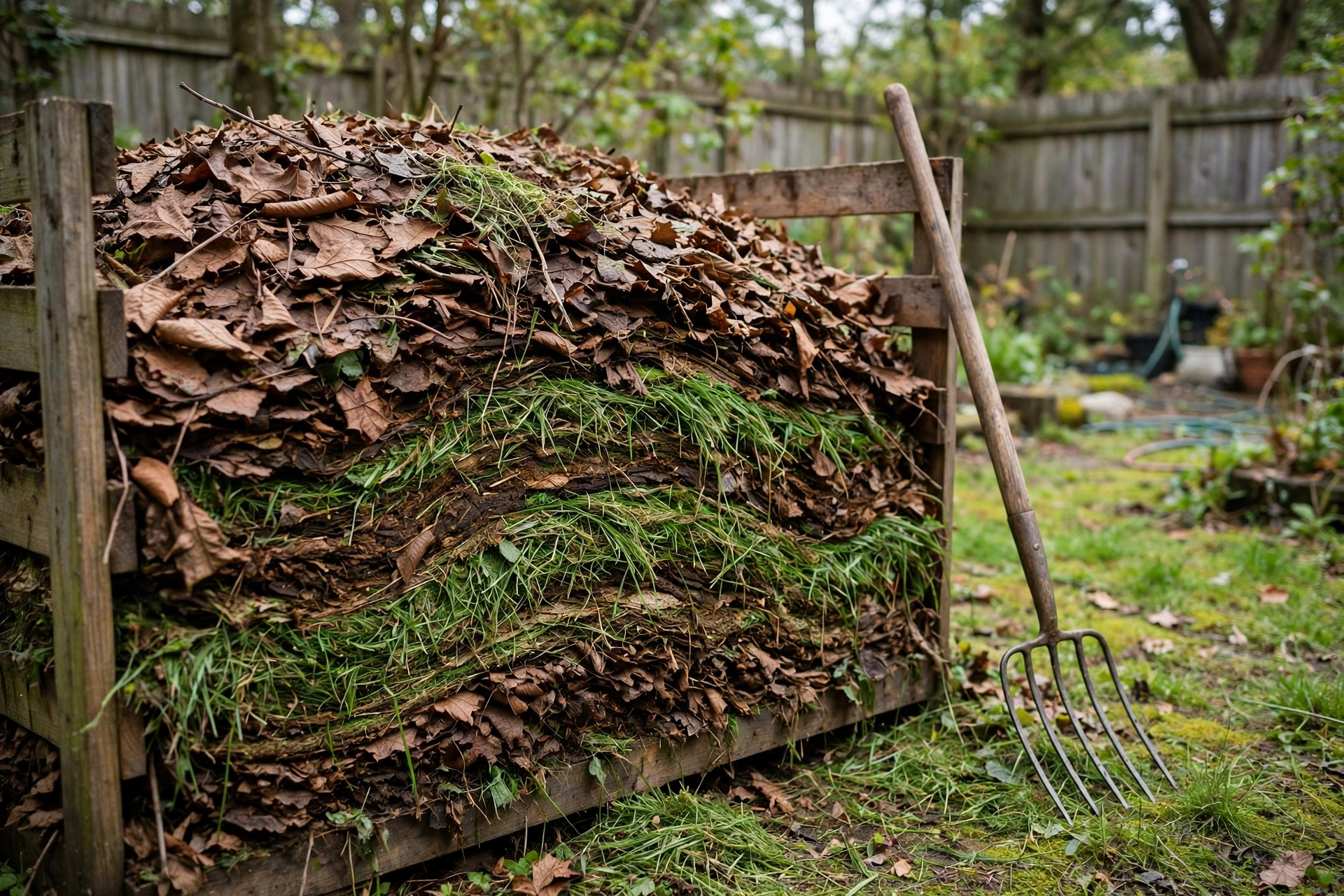
A compost pile that will not heat up is almost never a pile problem. It is a mix problem. Too much green and the pile smells like ammonia and goes slimy. Too much brown and it sits there, cool and quiet, for months. The fix is a ratio — the balance of carbon-rich browns to nitrogen-rich greens — and the target is 25 to 30 parts carbon for every part nitrogen. This calculator works out your mix from the dry weights you enter, and tells you what to add when the number is off.
Your compost mix
Enter each material in dry pounds — what it weighs after the water is out, not what the wheelbarrow weighed. If you weighed it fresh, convert it first: the table further down shows how. Leave any row at zero if you are not using that material.
What your number means
Below 25 to 1, your mix is too green: too much nitrogen for the carbon, and the pile is likely to smell of ammonia while the microbes lose nitrogen as gas. Between 25 and 30 to 1, you are in range — the mix has what the microbes need to heat up. Above 30 to 1, your mix is too brown: not enough nitrogen, so the pile stays cool and breaks down slowly. The calculator always tells you which way to adjust — add browns when the number is low, add greens when it is high — and if you picked a material to add, it works out the exact pounds to reach 30 to 1.
How the math works
Here is the whole method in plain words. Each material carries carbon and nitrogen in a fixed proportion — grass clippings hold about 15 parts carbon for every part nitrogen, dry leaves about 60. The calculator adds up all the carbon in your pile, adds up all the nitrogen, and divides the first total by the second. That is the blend’s ratio. What it never does is average the ratios: ten pounds of grass at 15 to 1 mixed with ten pounds of wood chips at 400 to 1 does not average out to about 200 to 1. The grass carries far more nitrogen per pound than the chips do, so the true blend is about 29 to 1 — right in range. Averaging the ratios is the one mistake that makes a good pile look hopeless, and this calculator does not make it.
Worked examples
A mix in range. Ten dry pounds of grass clippings plus fifteen dry pounds of leaves. The grass brings 0.30 lb of nitrogen and 4.50 lb of carbon; the leaves bring 0.125 lb of nitrogen and 7.47 lb of carbon. Add them up: 11.97 lb of carbon divided by 0.425 lb of nitrogen is 28.2 to 1 — in range, ready to heat up.
A mix that is too brown. Five dry pounds of food scraps plus ten dry pounds of straw. The scraps bring 0.135 lb of nitrogen and 2.03 lb of carbon; the straw brings 0.064 lb of nitrogen and 5.12 lb of carbon. That is 7.145 lb of carbon divided by 0.199 lb of nitrogen, or 35.9 to 1 — too brown, and slow. Adding about 2.6 dry pounds of grass clippings brings it to 30 to 1.
Why averaging fails. Ten dry pounds of grass plus ten dry pounds of wood chips. Averaging the two ratios gives 207.5 to 1, which would tell you the pile is hopeless. The real arithmetic: the grass brings 0.30 lb of nitrogen and 4.50 lb of carbon, the chips bring 0.011 lb of nitrogen and 4.40 lb of carbon. That is 8.90 lb of carbon divided by 0.311 lb of nitrogen — 28.6 to 1, in range. Same pile, two answers, and only one of them is right.
The numbers behind the calculator
The carbon-to-nitrogen figures come from the University of Georgia Extension’s composting circular, whose table is adapted from Cornell’s Compost Chemistry. The nitrogen percentages are representative values drawn from Cornell’s handbook table, chosen so the implied carbon content lands where dry plant matter actually sits — roughly 40 to 51 percent carbon by dry weight. Every figure here is a typical value, not a laboratory measurement of your particular leaves or grass, which is one reason the in-range band is as wide as it is.
| Material | C:N ratio | Nitrogen (% dry weight) | Implied carbon |
|---|---|---|---|
| Grass clippings | 15:1 | 3.0% | 45.0% |
| Food scraps | 15:1 | 2.7% | 40.5% |
| Cow manure (aged) | 20:1 | 2.4% | 48.0% |
| Dry leaves | 60:1 | 0.83% | 49.8% |
| Straw | 80:1 | 0.64% | 51.2% |
| Wood chips | 400:1 | 0.11% | 44.0% |
Two notes on the numbers. Cornell and an older Georgia circular both say the ideal is about 30 to 1, while the current Georgia circular gives a range of 25 to 30 to 1 — this calculator uses the range, and Cornell’s 30 sits at the top of it. The older circular also lists grass at 19 to 1 and wood at 700 to 1, where the current one says 15 and 400; both older figures sit inside Cornell’s published ranges, and the current circular governs here.
The calculator works in dry weights, so fresh material needs converting first. Fresh grass is about 82 percent water, food scraps about 69 percent, aged cow manure about 81 percent, dry leaves about 38 percent, straw about 12 percent; no published moisture figure exists for wood chips, so none is given here. The conversion is simple: ten pounds of fresh grass at 82 percent moisture is 1.8 dry pounds. Weigh it, knock off the water, enter the dry number.
What this calculator does not do
This tells you the starting mix of one pile — not how wet it is, how hot it will get, or how big it should be. A pile in the right range still needs air, moisture between 40 and 60 percent (squeeze a handful: a few drops should come out), and enough mass to hold heat, about 27 cubic feet at minimum. It also does not know your weather or your soil, and the ratio it reports is total carbon, not the carbon microbes can actually reach — the carbon in wood chips and straw is partly locked up in lignin, so a woody-heavy mix may behave as if its ratio were lower than the number shown, and aiming toward the top of the range is the safer play.
A good pile also needs the right care around the mix. Keep the active pile between 131 and 160 degrees, turn it about once a week, shred material to between a quarter inch and two inches, and keep meat, bones, grease, dairy, and human or pet waste out of it entirely. When the compost is finished, its ratio will have fallen to about 10 to 15 to 1 — that drop is the sign the work is done. If you want a tumbler to hold the pile while it cooks, the 53-gallon compost tumbler review covers one that lets one side cure while you fill the other, and the pine-needle composting guide and the pine-needle mulch comparison cover what to do with the leaves this calculator just helped you mix.
Sources
University of Georgia Cooperative Extension, “Composting Basics and Considerations for Growers and Landscapers,” Circular C1365-01 (published January 6, 2026; updated March 12, 2026; fetched in full November 8, 2026; re-checked November 9, 2026): https://fieldreport.caes.uga.edu/publications/C1365-01/composting-basics-and-considerations/. Cornell Waste Management Institute, “Compost Chemistry” (1996; fetched in full November 8, 2026; re-checked November 9, 2026): https://www.css.cornell.edu/cwmi/compost/chemistry.html. Cornell Composting (Richard and Trautmann), “C/N Ratio” (fetched in full November 8, 2026; re-checked November 9, 2026): https://www.css.cornell.edu/cwmi/compost/calc/cn_ratio.html. Cornell Waste Management Institute / Rynk, ed. (1992), “On-Farm Composting Handbook, Appendix A: Table A.1” (fetched in full November 8, 2026): http://cwmi.css.cornell.edu/AppendixATable1OFCH.pdf. University of Georgia Cooperative Extension, “Composting and Mulching,” Circular C816 (fetched in full November 8, 2026): https://fieldreport.caes.uga.edu/publications/C816/composting-and-mulching/.