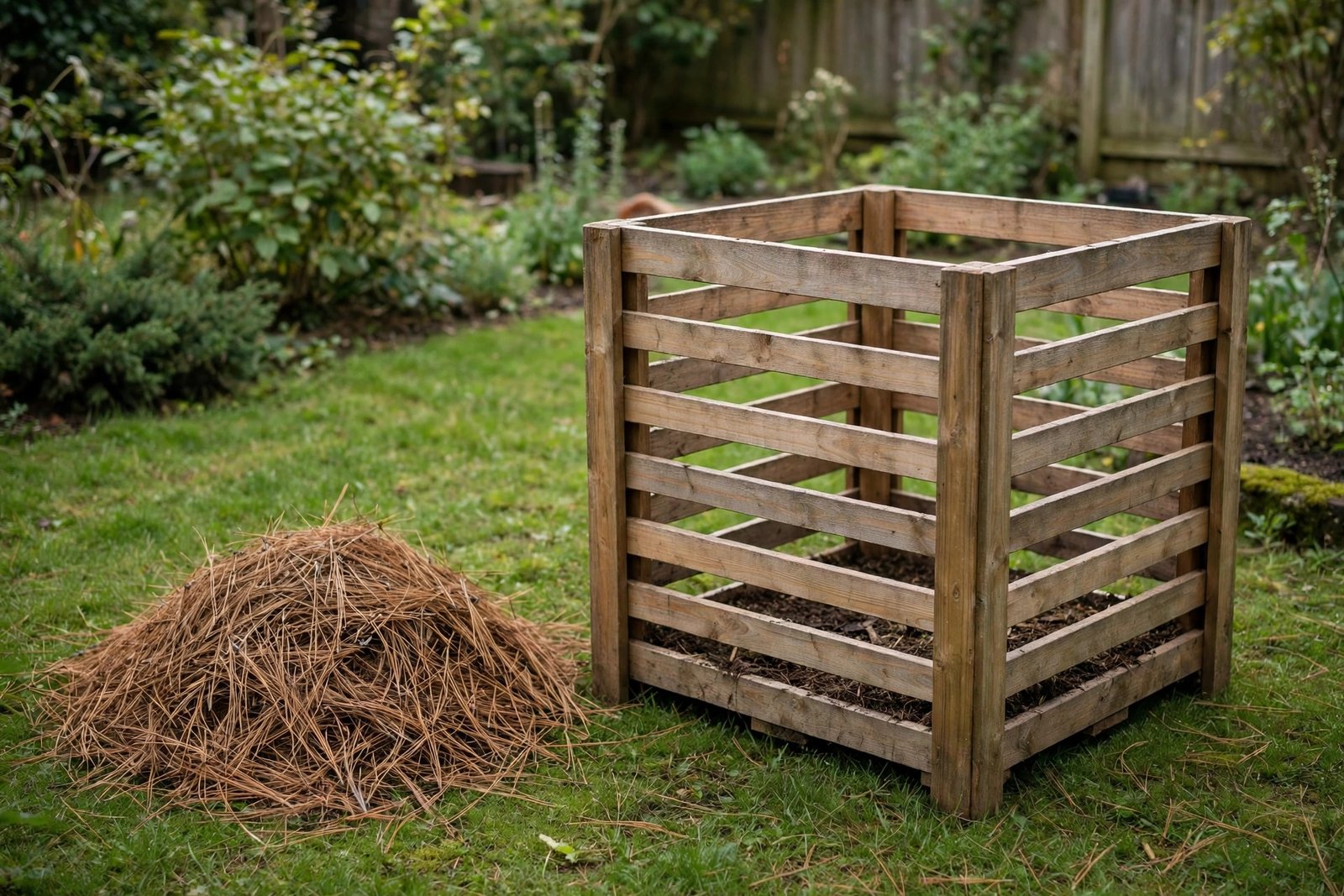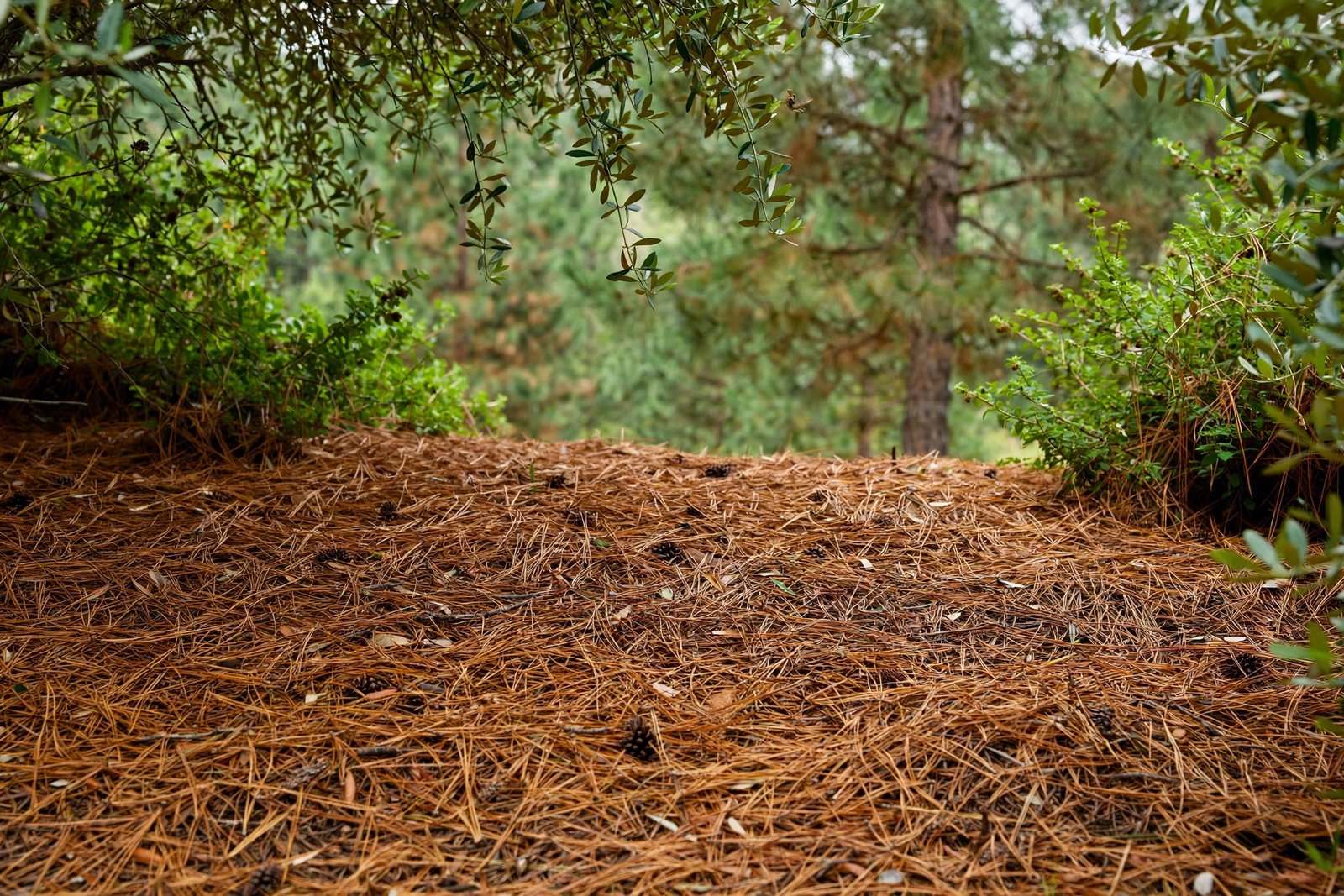
If you have pine trees, you have pine needles — a free mulch that arrives every fall whether you want it or not. Bark mulch arrives in bags from the store, costs money, and looks tidy the day it goes down. Both suppress weeds, hold moisture, and even out soil temperature. The differences show up later: on a slope after a hard rain, in the second year when one needs topping up and the other does not, and under acid-loving plants that prefer one over the other.
Why mulch choice matters in a pine-tree bed
Under a pine, the soil is dry, shaded, and full of roots competing for water. Mulch there has two jobs: keep what moisture arrives in the soil, and keep weeds from taking the little light that reaches the ground. A mulch that washes away in the first storm fails the first job; a mulch that mats into a waterproof sheet fails it differently, by shedding rain off the surface. Pine needles interlock as they settle, which is why they stay put on slopes and in wind. Bark nuggets, by contrast, are individual pieces that float and roll — fine on flat ground, restless on a slope. Shredded bark behaves better than nuggets, because the pieces knit together the way needles do.
| Factor | Pine needle mulch | Bark mulch |
|---|---|---|
| Stays in place | Excellent — needles interlock, good on slopes | Shredded: good. Nuggets: wash and roll on slopes |
| How long it lasts | Longer — breaks down slowly, top up yearly | Shorter — decomposes faster, top up more often |
| Soil acidity | Does not meaningfully acidify soil as it breaks down | Near neutral; no acidity concern either |
| Cost and supply | Free under your own pines; sold as bales elsewhere | Sold by the bag everywhere; cheaper per bag |
| Best beds | Slopes, pine beds, blueberries, azaleas | Flat beds, paths, general landscaping |
The acidity myth, plainly
Pine needles are acidic when fresh, and generations of gardeners have assumed they acidify the soil. Extension research has tested that assumption and found it does not hold in practice: pine needle mulch breaks down slowly, and the soil beneath it stays close to its starting pH. The same finding applies to composted needles — see how to compost pine needles faster. If your soil test shows acidity, the cause is the soil, not the mulch on top of it. Choose pine needle mulch because it stays put and lasts, not because you need acid soil — and do not avoid it because you fear it.
Depth and timing
Both mulches work at 2 to 3 inches deep. Less than 2 inches, and weeds push through; more than 4 inches, and water struggles to reach the soil, while the mulch itself stays dry on top and damp underneath. Keep mulch a few inches away from tree trunks and shrub stems — mulch piled against bark holds moisture where rot starts, whatever the material. Refresh pine needle mulch once a year, in spring, by adding a thin layer over the old; refresh bark mulch when it has visibly thinned, usually every year or two depending on the type. Under pines, the needles fall and refresh themselves, which is part of their appeal: rake the surplus off paths and lawns, and let the bed keep what falls.
Timing follows the season, not the mulch. Mulch in late spring, after the soil has warmed, so you are not insulating cold soil and delaying growth. A fall top-up is fine too, ahead of winter, to protect roots from freeze and thaw. In the beds under pines, check first what will actually grow there — what grass grows under pine trees covers the shade and root competition that mulch alone cannot fix.
When bark is the better buy
Bark wins on flat, visible beds where a uniform look matters — front foundation beds, paths, and anywhere the mulch is part of the landscaping rather than a working layer. It is sold everywhere, in consistent bags, in colors that match the house. Pine needle mulch wins wherever it has to stay put, last a long time, or come free: slopes, beds under pines, and woodland edges. In a garden with both kinds of bed, there is no rule against using both — pine straw where it works hardest, bark where it looks best.
What to watch next
After the first heavy rain, check the edges: needles should still be where you put them, bark nuggets may have drifted downhill. After the first dry spell, push the mulch aside and feel the soil — damp means the depth is right, dry means it is too thick or too matted. The one mistake that undoes either mulch is piling it against stems and trunks. Pull it back, and the bed will do the rest.