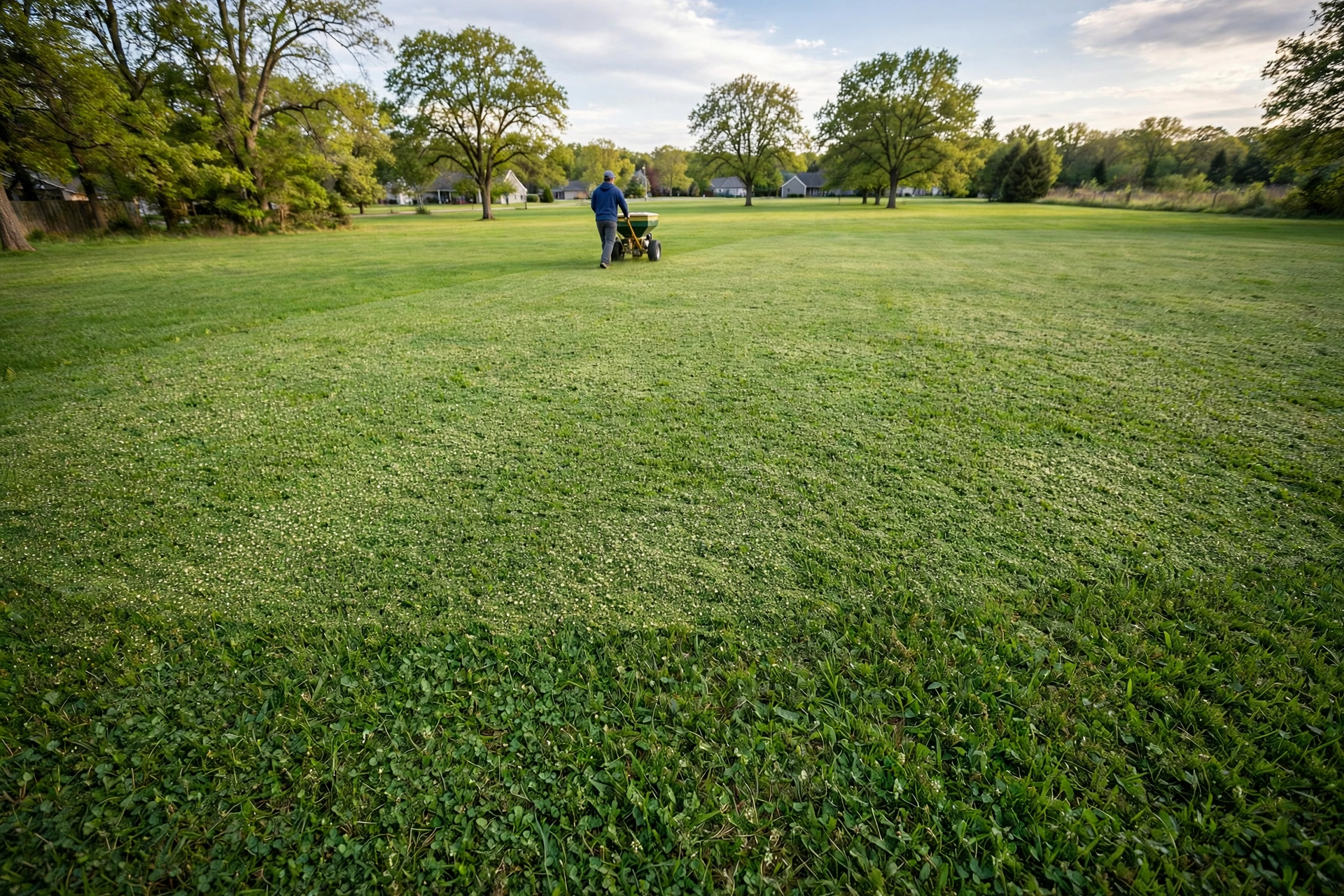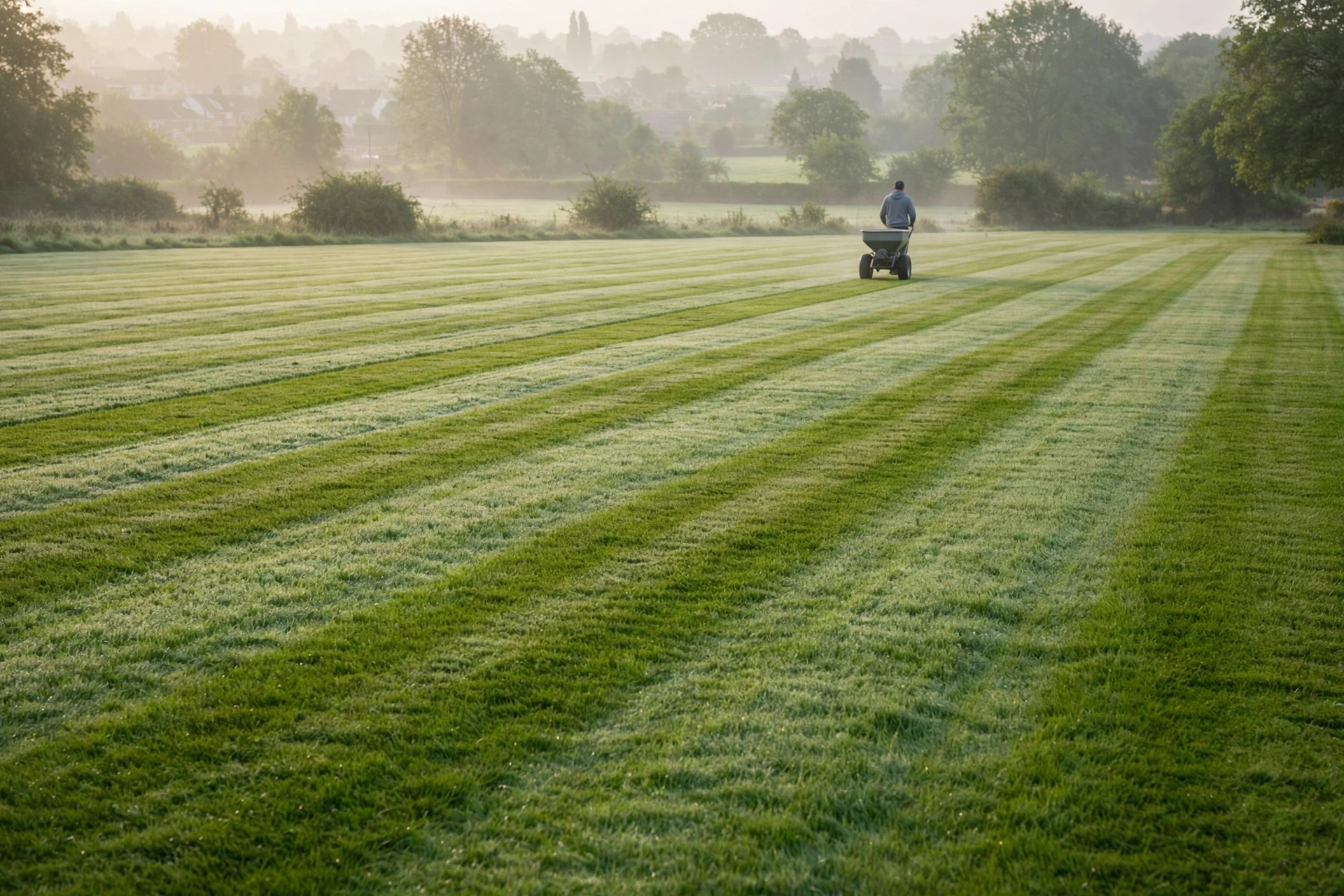
A lawn that looks hungry in June may not need feeding in June at all. The bag says feed in spring, the neighbor feeds in fall, and the lawn in between just sits there looking tired — but the right month depends on the grass itself, and feeding the wrong grass in the wrong month wastes the bag.
The fix is matching the feeding to the grass. Cool-season grasses — tall fescue, Kentucky bluegrass, and their mixes — do their real growing in spring and fall, so they eat in February, September, and November. Warm-season grasses — bermudagrass, zoysiagrass, St. Augustinegrass, and the rest — wake up late and grow hard through summer, so they eat from May into September. This table gives the months and the pounds for nine common grasses, from two university Extension guides, and every figure is pounds of actual nitrogen per 1,000 square feet.
The table
Months are central-Piedmont and Kansas months, so slide them a week or two with latitude and follow the grass itself — feed when it is actively growing, and stop once it goes dormant.
| Grass | Type | Feed in these months | Nitrogen per feeding | Nitrogen per year |
|---|---|---|---|---|
| Tall fescue | Cool-season | Feb, Sep, Nov | 0.5 lb (Feb), 1 lb (Sep), 0.5 lb (Nov) | 2 lb |
| Kentucky bluegrass | Cool-season | Feb, Sep, Nov | 0.5 lb (Feb), 1 lb (Sep), 0.5 lb (Nov) | 2 lb |
| Kentucky bluegrass + perennial ryegrass | Cool-season | Feb, Sep, Nov | 1 lb each | 3 lb |
| Bermudagrass | Warm-season | May, Jul, Sep | 1 lb each | 3 lb |
| Zoysiagrass | Warm-season | May, Jul | 1 lb each | 2 lb |
| St. Augustinegrass | Warm-season | May, Jul | 1 lb each | 2 lb |
| Centipedegrass | Warm-season | Jun | 1 lb | 1 lb |
| Bahiagrass | Warm-season | May, Jul | 0.5 lb each | 1 lb |
| Buffalograss | Warm-season | Jun (one feeding), or May + Jul (two) | 1 lb each | 1–2 lb |
The first eight rows follow NC State Extension’s monthly schedule; the buffalograss row follows Kansas State University Extension’s warm-season calendar. Mixed bluegrass-and-fescue lawns follow the same schedule as the tall fescue and Kentucky bluegrass rows.
What the numbers mean in bag terms
A typical feeding is 1 pound of nitrogen per 1,000 square feet, and the bag tells you how much product that takes: 10 pounds of 10-10-10, 5 pounds of 20-5-5, or 4 pounds of 26-3-4 all put down the same pound of nitrogen. The first number on the bag is the nitrogen percentage, so divide 1 by that percentage to work out any other bag. Leave the clippings on the lawn and you can cut the nitrogen you add by a third, because the clippings feed it back as they break down.
The feeding that matters most
For a cool-season lawn, the September feeding is the one not to skip — feed around Labor Day, when the grass is waking up from summer and growing hard again. The November feeding is taken up by the roots and used the following spring, so it still earns its place. One exception for watered lawns: if yours stays green all summer, a light May feeding can stand in for the February one.
For a warm-season lawn, more feedings give a deeper green, but they also mean more mowing and more thatch — especially with bermudagrass and zoysiagrass, where too much nitrogen builds thatch fast. Two feedings are plenty for zoysiagrass, and one is enough for centipedegrass, which wants a light hand; coastal centipedegrass lawns may get an extra August feeding to help performance there.
What not to do
Do not feed frozen ground or dormant turf — the fertilizer will not be absorbed and is more likely to wash away — and do not feed just before heavy rain for the same reason. Test your soil first: the test tells you whether you need phosphorus, potassium, or lime at all, and this table covers nitrogen timing only.
Standalone perennial ryegrass, standalone fine fescue, and seashore paspalum are not in this table, because neither guide gives a per-grass feeding schedule for them — so they are left out rather than guessed at.
Bottom line
Find your grass in the table, mark its months, and feed it on its schedule — September first for a cool-season lawn, May and July for a warm-season one. If November has you wondering whether the window has already closed, Is It Too Late to Fertilize Your Lawn in November? takes up exactly that question, and Spring Secrets: When to Fertilize Your Cool-Season Lawn walks through the spring side of the cool-season calendar.
Sources
NC State Extension, “Caring for Your Lawn and the Environment” (AG-597; Deanna Osmond and Erin Rivers; published June 25, 2025) — https://content.ces.ncsu.edu/caring-for-your-lawn-and-the-environment — fetched November 11, 2026.
Kansas State University Extension, “Lawn Calendar for Cool-Season Grasses” and “Lawn Calendar for Warm-Season Grasses” (K-State Research and Extension, Grant County) — http://grant.k-state.edu/docs/Lawn_Calendar_for_Cool_and_Warm_Season_Grasses.pdf — fetched November 11, 2026.