When the season turns and the cushions come off the chairs, the bench that fit in June is suddenly the one that doesn’t. All summer it held the throw pillows and the sunscreen without complaint, which is how you end up trusting it with the whole cushion set on the first cold weekend — and finding out, one cushion at a time, that the box you bought for the easy months was never sized for the real job.
The fix is not a bigger guess. It is a tape measure and ten minutes, before you spend anything, because bench sizes are sold in gallons and nobody buys cushions by the gallon. This guide works through what each size actually holds, how to measure the stack you own, and the seating question most people forget until the bench is already on the patio.
Why gallons lie a little
A gallon is a measure of volume, and your cushions are not liquid. They are flat, stiff, and awkward, which means they waste space in ways a gallon rating never accounts for — the corners of the box stay empty while the middle bulges, and a cushion that is two inches too long for the interior does not fit at all, even if the box has gallons to spare. A 100-gallon bench with a 48-inch interior holds more of your actual cushions than a 120-gallon bench with a short, deep interior, because cushions stack flat and wide.
That is why the length of the bench matters more than the gallon number on the listing. Measure the longest cushion you own, then buy a bench whose interior is longer than that cushion by at least two inches. If the listing only gives exterior dimensions, subtract about two inches for the walls — the Keter Westwood, for instance, is 61 inches long outside, which leaves room for a cushion stack just under five feet long.
What fits in each size
Use this table as a starting point, then measure your own stack before you buy — the table is a rough guide, and your cushions are the deciding vote.
| Bench size | Holds, roughly | Best for |
|---|---|---|
| Under 30 gallons | A couple of throw pillows | Balconies, side tables |
| 50 to 75 gallons | Seat cushions for two chairs | Small patios, two-chair sets |
| 90 to 100 gallons | Cushions for a four-chair set | Most patios |
| 120 to 150 gallons | A full set plus throws and tools | Large sets, shared storage |
The jump that matters most is the one from 75 gallons to 90. Below it, you are choosing which cushions stay outside; above it, the whole set goes in together, which is the difference between a bench that ends the chore and a bench that only shortens it. Our storage bench roundup puts numbers to it: the 92-gallon Keter Kentwood holds a four-chair set, the 100-gallon Devoko does the same in a 48-inch box, and the 150-gallon Keter Westwood takes the set plus everything else.
Measure before you buy
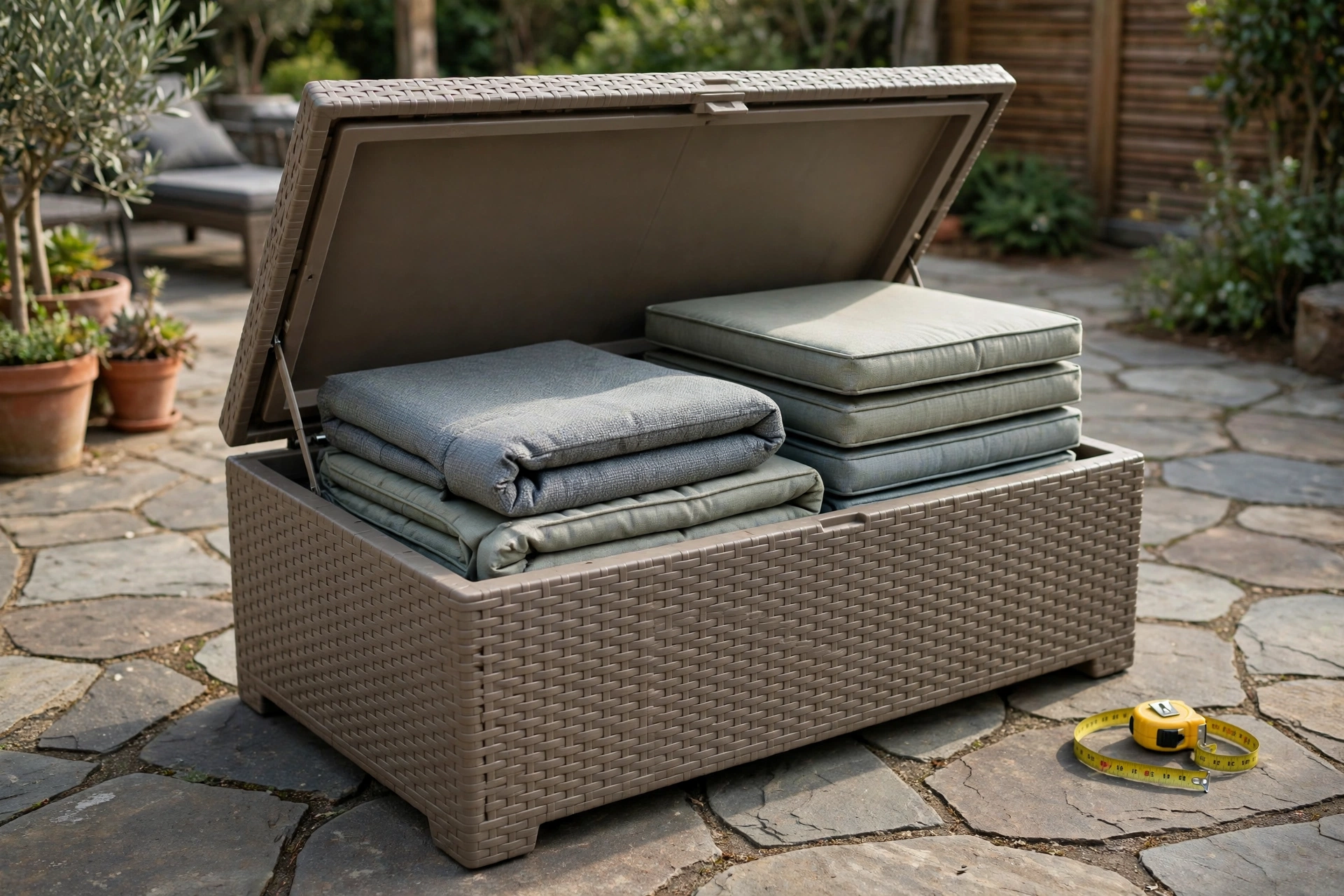
Stack the cushions the way you will store them. Seat cushions flat, back cushions on top, throw pillows tucked in the gaps — the stack you actually make, not the neat pile in your head.
Measure the stack three ways. Length, width, and height, in inches, with the tape pulled snug. Write the numbers down, because the listing will not wait while you re-measure.
Add two inches to each number. That is the clearance the cushions need to slide in without catching, and the lid needs to close without pressing down on the top cushion.
Compare against the bench’s interior, not its exterior. Listings lead with exterior dimensions, and the walls take about an inch a side. If the listing does not give interior dimensions, subtract two inches from the exterior length and width before you compare.
Leave room for what else lives on the patio. If the bench is also where the pool toys, the garden tools, and the outdoor throw blankets go, add their stack to the measurement before you choose a size. A bench bought for cushions alone becomes a second purchase by July.
Don’t forget the seat
A storage bench is also a seat, and its height decides whether it is one you will actually use. A standard chair seat sits about 17 to 18 inches off the ground, while most storage benches stand 23 to 25 inches tall — the Westwood, for instance, is 25.2 inches high. That makes the bench a perch rather than a chair: fine for tying a shoe or setting down a drink, higher than you want for an evening of sitting.
That is not a reason to avoid a tall bench, but it is a reason to know what you are buying. If the bench will be the extra seat at the table, look for the shortest bench that still holds your cushions, and check the lid’s weight rating — our roundup lists 660 pounds for the Westwood and 573 for the Kentwood, which is two adults with room to spare. If the bench will mostly hold cushions and only occasionally hold a person, height matters less than gallons, and the taller box is the better buy.
What to do next
Stack your cushions, measure the stack, add two inches each way, and buy the bench whose interior beats those numbers with room for the extras. For most patios, that lands at 90 to 100 gallons — a four-chair set, in one load, with the lid closing cleanly. If the numbers land higher, the 150-gallon bench is the honest answer, not an indulgence, because a bench that fits is a chore that ends.
Once the size is settled, the material decides how long the bench lasts: our resin vs. wood comparison works through what rain and sun do to each one. And if you are weighing a bench against a plain deck box or a shed, our bench vs. deck box vs. shed comparison — and the deck box sizing guide — cover the rest of the decision.