Most people buy the bench that matches their furniture, then spend the next few summers learning what their weather does to it. The wood bench that looked right next to the teak chairs starts graying by August, and the resin bench that looked like plastic starts looking like the smartest thing on the patio. The mistake is buying for the afternoon you unbox it instead of the five summers after that.
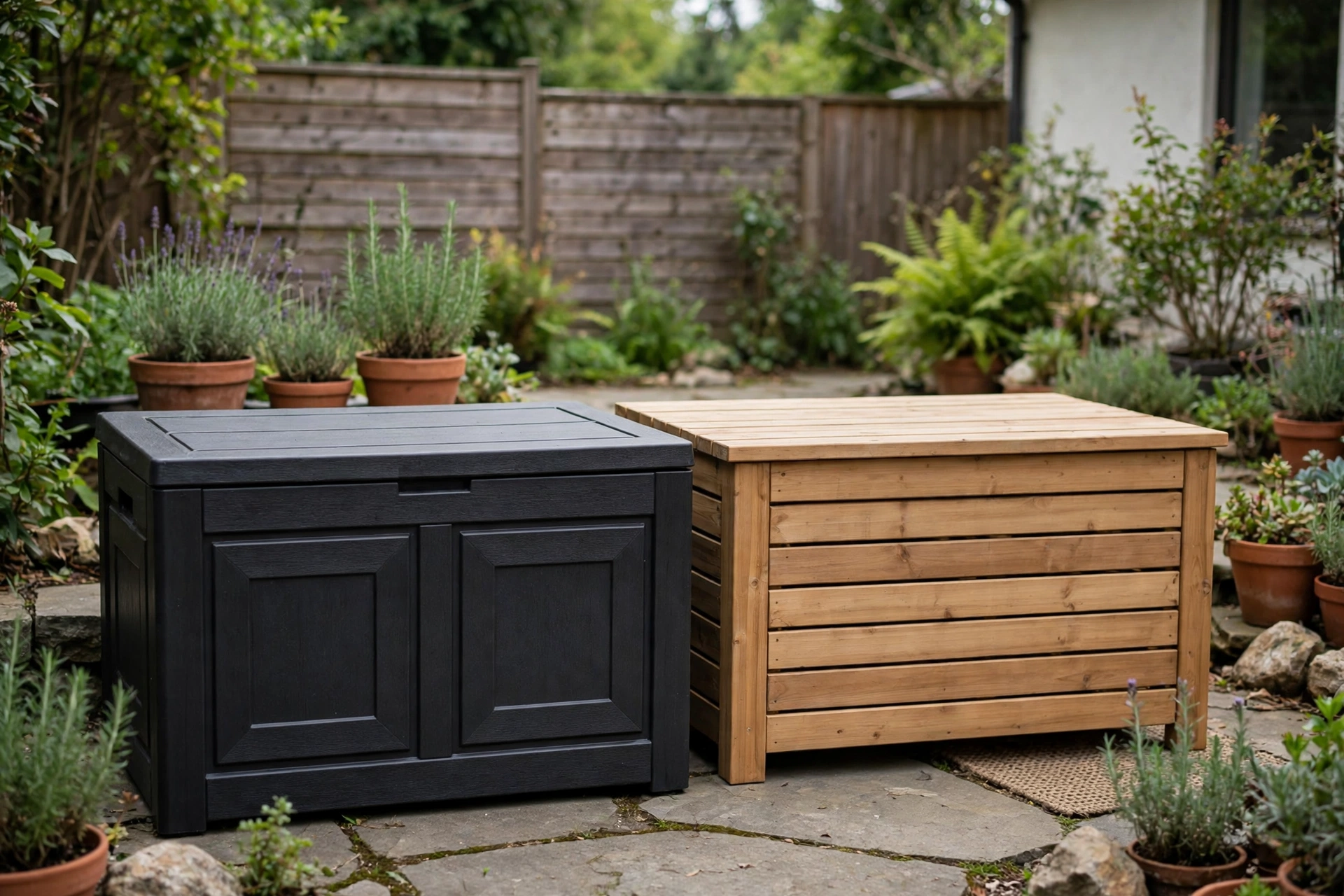
Here is the short version, before the details. Resin lasts longer with less work for most yards, because it does not rot, rust, or ask for a coat of anything before winter. Wood lasts longer only if you maintain it, and it repays the work with a bench that looks better every year instead of merely holding up. Buy resin unless you genuinely enjoy the upkeep — and if you buy wood, budget the afternoon a year it asks for.
What resin gets right
Resin is plastic engineered to sit outside, and its whole advantage is what it refuses to do. It does not absorb water, so it does not rot, swell, or split when a wet season follows a dry one. It does not rust, because there is no metal in the structure to rust. It does not need sealing, staining, or oiling, and it cleans with a hose and a brush, which is the entire maintenance schedule.
The weight ratings tell the rest of the story. The resin benches in our storage bench roundup carry published lid ratings — 660 pounds on the Keter Westwood 150-gallon, 573 pounds on the Keter Kentwood 92-gallon — because a molded resin lid spreads weight across the whole box instead of concentrating it on a joint. That is why a resin bench can be both a storage box and a two-person seat without a second thought.
Where resin gives up
Resin has two honest weaknesses, and both show up slowly enough that people miss them until they are obvious. The first is sun. Years of direct sun fade the color and make the surface chalky, especially on dark benches, and no amount of washing brings the color back. The second is looks: a resin bench is a molded box, and even the ones with a wood-grain or rattan pattern read as a box from across the patio, not as furniture.
Resin also has a failure mode that wood does not. A cracked resin panel is hard to repair well — glue and patches hold poorly on the slick surface, and a replacement panel may not exist for your model. When a resin bench fails, you usually replace it. When a wood bench fails, you usually fix it.
What wood gets right
A wood bench earns its keep in two ways resin cannot match. The first is appearance: cedar and teak age into a silver-gray that suits a garden in a way molded plastic never will, and a well-built wood bench looks like it belongs next to real furniture because it is real furniture. The second is repair. A loose board gets a new screw, a split slat gets replaced, a wobbly leg gets re-glued — and every one of those fixes is a Saturday-afternoon job with tools most people already own.
Wood is also the honest choice for a bench that will be sat on hard, every day, for years. A solid wood frame with through-bolts takes abuse that would crack a molded lid, and it can be tightened back to solid in ten minutes. Resin spreads weight well, but it does not forgive a dropped toolbox the way a thick cedar plank does.
Where wood gives up
Wood’s weakness is water, and it is not a small one. An unsealed wood bench left out through a wet winter absorbs water, swells, and then splits as it dries — and the split opens the grain to the next winter’s water, which is how a bench quietly rots from the inside out. Teak and cedar resist this longer than pine, because their natural oils slow the absorption, but they do not stop it. Every wood bench outdoors needs a coat of sealer or oil at least once a year, and a bench that skips two seasons in a row is a bench on a countdown.
That maintenance is also the real cost of wood, and it is not the price of the sealer. It is the afternoon: moving the cushions out, cleaning the wood, letting it dry, brushing on a coat, and waiting for it to cure before the bench goes back into service. Do it once a year and the bench lasts. Skip it twice and you are shopping for a replacement.
Resin vs wood, side by side
| Material | Rain | Sun | Upkeep | Repair |
|---|---|---|---|---|
| Resin | Will not rot or swell | Fades and chalks over years | Hose it off | Cracks are hard to fix |
| Wood | Rots if unsealed | Grays gracefully | Seal or oil yearly | Boards and joints are fixable |
Which one lasts longer where you live
In a wet climate, resin wins outright. A bench that cannot absorb water cannot rot, and that is the whole argument in a place where the rain does not let up for weeks. In a dry, sunny climate, the gap narrows: wood dries out between rains, which slows the rot, while resin takes the full force of the sun and fades faster. Even there, resin lasts longer for most people, because the failure that kills a resin bench — fading — is cosmetic, while the failure that kills a wood bench — rot — is structural.
The exception is the homeowner who maintains things. If you seal a cedar or teak bench every year without fail, it will outlast a resin bench and look better doing it, because wood can be repaired indefinitely while resin cannot. But that is a conditional, not a promise, and it depends on the one thing most of us run out of: the afternoon.
The mistake to avoid
The mistake is buying wood and treating it like resin. A wood bench that never gets sealed is not a low-maintenance bench — it is a bench rotting on a schedule, and the schedule is shorter than most people expect. If you buy wood, put the sealing afternoon on the calendar the day the bench arrives, before the first season teaches you what skipping it costs.
The other mistake runs the other way: buying resin and expecting it to look like furniture. It will not, and it will not get better-looking with age. If the bench sits where you entertain, and the way it looks matters as much as what it holds, that is a real cost — and it is the one reason to buy wood even knowing what the upkeep asks.
What to do next
Buy resin if you want the bench to disappear into the background of the patio and hold cushions without asking for anything back. Buy wood if you want a bench that looks like furniture and you will give it one afternoon a year, every year. Either way, check the lid rating before you buy — a bench that cannot hold two adults is a box with a lid, and our storage bench sizing guide works through the size question before you spend anything. And if you are still weighing a bench against a plain deck box or a shed, our bench vs. deck box vs. shed comparison settles that one too.