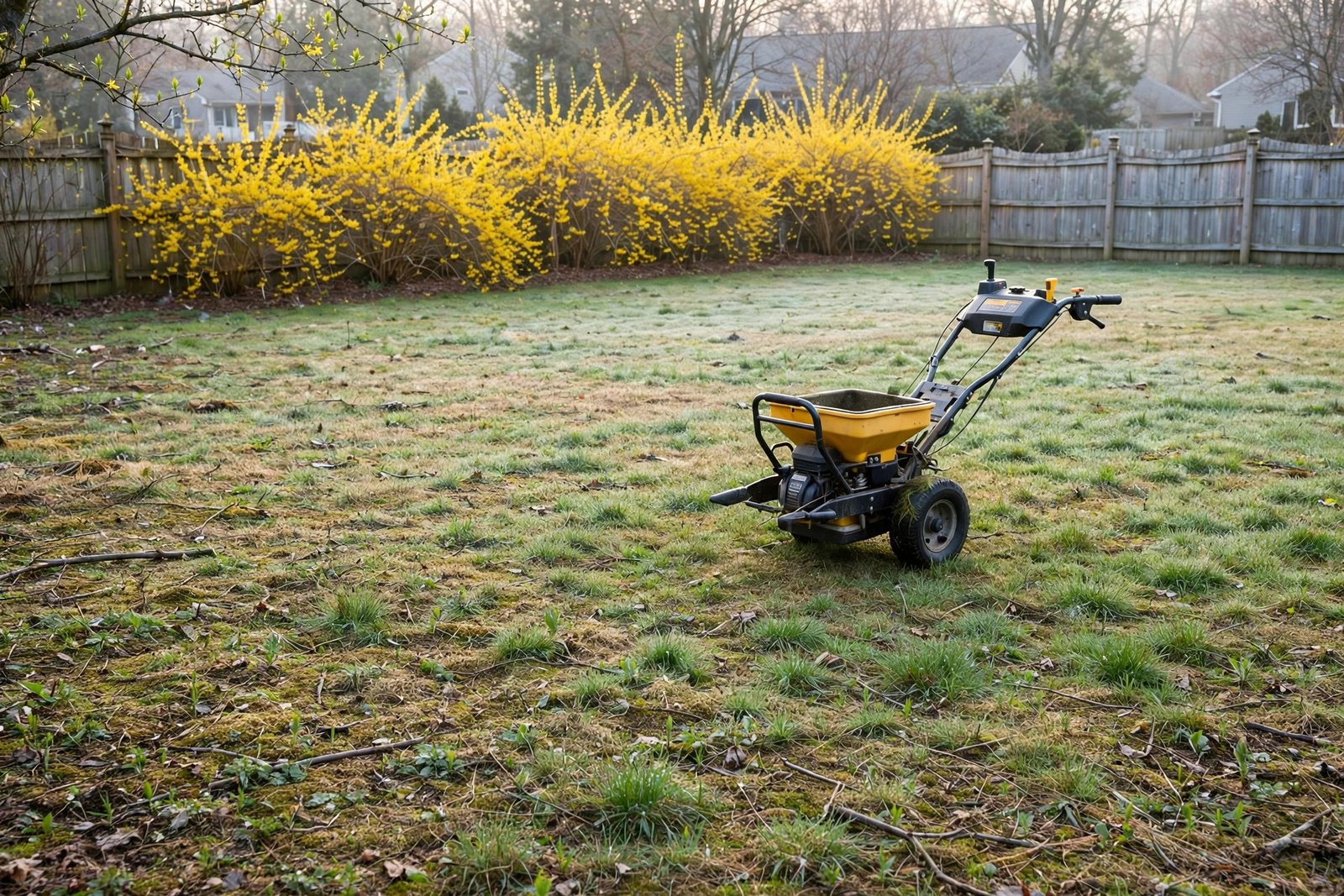
Spring opens with the same quiet standoff every year. The forsythia by the fence has turned yellow, the spreader is still sitting in the garage, and under the lawn the crabgrass seed is waiting on a signal that has nothing to do with either one — which is how the preventer so often goes down after the moment it would have worked.
The signal is soil temperature. Crabgrass starts to germinate once the soil holds near 55°F for several days running — NC State Extension puts it at a day-and-night average soil temperature of about 55°F for three to four consecutive days — so the barrier has to be in the ground before that, while the soil is still climbing through 50 to 55°F. Michigan State University Extension times the application to exactly that climb, and where no thermometer is handy, forsythia in full bloom is the standing cue: when the shrub is covered in yellow, the window is open.
Fall runs the same play in reverse. Annual bluegrass and the other winter weeds germinate as the soil cools below 70°F, which is why Texas A&M AgriLife Extension starts the fall application as soil temperatures come down to about 70°F — early enough that the barrier is already waiting when the seed wakes. Warm-season lawns live by both windows. Most cool-season lawns live by the spring one, and spend the fall on seed instead.
How to take the reading
Push a soil thermometer about 2 inches into an open, sunny part of the lawn and read it in the morning, when the soil is at its coolest. One warm afternoon proves nothing, because germination answers to the sustained temperature rather than the spike — act on several mornings in a row holding in the band. Once the product is down, water it in with a quarter to a half inch of water, so the barrier forms in the surface layer where the seed sits (Texas A&M AgriLife Extension).
The table
| Grass | Spring application | Signal to watch for | Fall application | What to know |
|---|---|---|---|---|
| Kentucky bluegrass & perennial ryegrass | Apply as soil climbs through 50–55°F, before it holds at 55°F | Forsythia in full bloom | Usually skip it — fall is overseeding season, and pre-emergent stops grass seed too | The spring barrier does the real work on these lawns, because crabgrass germinates as soon as the soil average holds near 55°F for a few days. (NC State Extension; Michigan State University Extension) |
| Tall fescue | Apply as soil climbs through 50–55°F, before it holds at 55°F | Forsythia in full bloom | Skip it in any year you overseed — and most fescue lawns overseed | Fescue’s prime seeding window is late summer into fall, which makes the fall choice seed over spray for most lawns. (University of Maryland Extension) |
| Fine fescues | Apply as soil climbs through 50–55°F, before it holds at 55°F | Forsythia in full bloom | Usually skip it — these are the low-input lawns | A single spring application is the one that earns its keep here, holding back the summer annual weeds that move into a thin fine fescue lawn by August. (University of Maryland Extension) |
| Bermudagrass | Apply as soil climbs through 50–55°F — the lawn will still look dormant, and that is fine | The soil thermometer, not the lawn’s color | Apply as soil cools to about 70°F | The fall application stops annual bluegrass, henbit and chickweed before they sprout — the winter weeds that show up green in a brown bermuda lawn all winter. (Texas A&M AgriLife Extension) |
| Zoysiagrass | Apply as soil climbs through 50–55°F, before it holds at 55°F | The soil thermometer — zoysia wakes too late to be the cue | Apply as soil cools to about 70°F | Zoysia can stay dormant well after the crabgrass clock starts, so time this by the soil and let the lawn catch up on its own schedule. (University of Maryland Extension; NC State Extension) |
| St. Augustinegrass | Apply as soil climbs through 50–55°F, before it holds at 55°F | The soil thermometer, not the lawn’s color | Apply as soil cools to about 70°F | The fall application also catches lawn burweed, the sticker weed nobody notices until it ripens in spring and meets a bare foot. (Texas A&M AgriLife Extension) |
| Centipedegrass | Apply as soil climbs through 50–55°F, before it holds at 55°F | The soil thermometer, not the lawn’s color | Apply as soil cools to about 70°F | Centipedegrass runs a light program by nature — choose a product labeled for centipedegrass, and hold to the label rate. (Texas A&M AgriLife Extension) |
| Bahiagrass | Apply as soil climbs through 50–55°F, before it holds at 55°F | The soil thermometer, not the lawn’s color | Apply as soil cools to about 70°F | Bahia greens up when the soil reaches about 65°F, weeks after the pre-emergent window has closed — the barrier goes down while the lawn is still waking. (Texas A&M AgriLife Extension) |
The spring window in every row follows Michigan State University Extension and NC State Extension; the fall window follows Texas A&M AgriLife Extension. The grasses share the numbers because the weed seed sets this schedule — what changes from row to row is what your lawn is doing while the window opens, and what the fall application is worth to it.
The choice that changes in fall
Pre-emergent cannot tell weed seed from grass seed, and it stops both. The University of Maryland Extension is blunt about the collision: a lawn being reseeded in the same season and a pre-emergent barrier cannot share the same ground. So the fall column of this table is really a decision. Cool-season lawns that need seed take the seed, and let the spring application carry the weed load; warm-season lawns, which are not seeded in fall, take the barrier and skip the winter weeds. Where the germination season runs long, as it does in the Deep South, Texas A&M AgriLife notes that a split application — part in spring, the rest several weeks later — stretches the barrier across the whole window.
For the day-by-day version of the spring rows, the Crabgrass Pre-Emergent Timing Checker reads your own morning temperatures and calls the window for your lawn. The rest of the spring workload, this application included, is laid out in the Spring Lawn Care Calendar.
Bottom line
Buy the thermometer before you buy the bag. Read the soil on a few spring mornings, spread the preventer as it climbs through the low 50s, and the crabgrass argument is settled before it starts — then, on a warm-season lawn, do the same in fall as the soil cools through 70. A strange spring can fool the calendar. It cannot fool the thermometer.
Sources
Michigan State University Extension, “Timing Crabgrass Preemergence Applications in Spring” (Kevin Frank) — https://www.canr.msu.edu/news/timing_crabgrass_pre_emergence_applications — fetched November 6, 2026.
NC State Extension, “When to Apply Preemergent Herbicides for Turfgrasses” (TurfFiles) — https://www.turffiles.ncsu.edu/news/when-to-apply-preemergent-herbicides-for-turfgrasses/ — fetched November 14, 2026.
Texas A&M AgriLife Extension, “Apply Fall Preemergence Herbicide to Avoid Spring Weeds” (AgriLife Today; Chrissie Segars) — https://agrilifetoday.tamu.edu/2020/09/23/apply-fall-preemergence-herbicide-to-avoid-spring-weeds/ — fetched November 14, 2026.
University of Maryland Extension, “Lawn Maintenance Calendar” — https://extension.umd.edu/resource/lawn-maintenance-calendar — fetched November 14, 2026.