The first warm weekend of spring hands you every lawn job at once. The mower needs to run, the beds need mulch, the spreader is still holding last fall’s settings — and buried in the pile is the one job that quietly cancels another one out if you do them in the wrong order.
This calendar puts the ten core spring jobs in their working order, region by region. It runs on three signals instead of dates — soil temperature, green-up, and the last hard freeze — because those are the signals the grass itself runs on, and they reach the Deep South weeks before they reach the North. Find your band, and work down the rows as each signal shows up.
How to read this calendar
The Deep South band is warm-season country: bermudagrass, zoysiagrass, St. Augustinegrass and centipedegrass, mild winters, and a spring that starts early and runs long. The Transition band is the wide middle where fescue and bluegrass lawns can sit within a county of bermuda and zoysia, so several rows carry both instructions. The North is cool-season country, where spring arrives last and fall does the heavy lifting. In every cell the anchor comes first — the soil reading, the green-up, the freeze line — and the season cue after it is simply what that anchor looks like from the porch.
The table
| Spring job | Deep South | Transition | North |
|---|---|---|---|
| First mow | At green-up — one lower cut to clear the brown winter growth, then back to your regular height | When growth reaches about a third past cutting height — a lawn kept at 3 inches gets its first cut at about 4½ inches | The same growth rule, arriving last — there is no set date, because the grass announces it |
| Pre-emergent for crabgrass | First of the three bands — soil reaches 50–55°F while the lawn may still be dormant, and that is the moment | As soil climbs through 50–55°F; forsythia in full bloom is the visual check | As soil climbs through 50–55°F — the same reading, weeks later than the South |
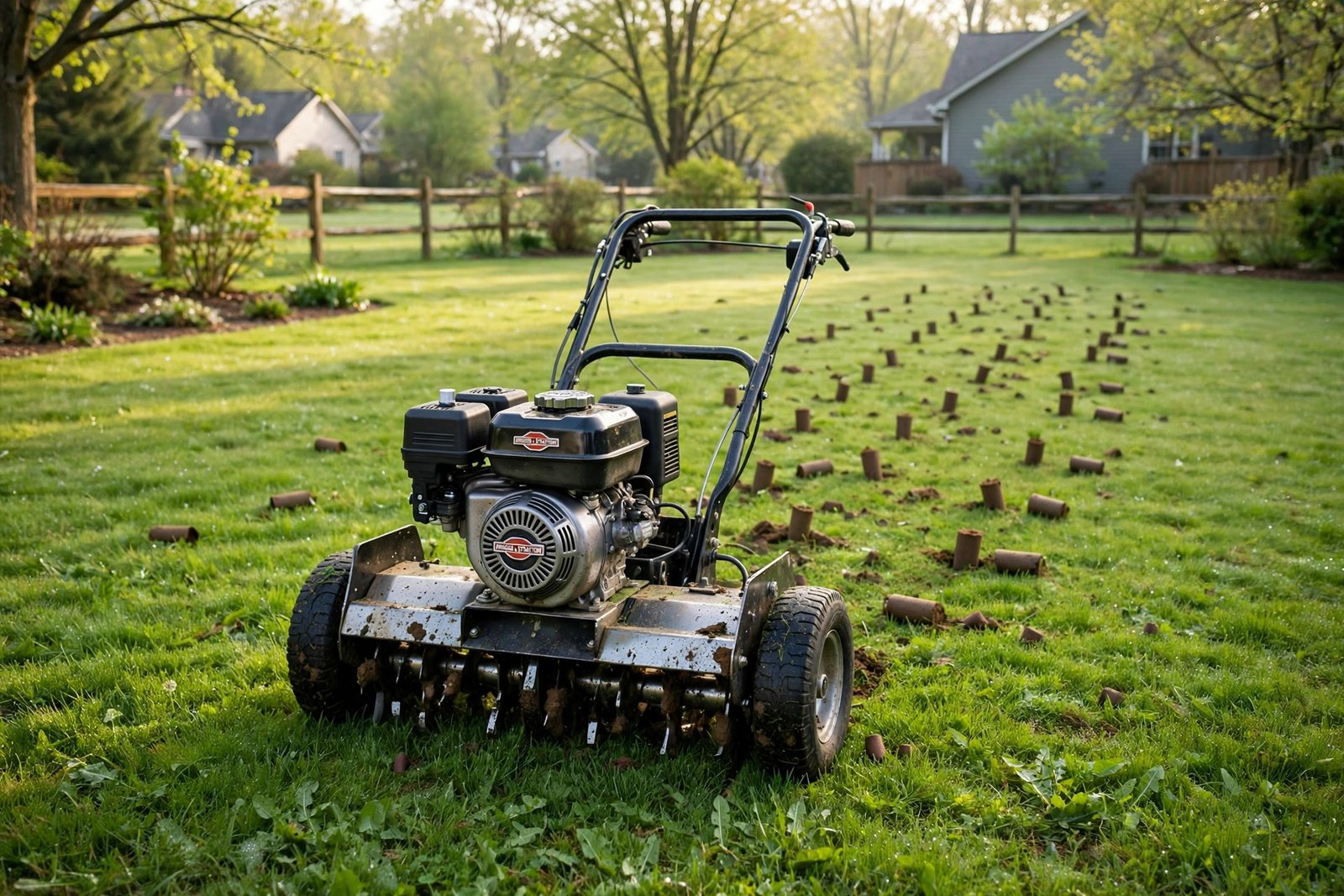
| Aerate | Late spring, once the lawn is fully green and growing hard — and before any pre-emergent goes down | Warm-season lawns: late spring, after green-up. Cool-season lawns: early spring works and fall is better — aerate before pre-emergent either way | Early spring, while cool-season grass is growing actively, with at least four good growing weeks ahead of it; fall remains the better window |
| Dethatch — only if thatch tops ½ inch | Spring, right after green-up, while the lawn is growing fast enough to fill back in | Warm-season lawns: after green-up. Cool-season lawns: hold for late summer into early fall, the season Extension picks for it | Not a spring job for cool-season lawns — late summer into early fall. In spring, just cut a wedge and measure the thatch |
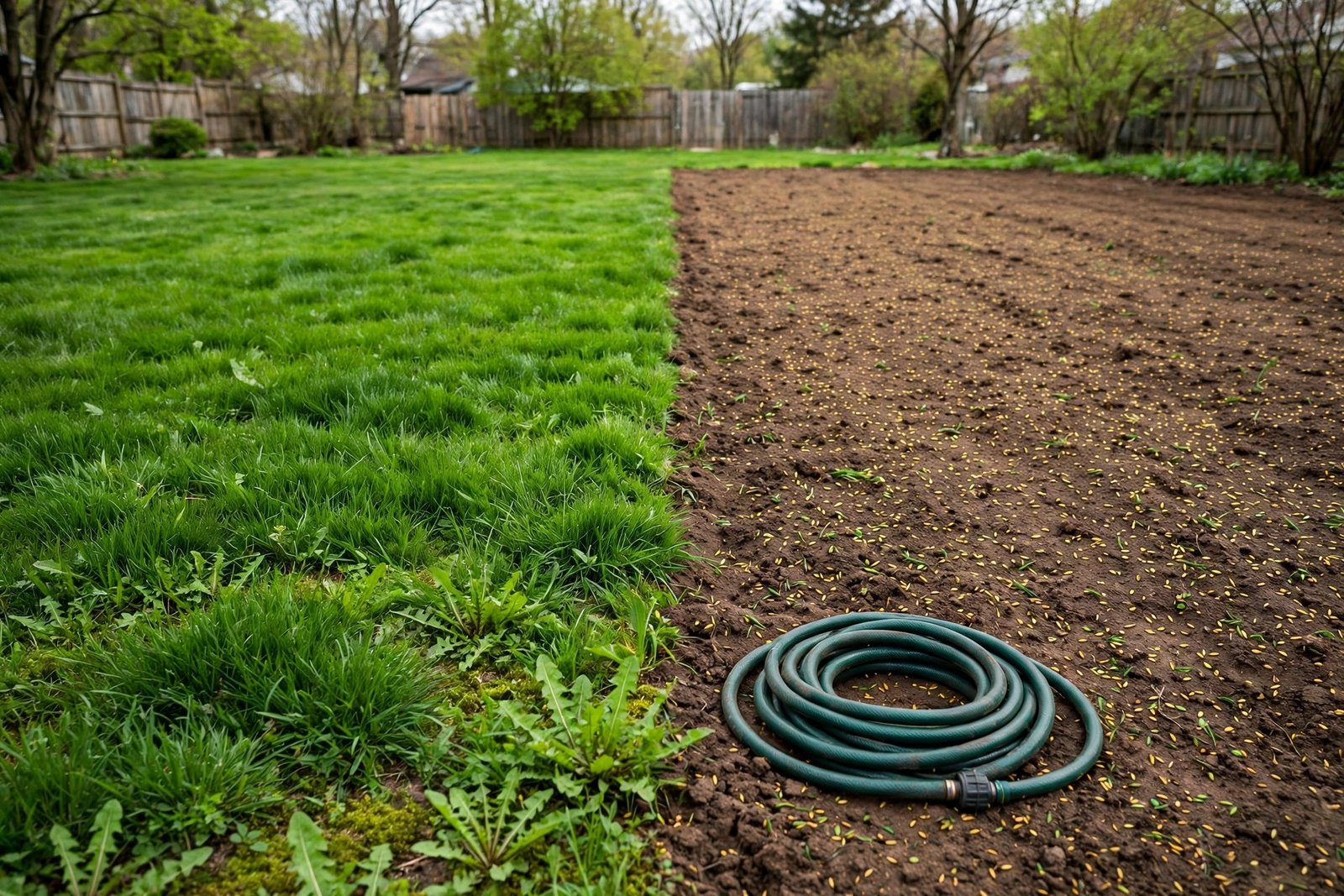
| Overseed a cool-season lawn | The exception — cool-season lawns are few here and their seeding season is fall; patch bare spots only | Early spring, where a repair cannot wait for fall — as soon as the soil can be worked and is warm enough for seed to sprout | Early spring as the ground opens up; seed dormant-sown over winter sprouts on the same warming |
| Fertilize a cool-season lawn | Upper-South fescue only: one light spring feeding for a weak lawn — a lawn fed in fall skips spring | Once the lawn is green and growing, lightly — and only if it was not fed last fall | After green-up, lightly. Fall is the main feeding of the year, and a fall-fed lawn can skip spring entirely |
| Fertilize a warm-season lawn | After full green-up — soil holding about 65°F, with nights staying above 60°F | After green-up completes, in late spring — never feed a half-awake lawn, because the winter weeds spend that nitrogen instead | Zoysia at the band’s warm edge: after green-up, which can run into late spring |
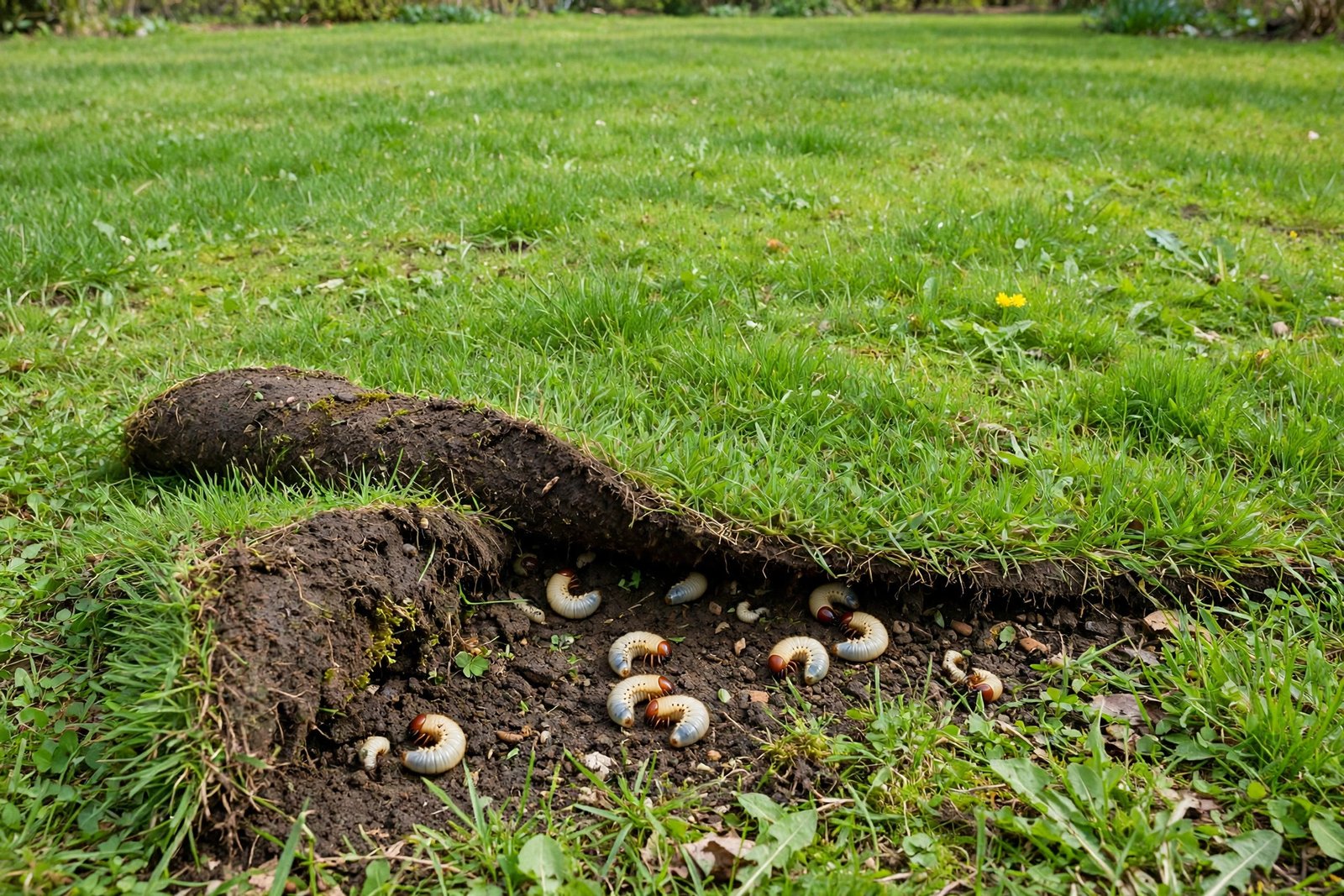
| Grub prevention | Early spring, ahead of the earliest egg hatch — chlorantraniliprole products are the ones made for the spring window | Spring, well before summer egg hatch; water the product in with at least ½ inch | Spring into early summer — in the North the window runs about May to early July |
| Irrigation start-up | Before the heavy watering season — run the four-step spruce-up: inspect, connect, direct, select | Once the hard freezes are past and regular watering is about to begin — the same four steps | After the last hard freeze, ahead of the first dry spell — the same four steps |
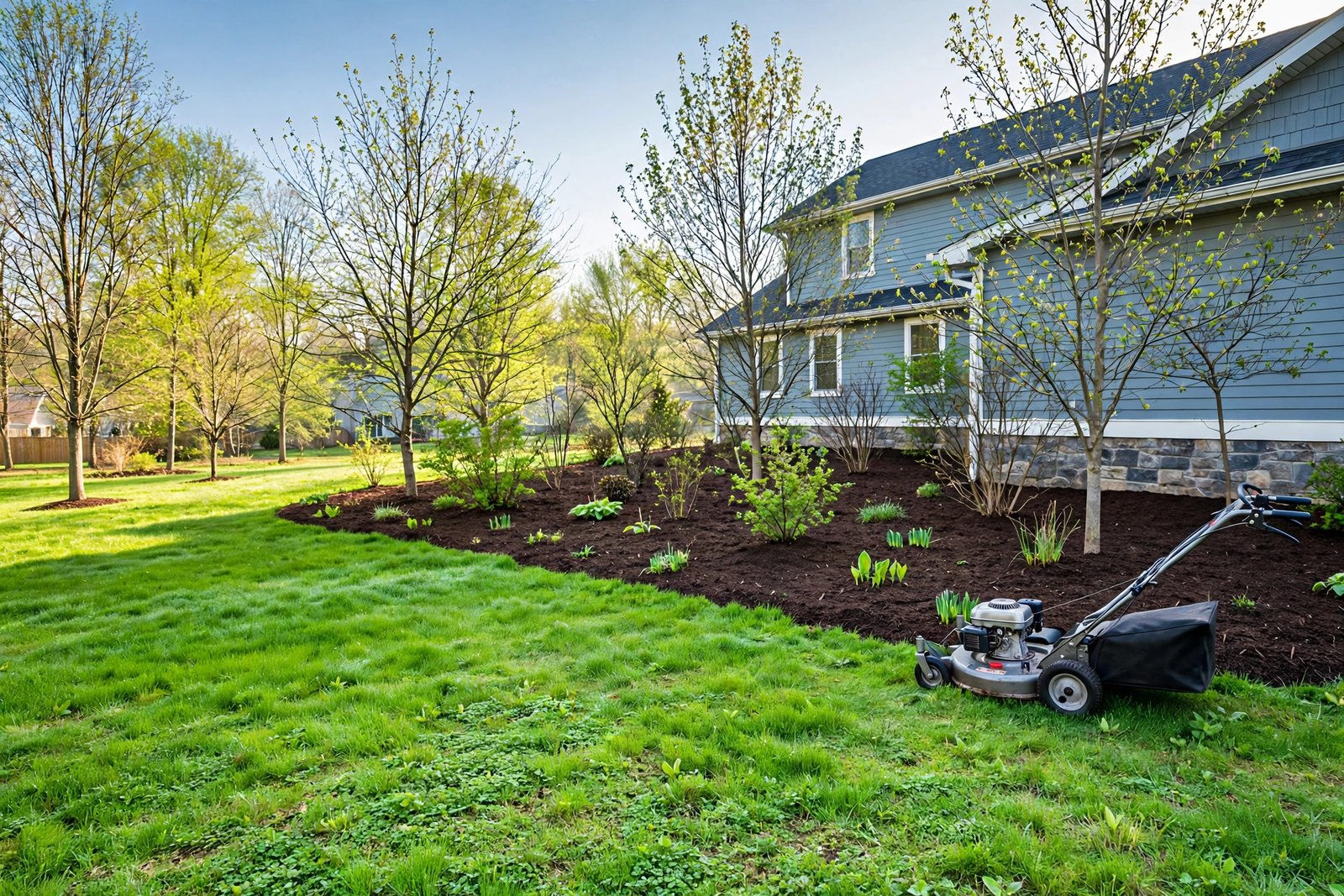
| Mulch refresh | Early spring, before weed seeds sprout — top beds back up to 2–3 inches | Early spring on the same cue — 2–3 inches of fine bark or wood mulch, kept 2–3 inches clear of stems | As the beds open up in spring — the same depths, and coarse bark nuggets can run to 4 inches |
Row sources: first mow — Iowa State University Extension. Pre-emergent — Michigan State University Extension, NC State Extension and Texas A&M AgriLife Extension. Aerate and dethatch — Clemson University Extension (HGIC). Overseed — Iowa State University Extension and University of Maryland Extension. Fertilize a cool-season lawn — University of Maryland Extension. Fertilize a warm-season lawn — Texas A&M AgriLife Extension. Grub prevention — University of Minnesota Extension. Irrigation start-up — U.S. EPA WaterSense. Mulch refresh — Clemson University Extension (HGIC 1604).
The order matters more than the dates
Three of these jobs collide if you sequence them carelessly. Aerating tears holes through a pre-emergent barrier, so Clemson University Extension’s order is firm: aerify first, and put the pre-emergent down afterward. Seed and pre-emergent cannot share ground at all, because the barrier stops grass seed along with the weed seed — so any patch you overseed this spring skips its pre-emergent, and any ground that gets pre-emergent waits for fall seed. Grub prevention is the one job on this list with a gate in front of it: the University of Minnesota Extension recommends it where grubs damaged the lawn last year or are expected to, not as a blanket ritual for every lawn.
One tool runs the whole calendar
A soil thermometer, read in the morning, calls most of these rows. Two inches down, it times the pre-emergent; four inches down, it confirms green-up in a warm-season lawn, which Texas A&M AgriLife puts at about 65°F once nights stay above 60°F. The fertilize rows above give timing only — the pounds per feeding for nine grasses are in Reference Table: When to Fertilize Cool-Season vs Warm-Season Lawns, the cool-season spring feeding is walked through step by step in Spring Secrets: When to Fertilize Your Cool-Season Lawn, and the pre-emergent rows have their own full table: When to Apply Pre-Emergent — Soil Temperature Timing by Grass Type.
Bottom line
Work the rows in order, on the lawn’s signals rather than the calendar’s, and spring stops being ten jobs at once. It becomes three or four good weekends, each task done in the stretch when it can actually take — and a lawn that goes into summer already ahead of the season.
Sources
Iowa State University Extension, “When Do I Start Mowing in Spring?” — https://yardandgarden.extension.iastate.edu/faq/when-do-i-start-mowing-spring — fetched November 14, 2026.
Iowa State University Extension, “Seeding a New Lawn” — https://yardandgarden.extension.iastate.edu/how-to/seeding-new-lawn — fetched November 14, 2026.
Michigan State University Extension, “Timing Crabgrass Preemergence Applications in Spring” (Kevin Frank) — https://www.canr.msu.edu/news/timing_crabgrass_pre_emergence_applications — fetched November 6, 2026.
NC State Extension, “When to Apply Preemergent Herbicides for Turfgrasses” (TurfFiles) — https://www.turffiles.ncsu.edu/news/when-to-apply-preemergent-herbicides-for-turfgrasses/ — fetched November 14, 2026.
Texas A&M AgriLife Extension, “Apply Fall Preemergence Herbicide to Avoid Spring Weeds” (AgriLife Today; Chrissie Segars) — https://agrilifetoday.tamu.edu/2020/09/23/apply-fall-preemergence-herbicide-to-avoid-spring-weeds/ — fetched November 14, 2026.
Texas A&M AgriLife Extension, “Suns Out, Fertilizer Out?” (ForageFax; Vanessa Corriher-Olson) — https://foragefax.tamu.edu/suns-out-fertilizer-out/ — fetched November 14, 2026.
Clemson University Extension (HGIC), “Aerating Lawns” — https://hgic.clemson.edu/factsheet/aerating-lawns/ — fetched November 14, 2026.
Clemson University Extension (HGIC), “Controlling Thatch in Lawns” — https://hgic.clemson.edu/factsheet/controlling-thatch-in-lawns/ — fetched November 14, 2026.
Clemson University Extension (HGIC 1604), “Mulch” — https://hgic.clemson.edu/factsheet/mulch/ — fetched November 14, 2026.
University of Maryland Extension, “Lawn Maintenance Calendar” — https://extension.umd.edu/resource/lawn-maintenance-calendar — fetched November 14, 2026.
University of Minnesota Extension, “White Grubs Threaten Minnesota Lawns: Identification and Treatment Tips” — https://extension.umn.edu/news/white-grubs-threaten-minnesota-lawns-identification-and-treatment-tips — fetched November 14, 2026.
U.S. Environmental Protection Agency, WaterSense, “Sprinkler Spruce-Up” — https://www.epa.gov/watersense/sprinkler-spruce-up — fetched November 14, 2026.