You ran the sprinkler until the lawn looked wet, shut it off feeling reasonably virtuous, and then wondered — as everyone does, standing there with the hose in hand — whether that was actually enough water, or just enough to feel like enough.
This calculator answers the gallon half of that question. Type in the size of the area and the depth of water you want to put on it, and it tells you how many gallons that depth really is, so you can check it against what your sprinkler or your water meter says you delivered.
Lawn watering volume calculator
Use the first choice before you water, and the second choice after — for example, when a meter or a tank tells you the gallons and you want the depth.
Measure length times width for each section and add the sections together. A quarter-acre lawn is about 10,900 square feet of ground in total, and the lawn itself is usually less once the house, drive, and beds come out.
One inch a week is the general rule for garden areas, lawns included. Lawns themselves run 1 to 1 1/2 inches a week. Subtract any rain that already fell this week before you type — the calculator converts the depth you still need to apply.
Use this only with the second choice above: the gallons your meter, tank, or bill says went onto the area.
To measure it, time how long your hose takes to fill a 5-gallon bucket, then divide 5 by the minutes. A hose that fills the bucket in about 2 minutes 26 seconds is delivering about 2.1 gallons per minute. If you enter a flow, the calculator also gives you a runtime.
What do I type in?
Start with the area, because every other number hangs off it. Pace or measure each lawn section, multiply length by width, and add the pieces together rather than guessing from the lot size on a listing, which counts the house and driveway as if they needed watering too.
Then type the depth you still need to apply. If the week has already brought half an inch of rain and your target is an inch, the depth to type is half an inch — rain that already fell is water the lawn already has, and watering on top of it to the full inch is how lawns get soggy and shallow-rooted.
What does the number mean?
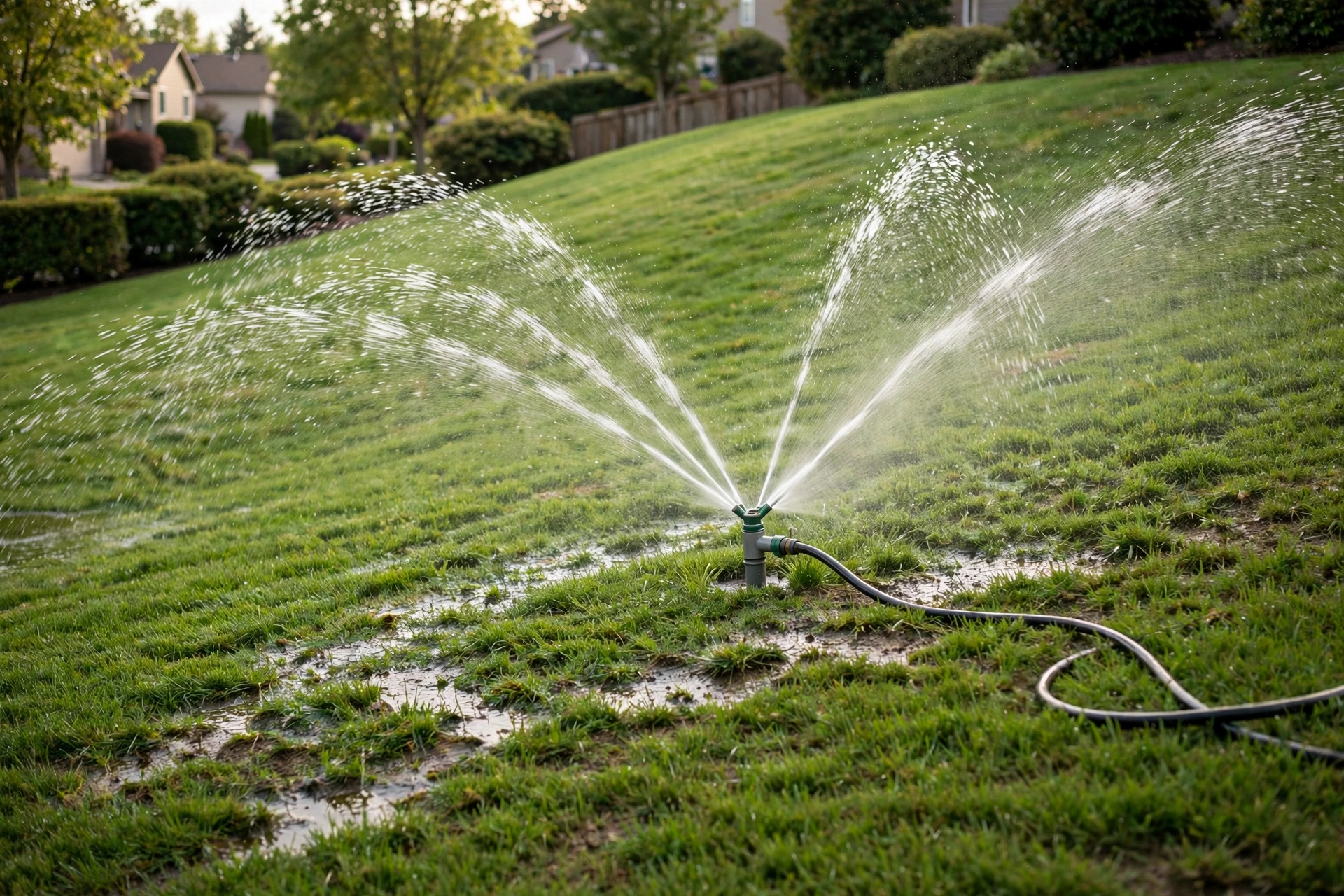
The answer is the net water that needs to reach the soil — the gallons that have to land on the lawn and soak in. What a sprinkler throws will always be somewhat more, because wind and evaporation take a share before the water lands, which is why the honest check is measuring what actually arrives. Set two or three rain gauges inside the spray pattern while you water, and read the depth they catch. Our sprinkler catch-can calculator turns that kind of measurement into a rate and a runtime.
Early morning, between about 5 and 9 a.m., is when the most water reaches the roots: the air is calm, evaporation is low, and the grass dries quickly afterward. Midday watering loses the most to evaporation and wind, and evening watering leaves the lawn wet overnight, which invites disease.
How the math works
The calculator multiplies your area by your depth, then by 0.623 — the gallons it takes to cover one square foot with one inch of water. That is the whole formula, and it is why the numbers get big so quickly: a modest 5,000-square-foot lawn at one inch is already 3,115 gallons.
Running it backward, the calculator divides your gallons by your area and then by the same 0.623, which gives the depth those gallons actually delivered. The runtime is simpler still: gallons divided by your flow rate in gallons per minute gives minutes.
Worked examples
A thousand square feet at one inch. 1,000 × 1 × 0.623 = 623 gallons. This is the figure to keep in your head: every inch on every thousand square feet costs about 623 gallons.
A newly planted tree. A root zone of 16 square feet at one inch needs 16 × 0.623 = 9.97 gallons — call it 10 gallons, delivered slowly enough to soak in rather than run off.
A 5,000-square-foot lawn at one inch. 5,000 × 1 × 0.623 = 3,115 gallons. With the factor rounded to 0.62, the same watering is 3,100 gallons — the same answer at a coarser rounding, which is why either figure checks out against the other.
How long with a hose. Those 9.97 gallons for the tree, from a hose delivering 2.1 gallons per minute, take 9.97 ÷ 2.1 = 4.7 minutes — about 4 minutes 42 seconds.
Gallons by lawn size and depth
| Area | 1/2 inch | 1 inch | 1 1/2 inches |
|---|---|---|---|
| 1,000 sq ft | 312 gal | 623 gal | 935 gal |
| 2,500 sq ft | 779 gal | 1,558 gal | 2,336 gal |
| 5,000 sq ft | 1,558 gal | 3,115 gal | 4,673 gal |
| 7,500 sq ft | 2,336 gal | 4,673 gal | 7,009 gal |
| 10,000 sq ft | 3,115 gal | 6,230 gal | 9,345 gal |
One more check for big lawns: an acre is 43,560 square feet, and one inch on an acre comes to about 27,138 gallons with the 0.623 factor. The exact conversion works out to 27,154 gallons, so the rounded factor lands within a fraction of a percent.
How much water does a lawn want each week?
About an inch a week is the general rule for garden areas, and lawns sit at 1 to 1 1/2 inches a week. Put that amount down in one application, or split it into two applications three or four days apart — deep and infrequent beats a light daily sprinkle, which keeps roots hovering at the surface where the heat finds them first.
A lawn that has gone dormant in a dry summer can usually ride out four to six weeks, and when you do water a dormant lawn, give it 1 to 1 1/2 inches in a single application and repeat a week later to bring it back green. Whether to water before or after other lawn work matters too — see whether to water before or after aerating for the timing that surrounds this math.
What this calculator does not do
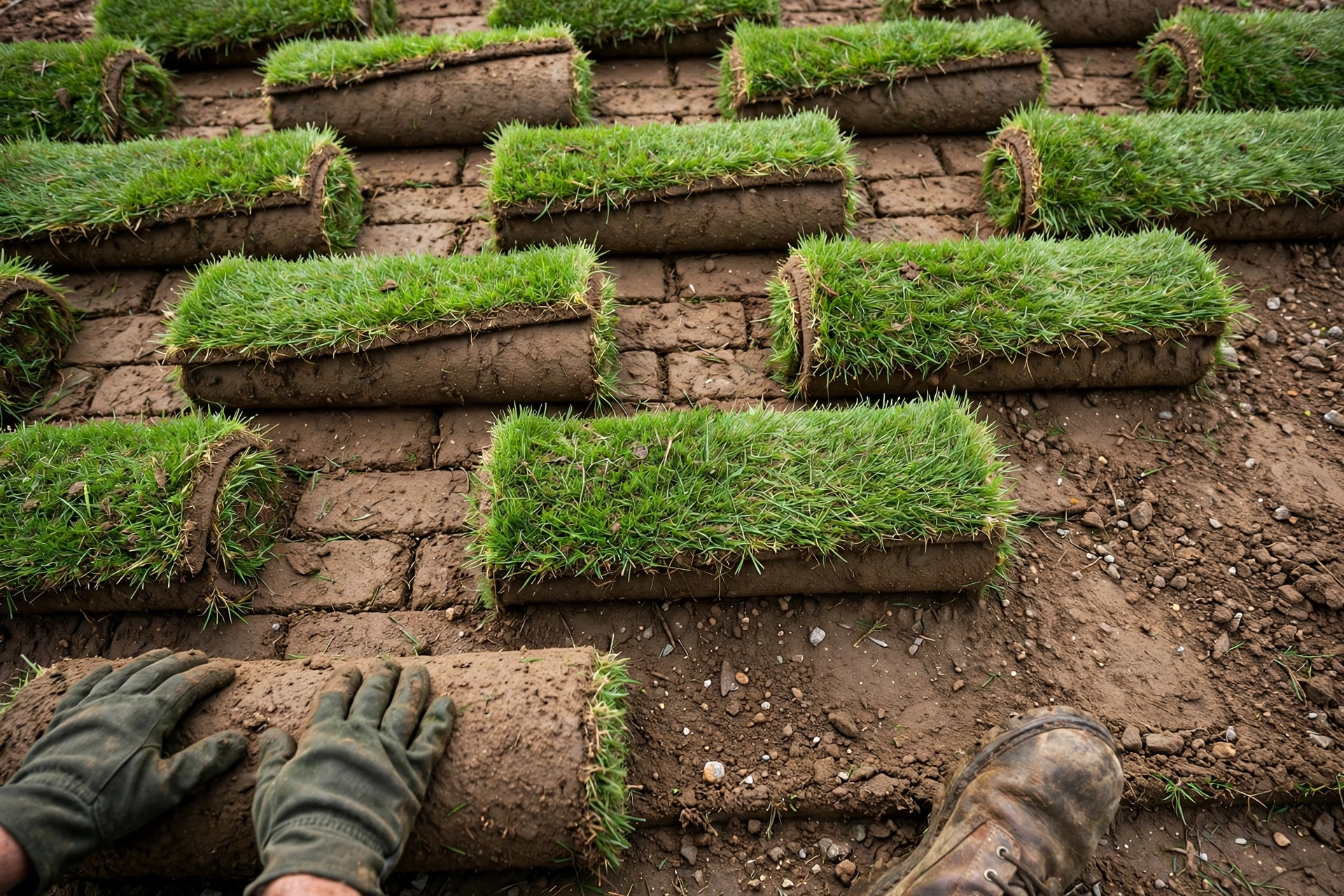
This calculator turns a depth and an area into gallons — it does not adjust that depth for your soil, slope, grass type, shade, or weather, and it does not tell you how often your lawn needs watering. New seed and new sod are also a different job: they want frequent, light waterings that keep the top inch of soil moist, once or twice a day, which is the opposite of the deep weekly soaking this page is about. For watering through drip lines instead of sprinklers, the drip irrigation runtime calculator works the same question from your emitters.
Sources
Iowa State University Extension and Outreach, “How do I determine how much water to use when watering my garden plants?” — fetched in full Nov 13, 2026 and re-fetched Nov 16, 2026: https://yardandgarden.extension.iastate.edu/faq/how-do-i-determine-how-much-water-use-when-watering-my-garden-plants
Iowa State University Extension and Outreach, “Watering Home Lawns” (published Jun 8, 2022; updated Jul 14, 2026) — fetched in full Nov 13, 2026 and re-fetched Nov 16, 2026: https://yardandgarden.extension.iastate.edu/how-to/watering-home-lawns
K-State Research and Extension, Riley County, “Cost of One Inch of Manhattan Water Applied to Your Lawn” (PDF) — fetched in full Nov 13, 2026: https://www.riley.k-state.edu/docs/lawnandgardenandother/Cost%20of%20One%20Inch%20of%20Manhattan%20Water%20Applied%20to%20Your%20Lawn.pdf