You have measured the yard twice, the sod farm is asking how many pallets, and the difference between one pallet too few and one too many is a second delivery fee or a pallet wilting in the driveway — this is the arithmetic that settles it before you order.
This calculator works out how much sod to order: your lawn area, plus a little extra for cutting, turned into pallets and pieces in the sizes your farm actually sells. Enter your numbers, and it does the rounding up for you, because sod is sold whole.
Sod coverage calculator
Measure length times width, and subtract your house, driveway, and beds. For an uneven lawn, measure it in rectangles and add them together.
5% suits straight edges. Use 10% when the lawn curves around beds and trees, because every curve costs cut-off pieces.
Ask your farm — pallet sizes are not standard. A typical pallet holds 450 to 500 square feet, and pallets across farms run from about 400 to 700 square feet.
A common roll is 2 feet by 5 feet, which is 10 square feet. A common slab is 16 inches by 24 inches, which is about 2.67 square feet. Confirm your farm’s piece size.
Your browser has JavaScript turned off, so the calculator cannot run. The tables and worked examples below give you the same answers by hand.
What your numbers mean
The order area is your lawn plus the cutting extra, rounded to a whole square foot. Pallets and pieces are always rounded up, because a farm will not sell you nine-tenths of a pallet, and running short with half the lawn down is worse than having a few pieces left for patching thin spots.
The leftover figure tells you how much of your last pallet is spare. When more than half of that last pallet is spare, ask the farm whether it sells partial pallets or loose pieces — many do, and the leftover number is exactly what to ask about.
Two delivery notes belong with every result. A 450-square-foot pallet can weigh as much as a ton, so plan for the truck to place pallets close to the work, not for carrying sod across the yard. And sod needs to go down within 48 hours of delivery, sooner in summer heat, so finish your soil preparation before the truck comes, not after.
How the math works
The calculator takes your lawn area and adds your cutting extra to get the order area. It divides the order area by your pallet size and rounds up to whole pallets, then does the same division with your piece size for a piece count. It also turns the order area into square yards — one square yard is 9 square feet — because some farms sell by the yard.
Worked examples
A 1,000-square-foot lawn, 5% extra, 450 square feet to a pallet, 10-square-foot rolls. Order area is 1,000 times 1.05, which is 1,050 square feet. Pallets: 1,050 divided by 450 is 2.33, rounded up to 3 pallets, with 300 square feet spare on the last pallet. Rolls: 1,050 divided by 10 is 105 rolls. In square yards, 1,050 divided by 9 is 116.7.
A 5,000-square-foot lawn, 10% extra, 500 square feet to a pallet. Order area is 5,500 square feet. Pallets: 5,500 divided by 500 is exactly 11 pallets, with nothing spare. Rolls at 10 square feet each: 550.
The same 1,000-square-foot lawn in slabs. At 2.67 square feet a slab, 1,050 divided by 2.67 is 393.26, rounded up to 394 slabs.
Coverage table
| Lawn | Order at 5% | Order at 10% | Pallets at 450 | Pallets at 500 |
|---|---|---|---|---|
| 500 sq ft | 525 sq ft | 550 sq ft | 2 / 2 | 2 / 2 |
| 1,000 sq ft | 1,050 sq ft | 1,100 sq ft | 3 / 3 | 3 / 3 |
| 2,500 sq ft | 2,625 sq ft | 2,750 sq ft | 6 / 7 | 6 / 6 |
| 5,000 sq ft | 5,250 sq ft | 5,500 sq ft | 12 / 13 | 11 / 11 |
| 10,000 sq ft | 10,500 sq ft | 11,000 sq ft | 24 / 25 | 21 / 22 |
In the pallet columns, the first number is the count at 5% extra and the second is the count at 10% extra, each rounded up.
Measuring and laying, in brief
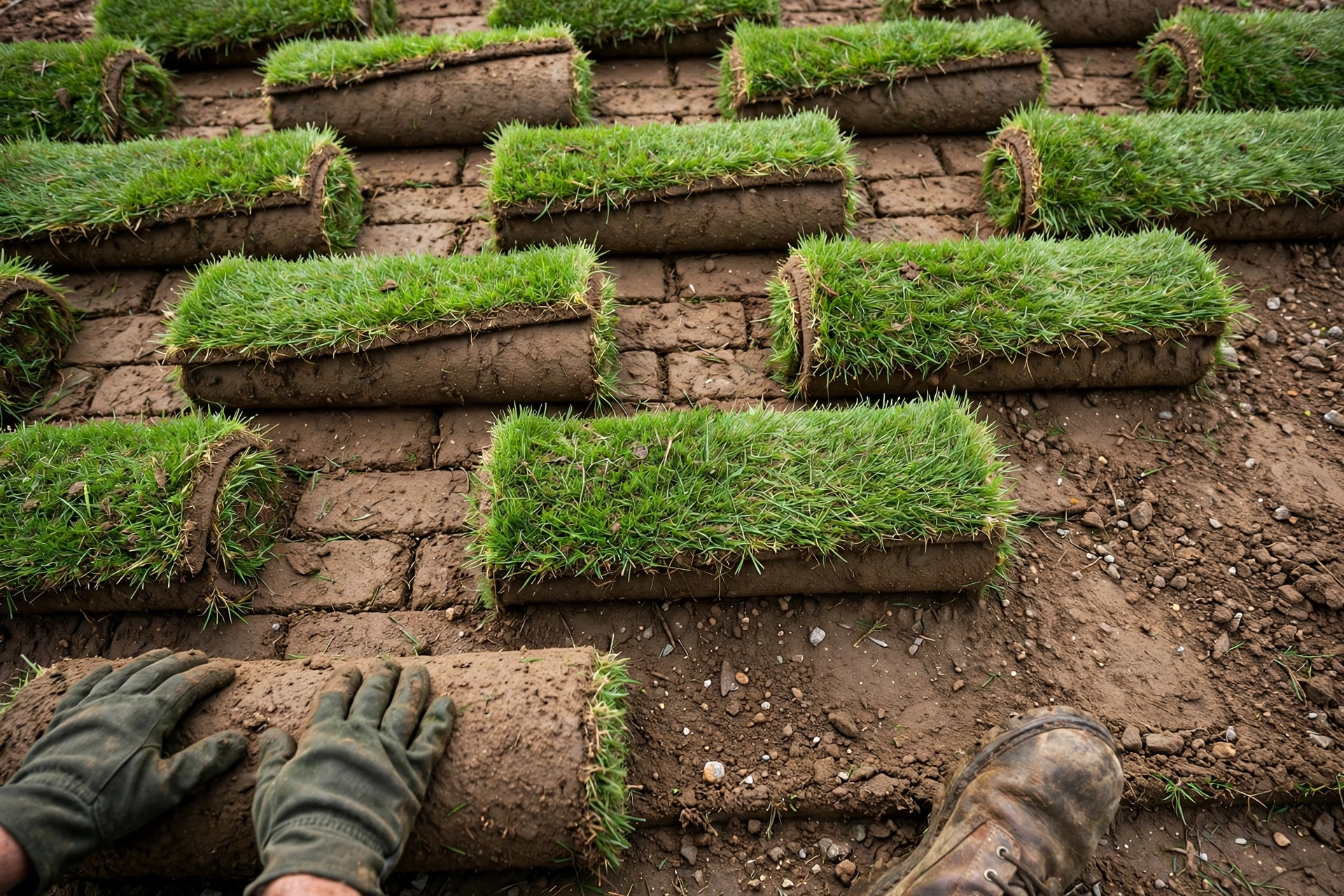
Measure with a tape or a measuring wheel, and subtract the house and any non-turf landscaping from the total. Lay pieces in a staggered brick pattern so the seams offset from row to row, butt the edges tight without overlapping, and do not stretch the sod — it shrinks as it dries and stretched pieces leave gaps. Roll or tamp the finished lawn to settle it against the soil, then water it deeply right away.
One square yard of sod can also be cut into about 324 two-inch plugs, or into about one bushel of sprigs, if you are patching rather than sodding whole. Those conversions belong to plug and sprig jobs, which this calculator does not figure — it orders sod, in pallets and pieces.
What this calculator does not do
This tells you how much sod to order — not which grass to choose, how to prepare the soil, or what the job will cost. It does not price sod, because prices are your farm’s to quote, and it cannot know your farm’s pallet size until you type it in.
For the jobs around this one, see the grass seed calculator if you are comparing sod with seed, and the tall fescue seeding rate calculator for transition-zone lawns.
Sources
- Mississippi State University Extension Service, “Sod Installation and Maintenance,” Publication 2951 — https://extension.msstate.edu/publications/sod-installation-and-maintenance (fetched in full November 14, 2026)
- UF/IFAS Extension, “Establishing Your Florida Lawn,” ENH-03/LH013 — https://edis.ifas.ufl.edu/publication/LH013 (fetched in full November 14, 2026)
- Clemson Cooperative Extension, “Lawn Establishment,” HGIC 1203 — https://hgic.clemson.edu/factsheet/lawn-establishment/ (fetched in full November 14, 2026)