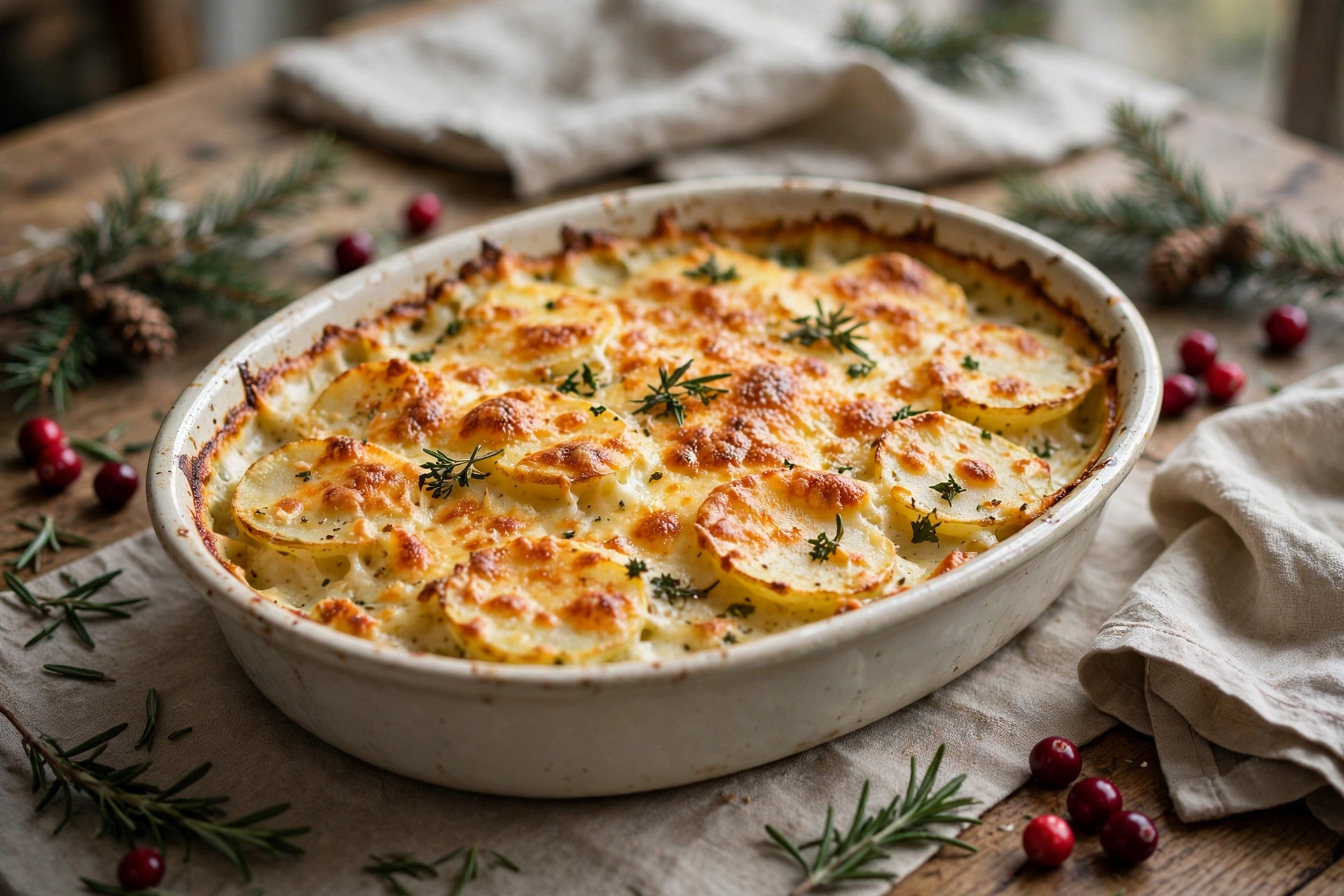
The top of the dish tells the whole story before a spoon goes in. Gruyere melted into browned ridges, cream bubbling up between the layers at the edges, and the thyme leaves darkened against the pale potatoes underneath.
Scalloped potatoes live or die on slice thickness, and this version holds every slice to 1/8 inch so the layers finish at the same time. The dish is built for a table where a rich side has real work to do, next to a roast or a glazed ham, and it needs to arrive tender all the way through rather than crisp on top and firm in the middle.
Why 1/8 Inch Is the Number
A slice thicker than 1/8 inch needs more time than the cream can give it before the top over-browns. A thinner slice dissolves into the sauce and loses the layered look that makes the dish worth building in the first place.
At 1/8 inch, a russet or Yukon Gold slice turns fork-tender in about an hour at 375F while still holding its shape in the layer. That single measurement does more for the finished dish than any extra cheese on top.
Cut the slices as evenly as patience allows, and set aside any very thick end pieces for another use. One thick slice in a layer is the slice that stays firm when everything around it is done.
Choosing the Potatoes and Cheese
Russets give the softest layers because their starch thickens the cream as the dish bakes. Yukon Golds hold a slightly firmer slice and bring a yellower color, and either one works in this dish without changing the method.
Gruyere is the cheese to use here, full stop. It melts smoothly into cream without turning stringy, and its flavor stands up to garlic and thyme instead of disappearing under them.
Grate the Gruyere on the large holes of a box grater rather than buying it pre-shredded. Pre-shredded cheese is coated to keep it from clumping in the bag, and that coating can keep it from melting evenly into the layers.
Building Layers That Cook Evenly
Warm the cream and milk with the garlic before the dish is assembled. Cold cream poured over cold potatoes adds a long stretch to the bake, while warmed cream starts the cooking the moment the dish goes into the oven.
Overlap the slices in each layer like shingles, covering the slice before it by about half. Gaps left between slices fill with cream and bake up as sauce pockets instead of potato, so a tight overlap is what gives the dish its clean layers when served.
Season each layer as it is built, not just the top. Salt and thyme only on the surface leave the middle layers plain, and no amount of seasoning at the table fixes a bland center.

Scalloped Potatoes with Gruyere and Thyme
Ingredients
Method
- Heat the oven and prepare the dish. Heat the oven to 375F. Rub a 9×13-inch baking dish or 2-quart baking dish with the butter.
- Warm the cream. Combine the cream, milk, garlic, and nutmeg in a saucepan over medium heat and warm for about 5 minutes, until steaming but not boiling. Remove from the heat.
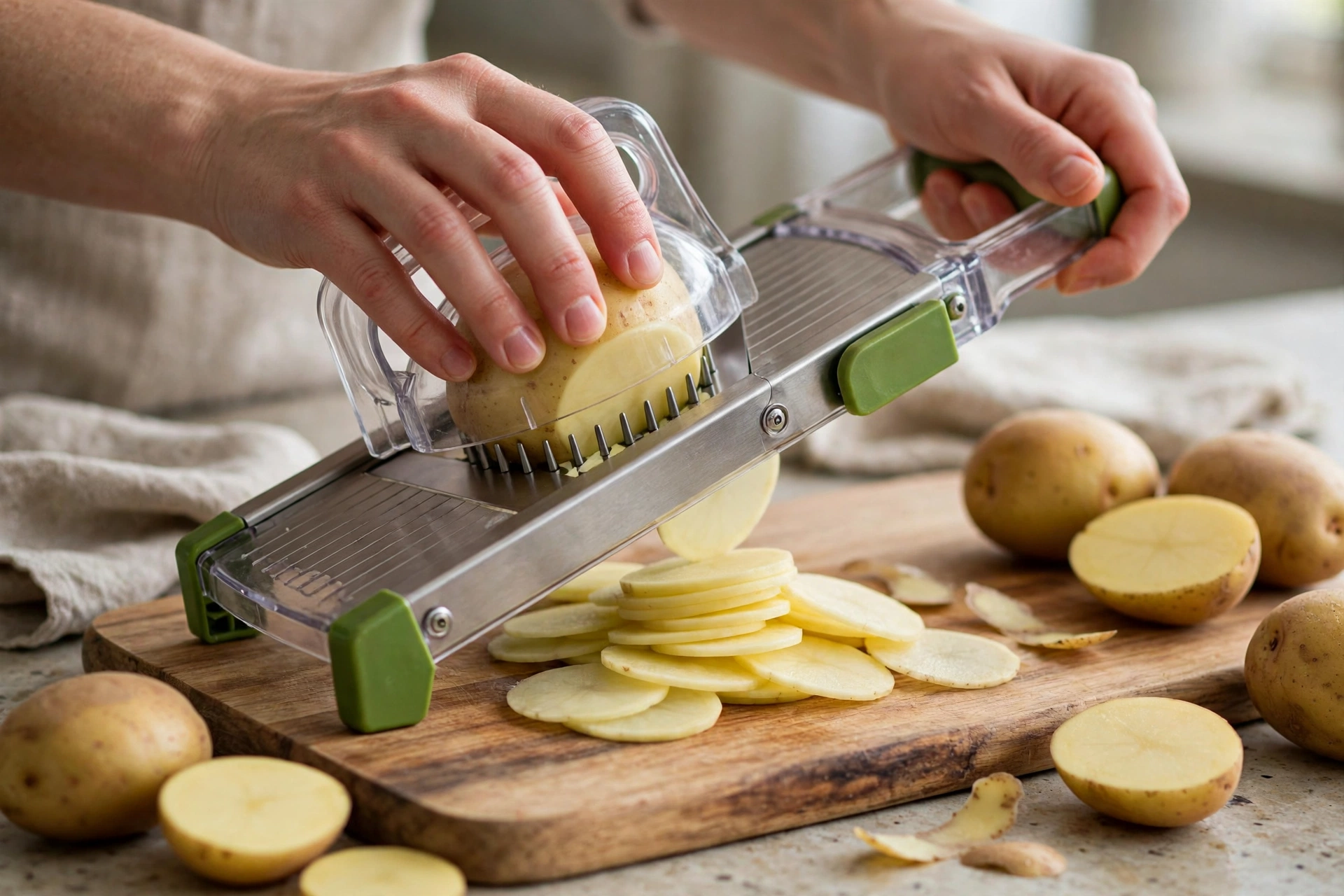
- Slice the potatoes. Peel the potatoes and slice them 1/8 inch thick with a knife, mandoline with its guard, or food processor slicing disc. Keep the slices as even as possible.
- Build the first layer. Arrange a third of the slices in the dish, overlapping by about half. Sprinkle with a third of the salt, pepper, and thyme, then a third of the Gruyere. Pour over a third of the warm cream mixture.
- Repeat the layers. Repeat step 4 twice more, finishing with Gruyere and a few extra thyme leaves on top.
- Bake covered. Cover the dish tightly with foil and bake at 375F for 40 minutes, until the potatoes are starting to soften.
- Bake uncovered. Remove the foil and bake for 25 to 30 minutes more, until the top is golden and a knife slides through the center layers with almost no resistance.
- Rest before serving. Rest for 15 minutes so the cream settles into the layers, then serve warm.
Covered First, Then Uncovered
The foil matters for the first stretch of the bake. Covered, the potatoes steam in the cream and soften through; uncovered for the last stretch, the top dries enough to brown and the Gruyere turns golden at the ridges.
Steam escapes in a rush when the foil comes off, so lift the far edge away first. The dish will look loose at that point, with cream still moving between the layers, and that looseness tightens as the uncovered bake finishes.
Test doneness in the center of the dish, not at the edge. A knife should slide through the middle layers with almost no resistance, because the edges always finish ahead of the center in a dish this dense.
Resting and Serving
Rest the dish for 15 minutes before serving. That rest lets the cream settle into the layers so a spoonful holds together on the plate instead of sliding apart in a pool of sauce.
The dish suits the same table as Turkey Meatloaf with Cranberry Glaze and a bright counterpoint like Cranberry Orange Relish, where the richness needs something sharp beside it. For a holiday spread it also sits comfortably next to Sweet Potato Casserole with Pecan Topping, one savory and one sweet.
Make Ahead and Leftovers
Assemble the dish up to a day ahead, cover it tightly, and refrigerate it unbaked. Add 10 minutes to the covered bake when it goes into the oven cold, and check the center with a knife before uncovering it.
Leftovers keep in the refrigerator for up to 3 days. Reheat a portion in a 350F oven, covered, for about 20 minutes, until the cream bubbles at the edges again; the microwave softens the top and is the weaker choice for this one.
Serve this version when the meal calls for a potato dish that can hold its place in the center of the table. It is the scalloped potato to build for a roast dinner, with the slices cut even and the Gruyere grated fresh.