This post contains affiliate links. If you buy through them, we may earn a commission at no extra cost to you.
The most common mistake in a pan of scalloped potatoes happens before the dish ever reaches the oven. Slices cut thick at one end and thin at the other bake at different rates, so the thin pieces fall apart while the thick pieces stay firm in the center.
Even slicing is a short skill with a clear target: 1/8 inch, the same from the first slice to the last. It is the step that makes Scalloped Potatoes with Gruyere and Thyme cook through in cream without a raw layer hiding in the middle.
Why Even 1/8-Inch Slices Matter
A gratin cooks from the edges inward, and the cream can only soften a slice as fast as heat reaches its center. A 1/4-inch slice needs substantially longer than a 1/8-inch slice sitting right beside it, and the oven cannot split that difference.
At 1/8 inch, slices also overlap neatly and settle into flat layers. Thicker, uneven slices prop each other up at angles, leaving pockets where cream pools instead of coating the potato.
The practical test is simple. Hold a finished slice up beside a ruler or the edge of a knife blade: 1/8 inch is about the thickness of two stacked quarters, thin enough to bend slightly without snapping.
The Mandoline, With the Guard Every Time
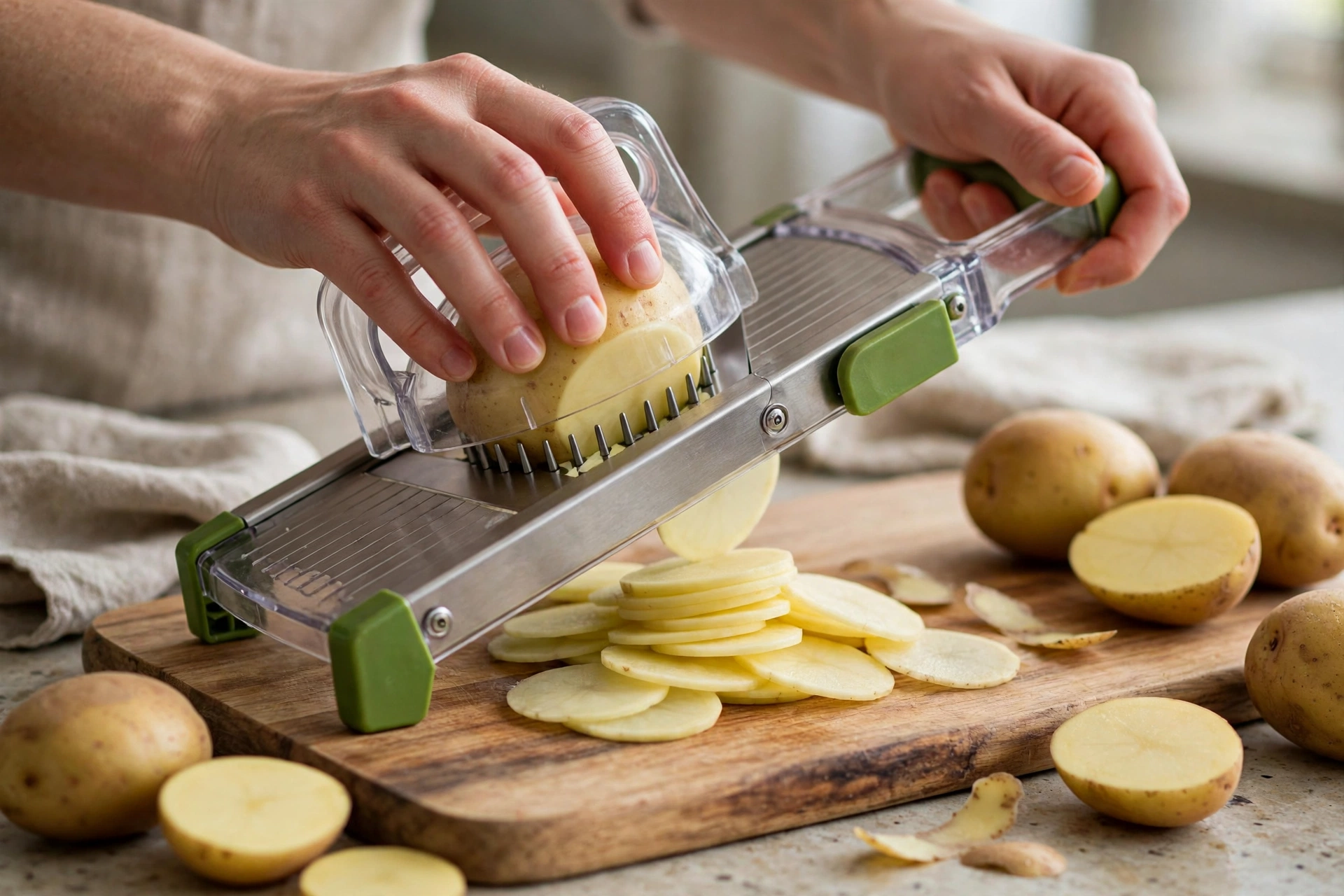
A mandoline is the fastest route to uniform slices because the blade height stays fixed while the potato moves. Set the dial or blade to 1/8 inch, run a test slice, and measure that first slice before cutting the rest of the batch.
Use the guard or food holder for the whole potato, not just the last piece. The guard keeps pressure even, which keeps thickness even, and it keeps fingers clear of a blade that stays sharp across the full pass.
Work with steady, full strokes rather than short sawing motions. A short stroke changes pressure mid-slice, and that pressure change shows up as a wedge that is thin at one edge and thick at the other.
Benriner Japanese Vegetable Slicer
Adjustable blade for even slices from fine to medium, with a safety guard for the last piece of each potato.
The Food Processor Slicing Disc
A food processor with a slicing disc cuts a whole batch in minutes, and the disc fixes the thickness so slices come out uniform by design. Choose the disc closest to 1/8 inch (about 3 mm) when the machine offers more than one.
Trim the potatoes so they fit the feed tube snugly, because a potato rattling loose in a wide tube tilts as it cuts. A tilted potato gives diagonal slices that are thick on one side, which is the exact problem the disc was meant to solve.
Use steady, moderate pressure on the pusher. Forcing the potato through flexes the disc and thickens the slice, while too little pressure lets it bounce and shave off thin scraps.
The Knife Method: Flat Side Down, Knuckle as Guide
A knife works fine for a small batch, and the setup matters more than speed. Cut a thin slab off one long side of the peeled potato first, then set the potato on that flat cut so it cannot roll while the knife works.
Curl the fingertips of the guiding hand inward and rest the flat of the blade against those knuckles. The knuckles set the spacing as the hand walks backward, slice by slice, and the blade rides against them at the same point every time.
Aim for slices that match the two-quarters check, and sort as you go. Pull any slice that is visibly thicker than the rest and trim it down, or set it aside for a use where thickness does not matter, such as a soup like Creamy White Bean Soup with Rosemary and Parmesan.
The counter holds a small offcut pile by the end of a careful batch, and that pile is a good sign. It means the thick pieces were caught at the board instead of being found, still firm, at the table.
Checking Thickness as You Work
Check the first slice, a middle slice, and the last slice from each potato. Thickness drifts as hands tire or a mandoline dial gets nudged, and a three-point check catches the drift while the batch can still be corrected.
Stack ten finished slices and measure the stack if a single slice is hard to judge. Ten slices at 1/8 inch stack to 1 1/4 inches, a measurement any ruler confirms in seconds.
Holding Slices in Water, Then Drying Them
A brief hold in cold water keeps cut slices from browning while the rest of the batch is finished, and it rinses off surface starch that can make layers stick in clumps. Keep the hold brief, about 30 minutes at most, so the slices do not take on water.
Dry the slices before they go into a gratin. Spread them on a clean towel or run them through a salad spinner, because water clinging to the slices thins the cream and leaves the finished dish loose.
For slicing work on other vegetables, the same flat-side and guide-hand habits carry over from How to Cut Delicata Squash, where a stable base matters just as much. For potatoes headed into the oven, pick the mandoline for a full 9×13 dish and the knife for a small one, and hold every slice to the same 1/8-inch check either way.