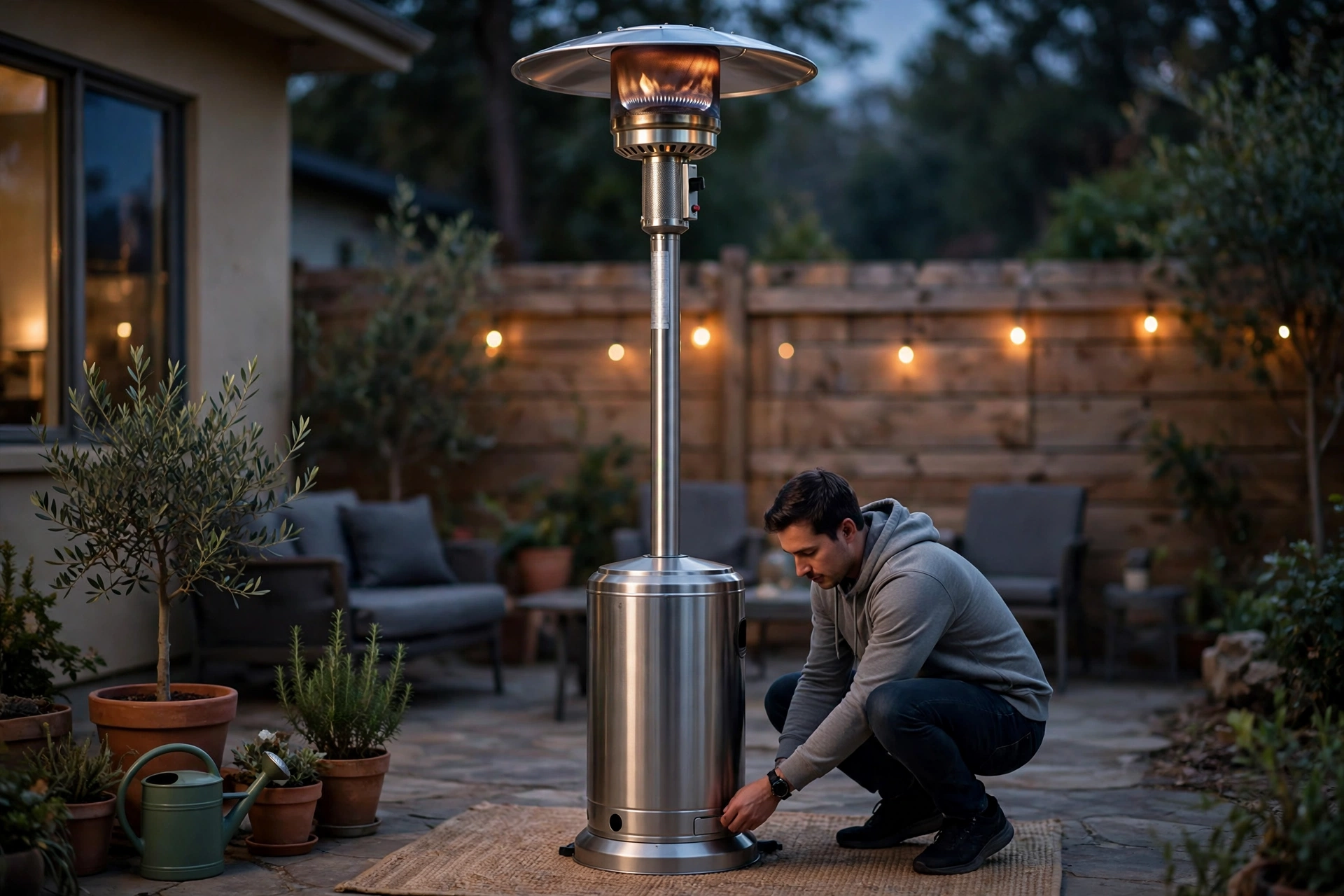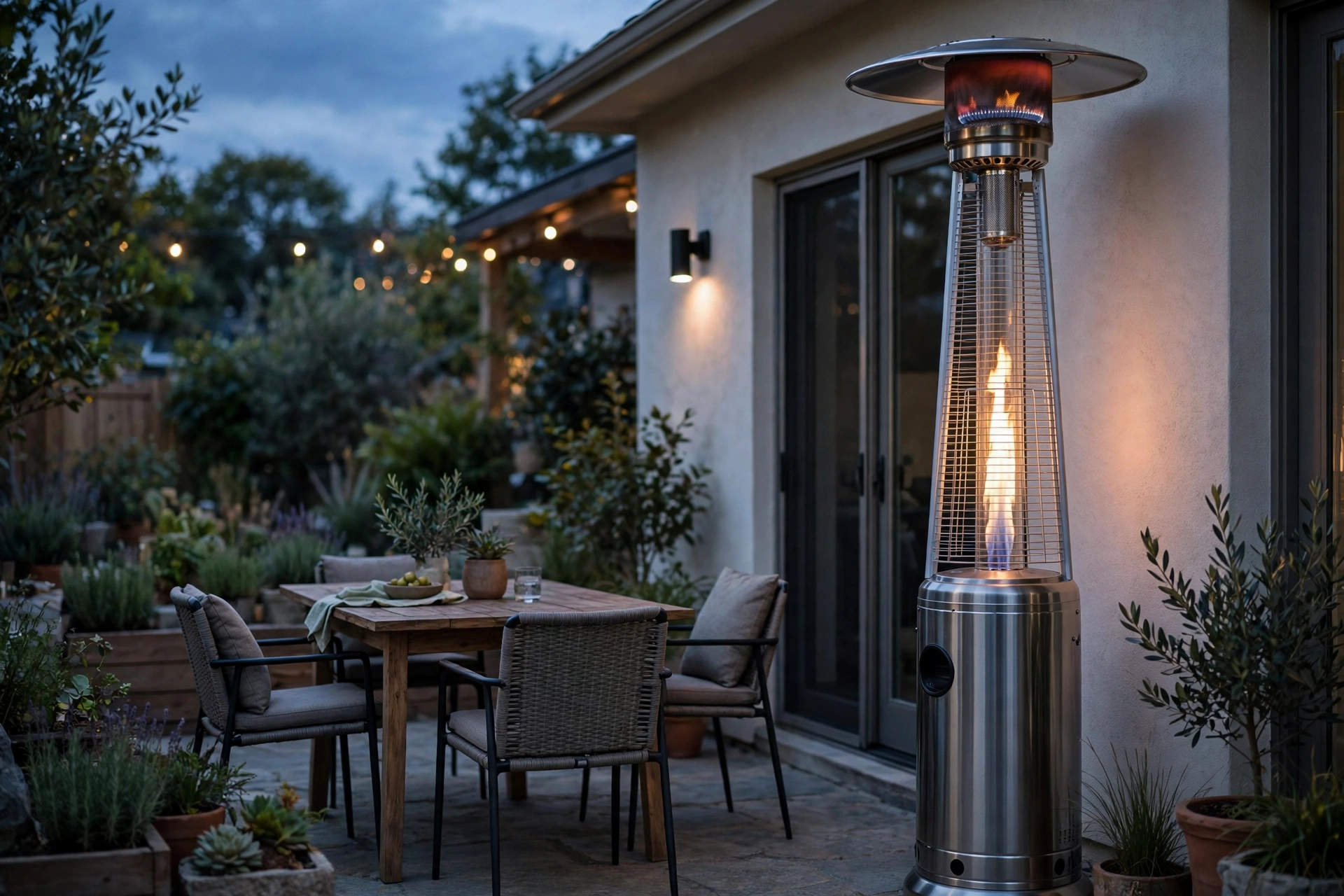
How far does a patio heater need to sit from the house wall? The short answer is three feet, and it is worth knowing exactly what that three feet is measured from, because the heater’s hot parts are not where most people assume.
A freestanding propane heater throws heat in every direction from a burner and reflector that sit seven or eight feet in the air. The wall clearance protects your siding from that radiant heat over a whole evening, and it is the single placement rule that decides where on a patio the heater can stand.
The Rule: 36 Inches From Combustibles
CSA-certified freestanding patio heater manuals set the minimum clearance to combustible materials at 36 inches (3 feet) from the sides of the unit. Combustible means more than a wood fence: vinyl siding, a wood deck rail, curtains on an open slider, stacked cushions, and paper or cardboard stored nearby all count.
Measure from the widest, hottest part of the heater (the reflector and emitter screen) to the surface, not from the base or the tank housing. The base can sit closer to the wall than the reflector does on a leaning unit, which is one more reason the heater belongs on a hard, level surface.
Overhead Clearance Is a Separate Number
The top clearance in those same manuals runs larger than the side clearance (up to 5 feet on some models, 2 to 3 feet on others), because heat rises straight off the reflector. Your model’s manual is the governing figure for the top; the side figure of 36 inches is consistent across brands. If the manual is gone, use 36 inches on the sides and treat any ceiling, eave, or pergola beam as needing the generous end of the range, or keep the heater out from under it entirely. Our guide to using a patio heater under a covered patio or pergola works through the covered cases.
Why Vinyl Siding Gets Extra Respect
Vinyl siding softens and can warp at temperatures well below ignition, around 160°F, long before anything is in danger of catching fire. A heater can be fully legal at 36 inches and still leave a wavy panel behind it after a season of evenings in the same spot. If your wall is vinyl, give it a fourth foot and rotate the heater’s position through the season.
Brick, stone, and fiber-cement siding tolerate heat far better. The 36-inch rule still applies (it also protects paint, trim, and anything stored against the wall), but heat damage to the surface itself is not the concern it is with vinyl.
Tabletop and Wall-Mounted Heaters Differ
Tabletop propane heaters are smaller, sit closer to people and surfaces, and carry their own manual clearances; do not borrow the freestanding numbers. Electric wall-mounted infrared heaters are different again: their manuals specify mounting distances from adjacent walls and ceilings that can be as low as 18 inches, because the unit is fixed and angled. In every case the manual for the exact model outranks any general rule, including this one.
A Placement Routine That Works
Start at the wall and measure out. Mark 36 inches from the siding, then set the heater beyond the mark, never inside it.
Check the circle, not just the wall. The same 3 feet applies to the fence, the rail, the outdoor curtain, and the cushion stack.
Confirm the overhead. Look straight up from the reflector: eaves, beams, branches, and string-light cords all need clearance too.
Re-check after moving it. Heaters migrate toward the seating, and the wall ends up closer than anyone set it. A ten-second check each time you roll it out is the whole system.
For the full placement picture, including wind and seating distance, see the patio heater safety and placement guide. On a small patio where 3 feet in every direction leaves nowhere legal to stand the heater, the honest answer may be a different heat source: patio heater vs fire pit for a small patio works through that trade-off. Keep the 36 inches. It is the cheapest safety rule on the patio.