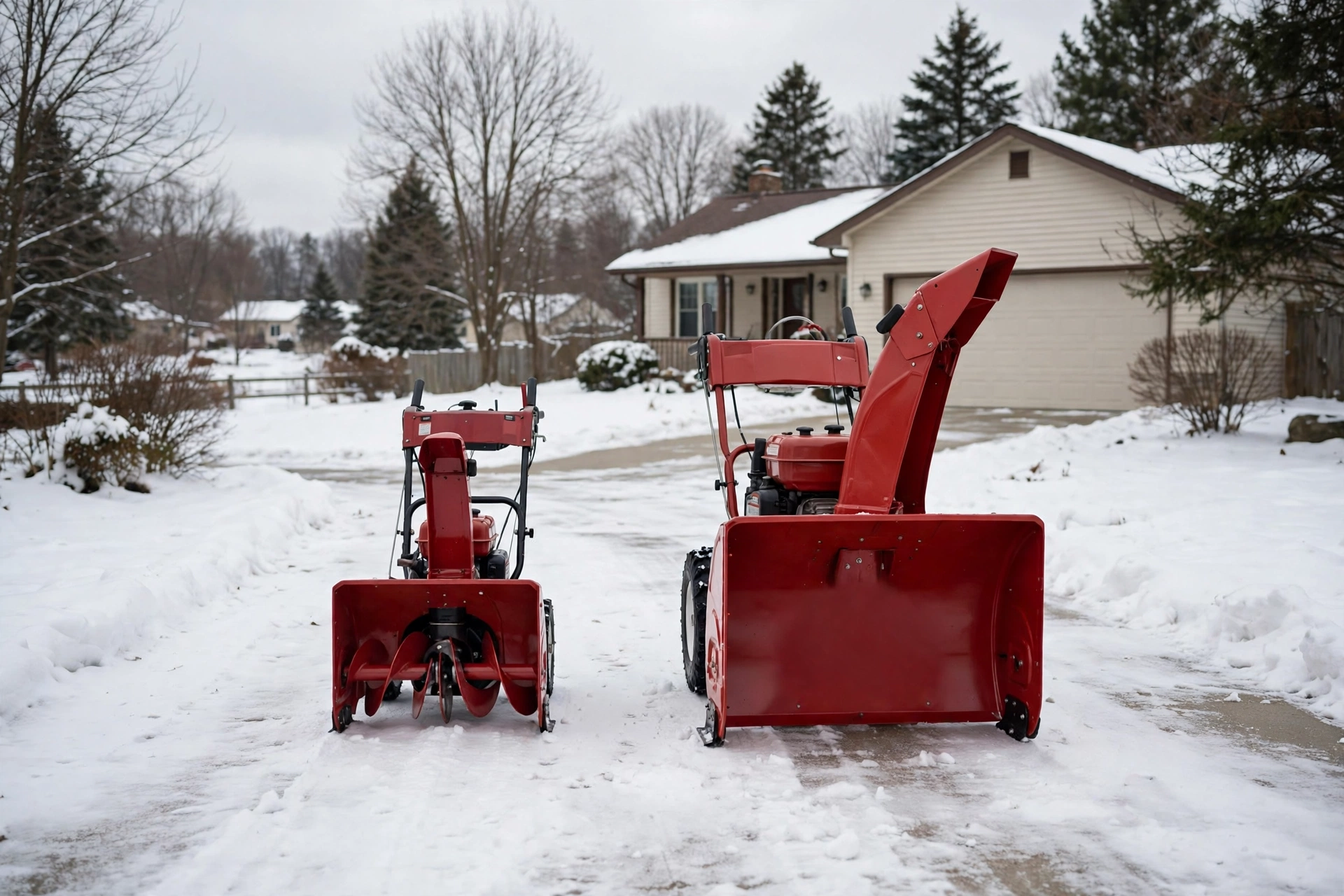
A single-stage snow blower clears with one auger that touches the ground and throws the snow itself. A two-stage snow blower uses an auger to feed snow into a separate impeller, and its housing rides above the surface on skid shoes instead of scraping it.
That mechanical difference decides which machine belongs on your driveway. Buy the wrong one for your surface and you either leave snow behind on every pass or throw your own gravel into the yard, the siding, and anything parked nearby.
Snow depth matters too, because the two designs top out at very different amounts. A short paved driveway in a light-snow climate and a long gravel drive that drifts are different purchases, even though both machines sit in the same aisle at the store.
How a single-stage blower works
A single-stage machine has one horizontal auger at the front, fitted with rubber paddles. The paddles spin fast, scoop the snow, and throw it out the chute in the same motion, which is why the design is simple and light.
Because those paddles contact the ground, they pull the machine forward as they work and clear right down to the pavement. A finished pass on asphalt or concrete looks swept, with no packed layer left for tires to polish into ice.
The trade-off is capacity. Most single-stage models handle roughly 12 to 18 inches of lighter snow before the intake is overwhelmed, and heavy, wet snow cuts that figure down further because the same auger has to lift and throw every pound of it.
Throwing distance is shorter as well, since paddle speed is the only force behind the snow. On a narrow driveway that rarely matters, but on a wide one the snow from the middle passes can land where you still have to clear.
How a two-stage blower works
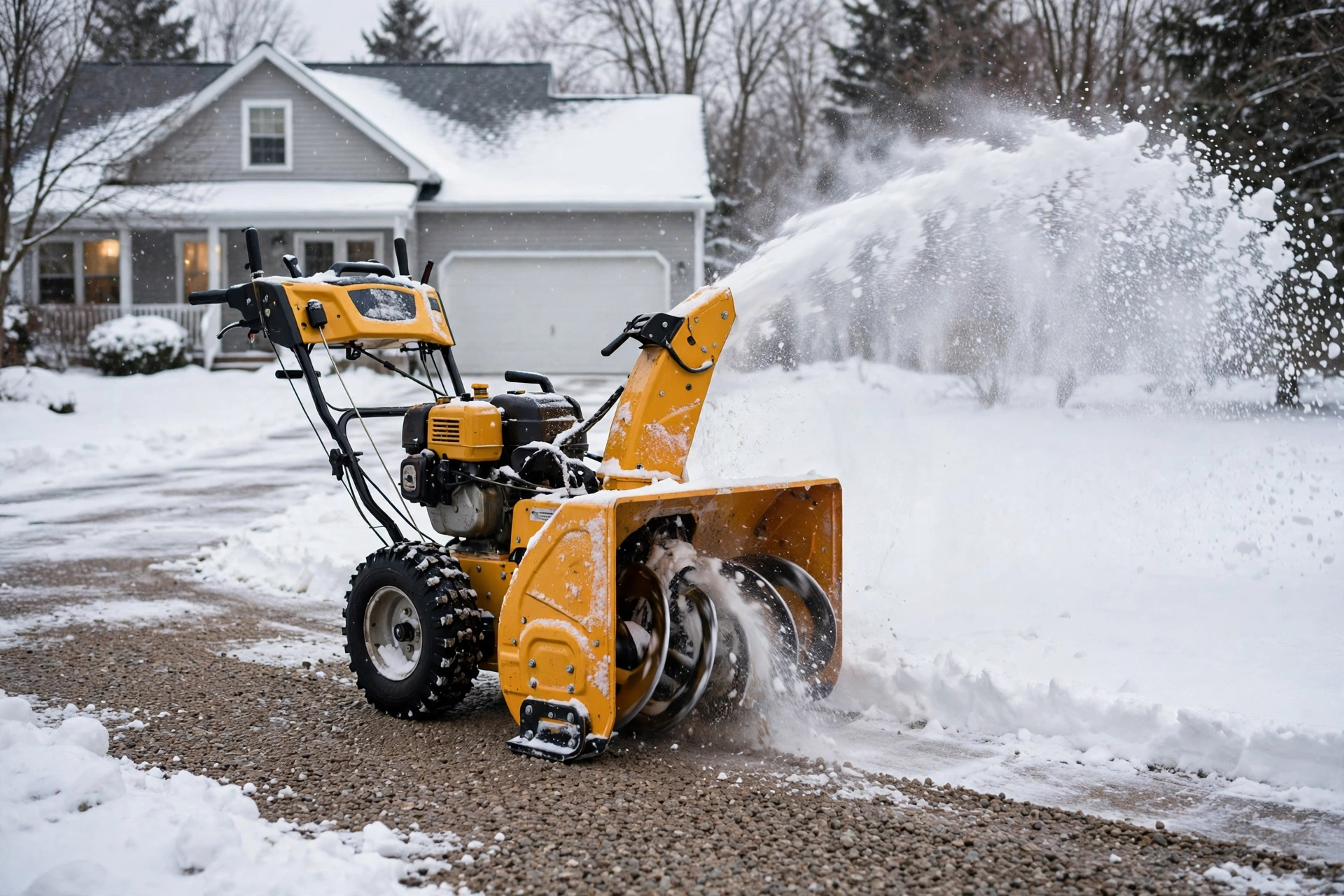
A two-stage machine splits the job. A slower steel auger gathers snow and pushes it back to an impeller, a high-speed fan that throws it up and out the chute with far more force than paddles can generate.
That second stage is what puts two-stage machines in the up-to-50-foot throwing class, and it is why they chew through 20 inches or more without bogging down. The pile the plow leaves at the end of the driveway, packed and half-frozen, is the load this design was built for.
The housing does not touch the ground. Skid shoes at the front corners set the clearing height, so the auger runs an inch or so above the surface and leaves a thin layer of snow behind rather than scraping bare.
Most two-stage models are also self-propelled, with driven wheels and several forward speeds. On a long driveway or any slope, that drive system matters as much as the throwing power, because the machine does the pushing instead of you.
Why gravel settles it
On gravel, a single-stage blower works against you. The ground-contacting paddles scoop up loose stone along with the snow and throw both at full paddle speed, which pits siding, cracks windows, and strips the top layer of your driveway into the lawn by spring.
A two-stage machine avoids the problem by design. Set the skid shoes so the housing rides an inch above the gravel, and the auger takes snow while the stone stays where it belongs, which is exactly the setup covered in our guide to the best snow blowers for gravel driveways.
The thin layer the two-stage leaves behind packs down into a working surface after the first storm or two. Most gravel-drive owners treat that packed base as a feature, since bare gravel in January means mud and ruts in March.
If part of your property is paved and part is gravel, the paved section still has to be cleared somehow. A snow shovel suited to gravel handles the paved apron and the walk without the paddle problem, and it costs a fraction of a second machine.
Size, weight, and what each class costs
Single-stage machines are the smaller purchase in every sense. Clearing widths usually run 18 to 22 inches, the machines are light enough to lift into a truck bed, and they commonly cost a few hundred dollars.
Two-stage machines start around 24 inches wide and go up from there, with weights that make lifting one a two-person job at best. Expect to pay roughly double a single-stage price or more, and expect the machine to claim real garage floor space from April through November.
That storage footprint is worth measuring before you buy, the same way you would size any storage purchase. If your cushions and your blower share one shed, the math in our guide to what size cushion storage box you need is the same kind of measure-first exercise.
The verdict by driveway
| Factor | Single-stage | Two-stage |
|---|---|---|
| Clearing action | One auger with rubber paddles that contact the ground | Auger feeds a separate impeller; housing rides on skid shoes |
| Snow capacity | About 12–18 inches of lighter snow | 20 inches and up, plus packed plow piles |
| Throwing distance | Shorter; paddle speed only | Up to about 50 feet on larger models |
| Gravel driveways | Paddles pick up and throw loose stone | Clears above the surface; the right choice |
| Paved driveways | Clears down to bare pavement | Leaves a thin packed layer |
| Drive | Paddle pull only | Self-propelled on most models |
| Typical cost | A few hundred dollars | Roughly double or more |
Bottom line
If your driveway is gravel, buy the two-stage and set the skid shoes an inch up. There is no adjustment that makes a ground-contacting paddle safe on loose stone, and the self-propelled drive and plow-pile capacity come with the machine you already need.
If your driveway is paved, short, and your storms usually drop less than a foot, buy the single-stage and keep the change. It clears to bare pavement, stores in a corner, and costs half as much to own.
The only genuinely hard case is a long paved driveway in a heavy-snow region, where depth and distance outrun a single-stage even though the surface suits it. There, buy the two-stage for capacity and accept the thin layer it leaves, because a machine that finishes the job beats one that scrapes cleaner and stalls halfway down the drive.