This post contains affiliate links. If you buy through them, Landscape & Leisure may earn a commission at no extra cost to you.
What do you do with more apples, herbs, and peppers than the week can use? Every gardener meets that week in late summer, when the counters fill faster than the meals do and the choice is between preserving the harvest and watching it soften.
Drying is the oldest answer to that week, and the VEVOR food dehydrator is the countertop version built for doing it in batches: ten stainless steel trays, 1000W of power, and digital temperature control from 99 to 170 degrees, for $167.90.
The honest framing comes first on this one. Owners rate it 4.14 out of 5 across 35 reviews on its Vevor listing, a small record with a middling score, so buy it for the capacity and the steel trays if you buy it, not on the strength of a crowd’s enthusiasm.
What it offers a preserving household is straightforward: enough tray space to dry a real harvest in one run, heat you set by the degree, and trays that go in the dishwasher when the run is done.
Ten steel trays change the batch math
Capacity is where small dehydrators fail the harvest test. A five-tray unit handles a few apples and a bunch of herbs; then the tomatoes ripen, the peppers come in, and the machine runs in shifts for days while the produce waits its turn on the counter.
Ten trays end the shifts. Apples on three trays, peppers on two, herbs on two more, and jerky marinating for the last three is a single load, dried in one session while the kitchen stays yours. For a household that cans, freezes, and dries in the same busy weeks, that one-run capacity is the feature the price is actually buying.
The trays are 304 stainless steel, the food-safe grade, and they are rigid enough to carry heavy, wet slices without flexing or spilling on the way in. Steel also skips the staining and lingering flavors that plastic trays collect after a season of peppers and garlic.
Two silicone sheets come in the box for fruit rolls and other wet mixes that would drip through a bare tray. It is a small inclusion that saves a separate purchase, and fruit rolls are usually the first thing a new dehydrator owner wants to try.
When the run ends, the trays go in the dishwasher. Anyone who has scrubbed sticky plum residue out of a tray by hand, ten trays in a row, will understand why that line earns its place near the top of this review.
Heat you set by the degree, and food you check without opening the door
The digital control sets the temperature anywhere from 99 to 170 degrees Fahrenheit, and a heating tube with a fan moves the warm air across every tray. Herbs want the low end of that range so they keep their color and scent, while jerky wants the high end, and one dial covering both jobs is what makes a dehydrator a preserving tool instead of a snack gadget.
Even airflow is the difference between rotating trays all day and trusting the machine. The fan-driven design is built to dry the top tray and the bottom tray on the same schedule, so a mixed load finishes together instead of in stages.
A large window and an LED light let you check progress without opening the machine and dumping the warm air you have spent hours building. Drying is slow work measured in hours, and every peek that costs you heat costs you time, so the window is a practical feature disguised as a convenience.
The machine is also built to run quietly, which matters more than it sounds. A dehydrator runs for hours at a stretch, often overnight, and a loud fan exiles it to the garage; a quiet one earns its counter space in the kitchen where the produce is.
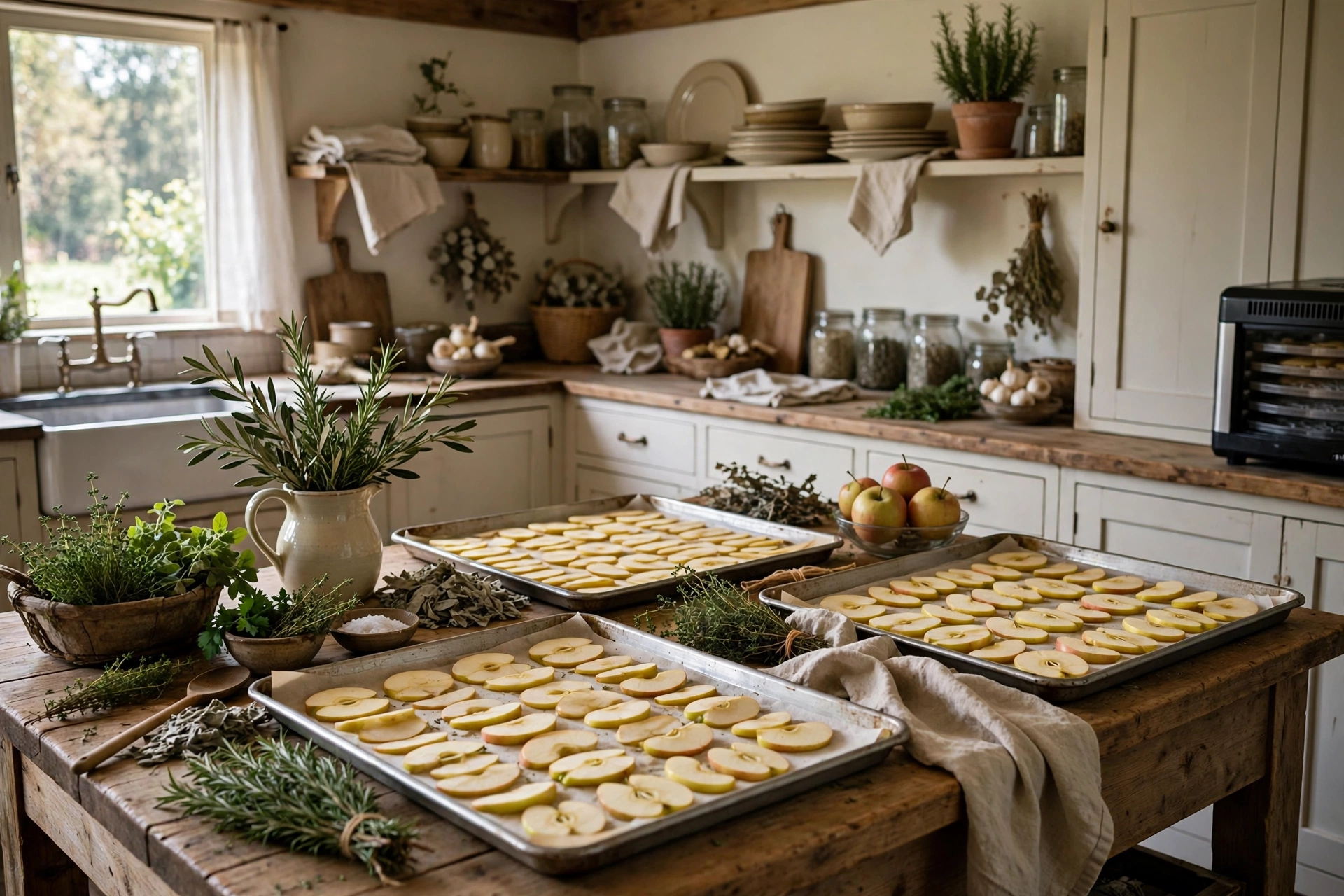
Picture the late-August version of that kitchen: tomatoes on the cutting board, a bowl of apple slices waiting for the last tray, and the low hum of the machine working through the pile while dinner happens around it. That scene, repeated across the harvest, is what this appliance is for.
What it dries, and where it fits a preserving kitchen
Fruit is the easy start: apples, pears, peaches, and berries dry into snacks that keep without preservatives or added sugar. Vegetables follow the same logic, from pepper flakes and dried tomatoes to soup mixes that turn a glut into a winter ingredient.
Jerky is the other headline use, and the 170-degree top of the range is the number that makes it practical. Herbs and teas dry at the gentle end, and the silicone sheets open up fruit rolls and crackers for anyone who likes a project.
Mixed loads are part of the design rather than a shortcut. Different foods can dry in the same run without trading flavors, so the peppers do not perfume the apples, and a tray of pet treats can share the session with the jerky above it.
The output lands in the parts of the pantry that store-bought snacks usually fill: lunchbox fruit, trail snacks, dried herbs in jars by the stove. Making them at home means the ingredient list is the produce itself, with nothing added that the garden did not grow.
Dried food stores compactly, too. A tray-load of fresh apple slices shrinks into a jar that keeps on a pantry shelf, and a summer of peppers becomes a small row of jars instead of a freezer packed to the door. For a small kitchen, that shelf-stable storage is half the value of the whole exercise.
Drying sits alongside canning rather than competing with it. Our canners and preservers gift roundup covers the jar side of the pantry; a dehydrator covers the produce that jars handle badly, like herbs, apple chips, and peppers bound for flakes. The fruit growers gift roundup makes the same point from the orchard side: a good harvest creates a preserving problem, and drying is one of the cheapest ways to solve it.
| Method | Batch size | Temperature control | Attention it needs |
|---|---|---|---|
| VEVOR 10-tray dehydrator | 10 steel trays in one run | Digital, 99 to 170 degrees | Check through the window; trays are dishwasher safe |
| Oven drying | A few sheet pans | Lowest oven setting, often above herb range | Ties up the oven for hours; door propped for airflow |
| Open-air drying | Whatever the screens hold | None; weather decides | Days of dry weather, and protection from insects |
The body is stainless steel inside and out, with a smooth interior surface that food does not cling to. The trays slide out for loading and washing, and a normal wipe-down handles the rest, with no strong chemicals needed after a sticky fruit run.
The digital control also suits a first-time preserver. You set the temperature and the machine holds it steady for the whole run, so there is no dial to babysit and no guessing about whether the heat drifted while you were out in the garden.
The honest limits
That 4.14 rating deserves a plain reading. With 35 reviews behind it, this is a machine owners find good rather than great, and the score says to expect a working appliance, not a flawless one. If a spotless record matters more to you than tray count, shop the category slowly and pay more.
Counter space is the other cost. A ten-tray stainless machine is a substantial box, and a kitchen that cannot give it a home between runs will resent it by October. Measure the counter and the cabinet it would live in before the box arrives.
Drying itself stays slow, whatever the machine. Thick, wet slices take hours, and no 1000W element changes the physics of pulling water out of a peach. The dehydrator’s job is to make those hours unattended and even, and on that job the fan, the window, and the steel trays all pull their weight.
Who should buy it
Buy the VEVOR food dehydrator if your garden or your market trips regularly produce more than the week can eat, and you want one machine that dries the surplus in a single run. At $167.90, it pays for itself in the currency preservers actually count: harvest that reaches winter instead of the compost.
Skip it if you dry a handful of herbs twice a year. A small unit, or the oven you already own, handles that job without giving up the counter space, and ten trays earn nothing sitting empty.
For the household that preserves in earnest, this is a sensibly built machine at a fair price: steel trays, degree-by-degree heat, a window that keeps the heat in, and enough capacity for the week the garden outruns the table. The record behind it is modest, so go in with clear eyes, and it will do the work it promises.
BEST FOR HARVEST BATCHES
VEVOR Food Dehydrator, 10 Stainless Steel Trays, 1000W
Ten dishwasher-safe steel trays and digital heat from 99 to 170 degrees, for $167.90.