This post may contain affiliate links. If you buy through them, we may earn a commission at no extra cost to you.
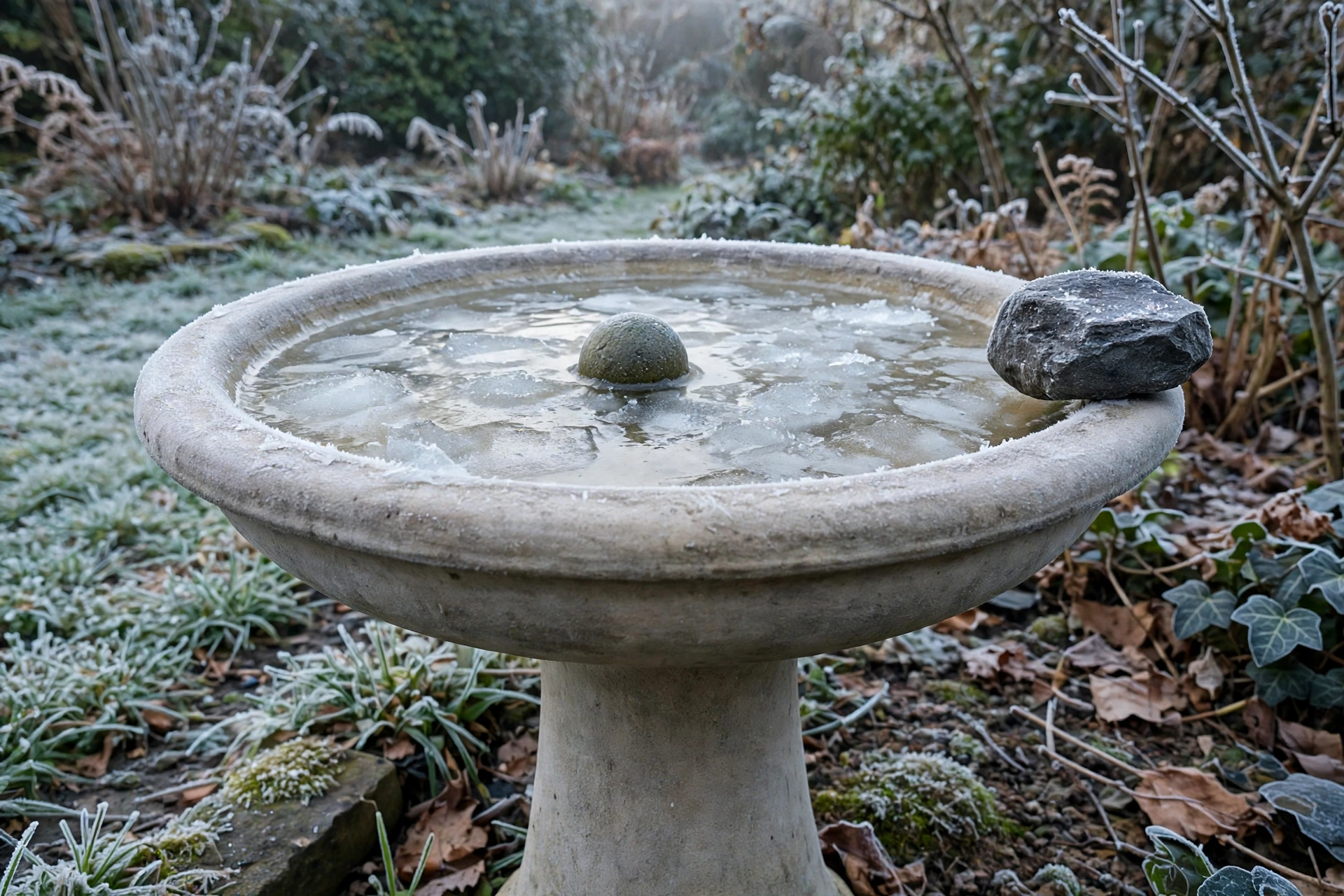
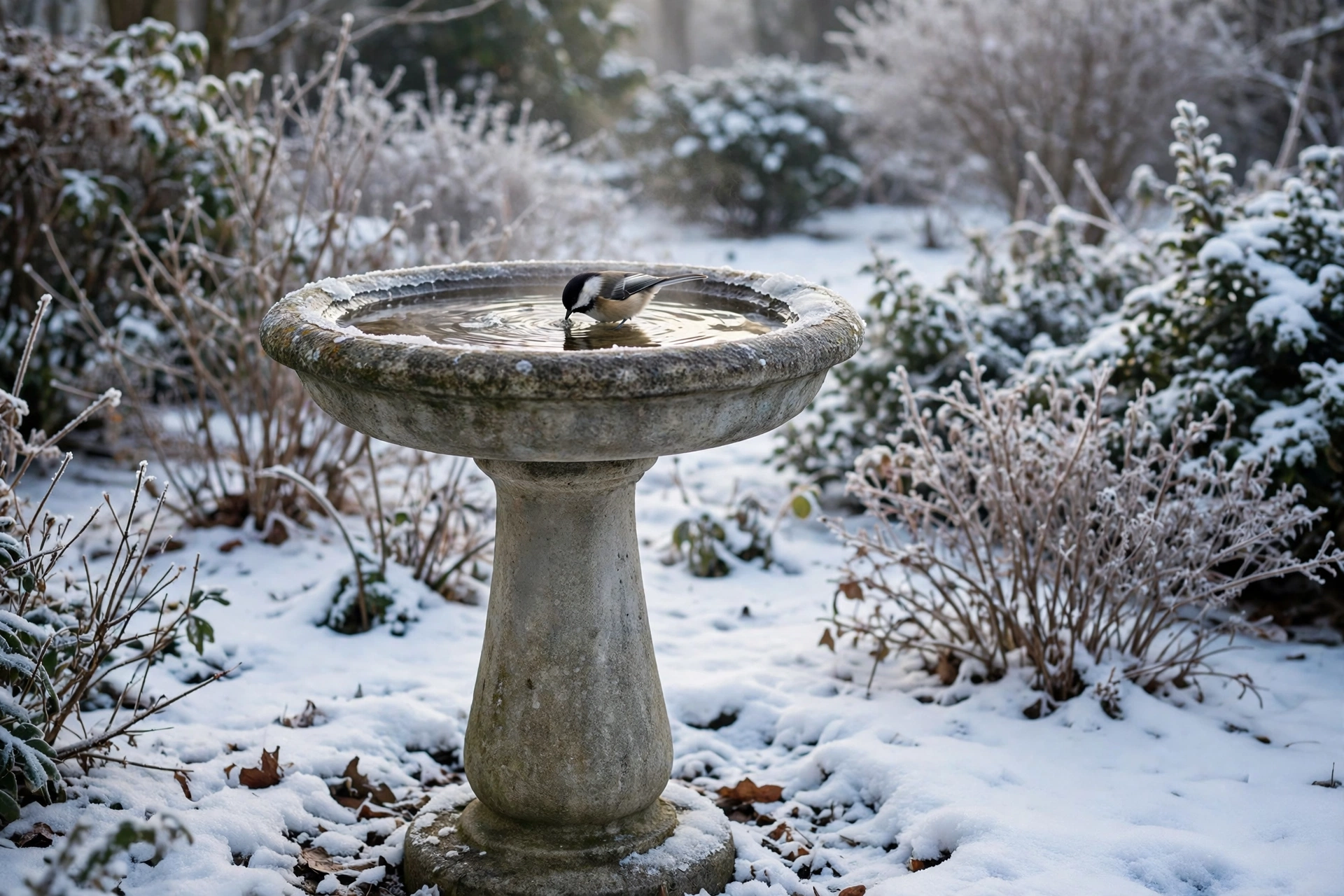
The first hard freeze of the season usually arrives overnight, and by morning the bird bath is a solid disc of ice with a chickadee standing on top of it, looking at the one thing in the yard it cannot use.
That bird is not being particular. Open water is the scarcest resource in a winter yard, because feeders hold seed for days while every puddle, creek edge, and unheated bath within flying distance locks up in the same cold snap — and birds still need to drink daily, and to bathe, because clean feathers insulate and dirty ones do not.
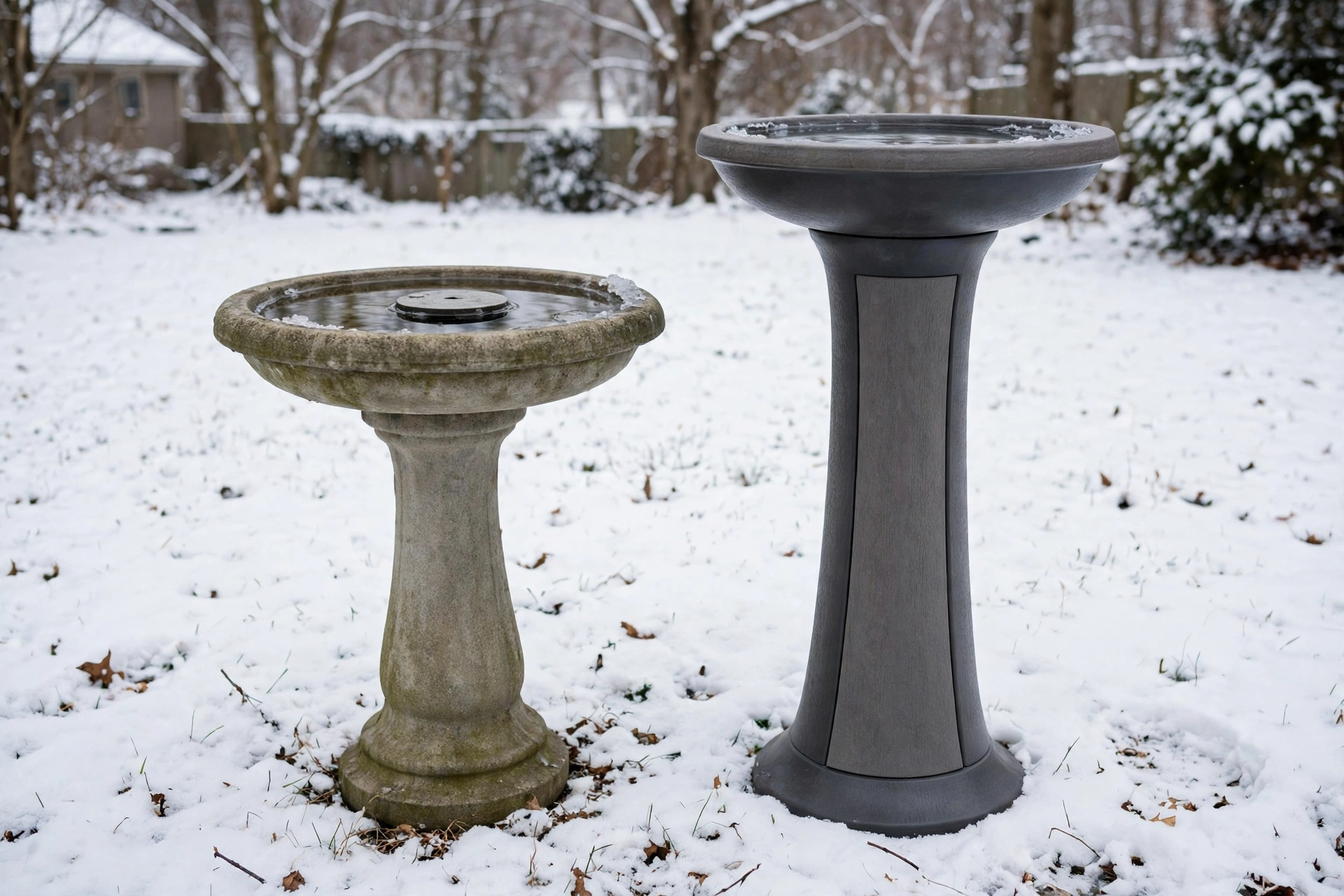
A heated bird bath answers that with a small electric element and a thermostat. There are three ways to buy one — a complete heated bath for a deck rail, a ground-level heated bath, and a drop-in de-icer that heats a bath you already own — and one underpowered model in the same catalogs is worth skipping outright.
What the thermostat actually does
None of these heaters tries to make the water warm, and that is the point most listings blur. Per Farm Innovators, the thermostat switches the element on when the water falls to about 35°F and off again near 45°F, which holds the surface in roughly the 35–40°F band — cold water, simply never ice.
Wattage decides how much cold a unit can hold that line against. Heated baths and de-icers in this class run from about 50 to 150 watts, and the spread maps to basin size and exposure: a sheltered 1-quart bowl gets by on 70 watts, while a wide deck basin in open wind needs the 120-watt end of the range.
Because the thermostat cycles the element off whenever the water is above the set point, the rated wattage is a ceiling, not a constant draw. A 120-watt bath running flat out for 24 hours would use 2.88 kilowatt-hours; at 16 cents per kilowatt-hour that is about 46 cents a day as an absolute worst case, and real winter use lands well under it.
The picks at a glance
| Product | Type | Watts | Capacity | Thermostat |
|---|---|---|---|---|
| Farm Innovators HBC-120 | Integrated bath, deck mount | 120 | About 1 gallon | Yes — on near 35°F, off near 45°F |
| Farm Innovators FS-1 Four Seasons | Integrated bath, ground level | 70 | 25-inch footprint, basin about 2 inches deep | Yes |
| Farm Innovators HR-75 Heated Rock | De-icer, drops into your bath | 75 | Works in the bath you have | Yes |
| Farm Innovators B-9 | De-icer, foil pad | 44 | Shallow baths only | Yes |
Best overall: Farm Innovators HBC-120 heated bird bath
The HBC-120 is a complete bath: a scalloped, stone-look basin of compression-molded plastic with the 120-watt heater built into the bowl and the electrical connection hidden underneath it. It twists onto a deck rail mount with thumb screws, and the dish twists back off for dumping and scrubbing, which matters more than it sounds — a heated bath still grows algae in January, just more slowly.
The basin holds about a gallon, enough depth for small songbirds to bathe and enough volume that the heater is not fighting a thimble of water on a windy night. The honest trade-off is the mount: this is a deck-rail bath, full stop. If the yard has no rail within reach of an outdoor outlet, it has no home.
Farm Innovators HBC-120 Heated Bird Bath, 120-Watt
A gallon-size deck bath with the heater built in, a thermostat that runs only near freezing, and a dish that twists off for cleaning.
Runner-up: Farm Innovators FS-1 Four Seasons heated bird bath
The FS-1 takes the opposite placement bet. It is a ground-level bath, about 25 inches across with a sand-coated, stone-look finish, and a concealed 70-watt element under a shallow basin roughly 2 inches deep. Ground placement is not a compromise for every yard: plenty of birds, juncos and towhees among them, prefer to drink at ground level, and a bath sitting in a garden bed reads as part of the planting rather than equipment bolted to the house.
What it gives up against the HBC-120 is wattage and shelter. Seventy watts in an exposed ground basin is a fair-weather-winter specification — fine through ordinary freezes, less certain in a week of single digits with wind. The cord also stores underneath for summer, so the bath stays out as an unheated ground bath the rest of the year.
Farm Innovators FS-1 Four Seasons Heated Bird Bath, 70-Watt
A ground-level, sand-coated bath for garden beds, with a concealed 70-watt element and a cord that tucks away in summer.
Already own a bath you like? Farm Innovators HR-75 Heated Rock de-icer
A de-icer is the third route, and for a yard with a good concrete or metal bath already in place it is the cheapest one. The HR-75 is a cast-aluminum unit shaped and finished like a flat rock, rated at 75 watts with the same style of thermostatic control: it sits in the basin, switches on as the water approaches freezing, and keeps a drinking hole open in the ice.
Farm Innovators lists it as safe for all birdbaths, including plastic. Its limit is arithmetic rather than design — 75 watts holds a smaller area of open water than a 120-watt integrated bath does, so in a wide basin expect an open patch around the rock rather than a fully clear surface. For drinking, which is the winter priority, a patch is enough.
Farm Innovators HR-75 Heated Rock Bird Bath De-Icer, 75-Watt
A cast-aluminum rock that drops into the bath you already own and keeps a drinking hole open through a freeze.
The one to skip: Farm Innovators B-9 foil de-icer
The B-9 is a 44-watt foil pad that molds to the bottom of a shallow bath, and 44 watts is the lowest output sold in this category. In a small, sheltered saucer it can hold off a light frost. In a standard basin during a real cold snap — the exact week the bath matters most — it does not have the output to keep water open, and a heater that works except when it is coldest is not a heater worth buying. Spend the difference on the HR-75.
Placement and power, briefly
Every unit here runs on a short attached cord, so an outdoor-rated extension cord on a GFCI outlet is part of the installation, not an accessory. Put the bath where it can be seen from a window and reached with a watering can, because winter refills happen on the coldest mornings and a bath that is a trudge across an icy yard gets refilled late.
Shelter matters as much as wattage. A bath on the lee side of the house or a fence loses far less heat to wind, which is why the same 75-watt de-icer can look strong in one yard and weak in another. Water is one piece of a winter yard; seed, suet, and cover complete it, and how to create a winter wildlife garden lays out the rest of the setup.
Bottom line
Buy the HBC-120 if a deck rail sits within cord reach of an outlet — it is the most complete answer here, and its gallon basin plus 120 watts cover the coldest ordinary weeks. Choose the FS-1 for a garden bed and ground-feeding birds, and the HR-75 when the bath in the yard is already the right one and only the ice is wrong. Two companion reads sort the remaining questions: heated bird bath vs. bird bath de-icer if the choice between the two forms is still open, and how to keep a bird bath from freezing without electricity for the no-outlet yard. By the second freeze, the chickadee on the rim should be standing next to open water instead of on it.