This post contains affiliate links. If you buy through them, Landscape & Leisure may earn a commission at no extra cost to you.
Buy the motor. That is the short answer, and harvest day is why: the supers are stacked in the honey house, the frames are uncapped and waiting, and a hand crank turns every batch into an arm workout that stretches one afternoon into two. The VEVOR electric honey extractor replaces the crank with a 140W motor and room for eight frames at a time.
It is a stainless steel drum spinner that holds 4 deep frames and 4 medium frames in a single load, with an adjustable speed up to 1,300 RPM. It sells for $269.90, and owners rate it 4.46 out of 5 across 371 reviews on the listing.
The honest short version: this is a small-apiary machine, sized for the beekeeper who has outgrown a two-frame hand crank and is not yet shopping for commercial extracting-room equipment. If that is where your apiary sits, it sits in a very useful spot.
Eight frames at a time changes the math of harvest day
Capacity is the whole story here. A two-frame crank extractor asks you to load, spin, flip, spin again, and unload, over and over, while the stack of supers barely shrinks. Four deep frames and four medium frames in one load means the batch rhythm changes completely: uncap while the drum spins, swap frames, keep moving.
The frame sizes are the standard ones your supers already use. Deep frames at 18.9 by 9 inches and medium frames at 18.9 by 6.3 inches both fit.
That means a mixed harvest — deeps from the brood boxes you robbed, mediums from the honey supers — runs through the same basket without sorting gymnastics.
Speed control matters more than top speed. The dial takes the drum up to 1,300 RPM, and the reason you want the range rather than a single fixed speed is comb: fresh, soft foundation drawn this season tears under a violent start, while older, tougher comb can take the full pace. Start gentle, let the light side empty, then bring the speed up. That one habit protects more comb than any feature on the machine.
Harvest day, start to finish
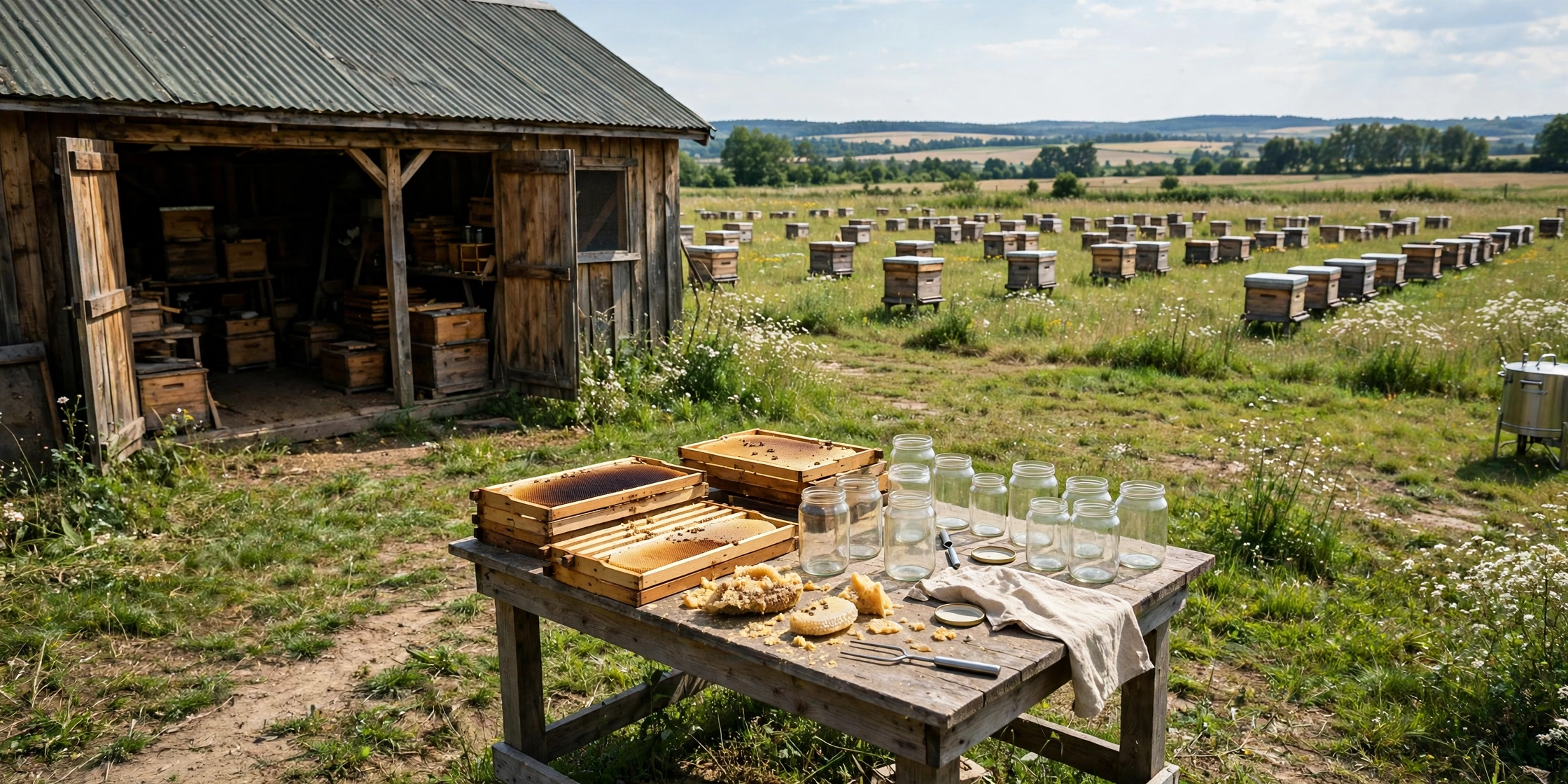
Picture the actual morning. The supers came off the hives yesterday, stacked in the warmest room you have, and the frames are heavy enough that you feel each one in your shoulders as you lift it. Uncapping comes first — knife or fork, the wax cappings falling into the tray — and that step, not the spinning, sets the pace of the whole day.
That is precisely why the motor matters. With a hand crank, uncapping and spinning compete for the same pair of arms, so you uncap four frames, crank them dry, uncap four more, and the day stretches. With the drum turning under power, the two jobs overlap: frames spin while your hands keep uncapping, and the extractor stops being the bottleneck it was with a crank.
Cleanup is the last act, and it is where stainless steel earns its keep a second time. Honey is sugar and water; a polished stainless drum with a burr-free surface rinses down without snagging your hands or holding residue in rough seams, and the wireframe basket lifts out for its own wash. The machine that is easy to clean is the machine that gets cleaned the same day, and honey equipment put away sticky is a misery you only schedule for yourself once.
There is a rhythm to the season that this capacity fits. Spring supers fill slowly and the first small harvest feels manageable with almost anything, but the late-summer pull is the one that buries a small apiary — every hive ready in the same fortnight, drawn comb you want emptied and returned before the fall flow ends. Eight frames at a time is sized for that fortnight.
The lid, the gate, and the legs
Three details separate a pleasant extracting session from a sticky one, and this machine gets all three right on paper and in its owner ratings. The lid is transparent, so you watch the honey sheet off the comb without lifting anything, and if you do open it mid-cycle, the drum stops spinning. That interlock is the kind of feature you appreciate exactly once — the first time you reach in too early out of habit.
The honey gate sits low on the drum, so honey drains out by gravity instead of pooling in the bottom where you would be scraping for it later. Anyone who has tilted a drum and chased the last cup of honey around the floor with a spatula knows what a low gate is worth at the end of a long day.
And when the season ends, the whole outfit breaks down to a drum, a basket, and a stand that store together in the corner the hand crank used to occupy — no small thing in a honey house that also holds supers, jars, and a winter’s worth of frames.
The stand deserves a word, too. Three outward-angled legs lower the center of gravity, the height adjusts from 39.3 to 42.5 inches so a bucket slides under the gate at the setting you choose, and the legs can be bolted down. Bolt them. An extractor with an uneven load walks at speed, and the bolt holes are there because the maker knows it.
| Detail | This extractor |
|---|---|
| Price | $269.90 |
| Capacity | 4 deep frames + 4 medium frames per load |
| Motor | 140W, adjustable speed up to 1,300 RPM |
| Drum | Stainless steel, polished burr-free surface, wireframe basket |
| Stand | 3 legs, height adjustable 39.3 to 42.5 in, bolt-down capable |
| Weight | 39.2 lbs |
| Owner rating | 4.46 out of 5, 371 reviews |
What the owner ratings add up to
A 4.46 average across 371 reviews is a healthy score for extraction equipment, a category where a single wobble or a rough weld seam earns a furious one-star notice. The praise clusters where you would hope: the motor ends the crank fatigue, the stainless drum rinses clean, and the capacity turns a weekend of extracting into a day.
Keep two honest limits in view. At 39.2 pounds, this is a machine you carry to its spot twice a year, not one you casually move around the garage — give it a home corner for extracting season. And eight frames is a ceiling as well as a convenience: a beekeeper running dozens of colonies will outgrow the drum the same way you outgrew the hand crank, just one step later.
One more thing the electric drum protects, quietly: the comb itself. Drawn comb is the most valuable thing your bees own, because a frame the bees do not have to rebuild is a frame they can fill. Spinning honey out leaves the comb intact to go straight back on the hive, and a controlled start — slow first, faster once the heavy side has emptied — is what keeps that comb from blowing out against the basket. Treat the speed dial as a comb-preservation tool, not just a throttle, and the machine pays you back in next season’s honey as well as this season’s time.
Storage is the unglamorous final test. At 39.2 pounds with the stand, the extractor wants a dry corner it can keep — a garage shelf low enough that lifting it down is a two-hand job, not a ladder job. Stainless does not rust in a damp shed the way lesser drums do, but the motor will thank you for the dry corner anyway, and a machine stored ready is a machine that actually gets used on the one warm weekend the harvest cannot wait for.
If your bees are still in their first boxes, our review of the VEVOR 40-frame Langstroth hive kit covers the boxes these frames come out of, and our gift guide for beekeepers rounds up the smaller tools — uncapping knives, strainers, jars — that extracting day also calls for.
Who should buy it, and who should keep cranking
Buy the electric extractor if you run a handful of colonies and harvest day has become the bottleneck of your beekeeping year. The jump from two frames and a crank to eight frames and a motor is the single biggest time saving in the whole honey workflow, and $269.90 is a modest price for getting your weekends back.
Keep cranking if you run one or two hives. A small hand-crank extractor costs far less, stores in a closet, and a dozen frames a year simply do not justify a motor. And if you sell honey at scale, shop a step up in drum size instead — this machine will feel small by your second season of growth.
For the growing small apiary, though, the verdict is plain: this is the right capacity, the right build material, and a lid that watches out for you while you watch the honey flow.
VEVOR Electric Honey Extractor, 4/8 Frames
Eight frames per load, a 140W motor with speed control up to 1,300 RPM, and a stainless drum on a bolt-down stand.