This site contains product affiliate links. We may receive a commission if you make a purchase after clicking on one of these links.
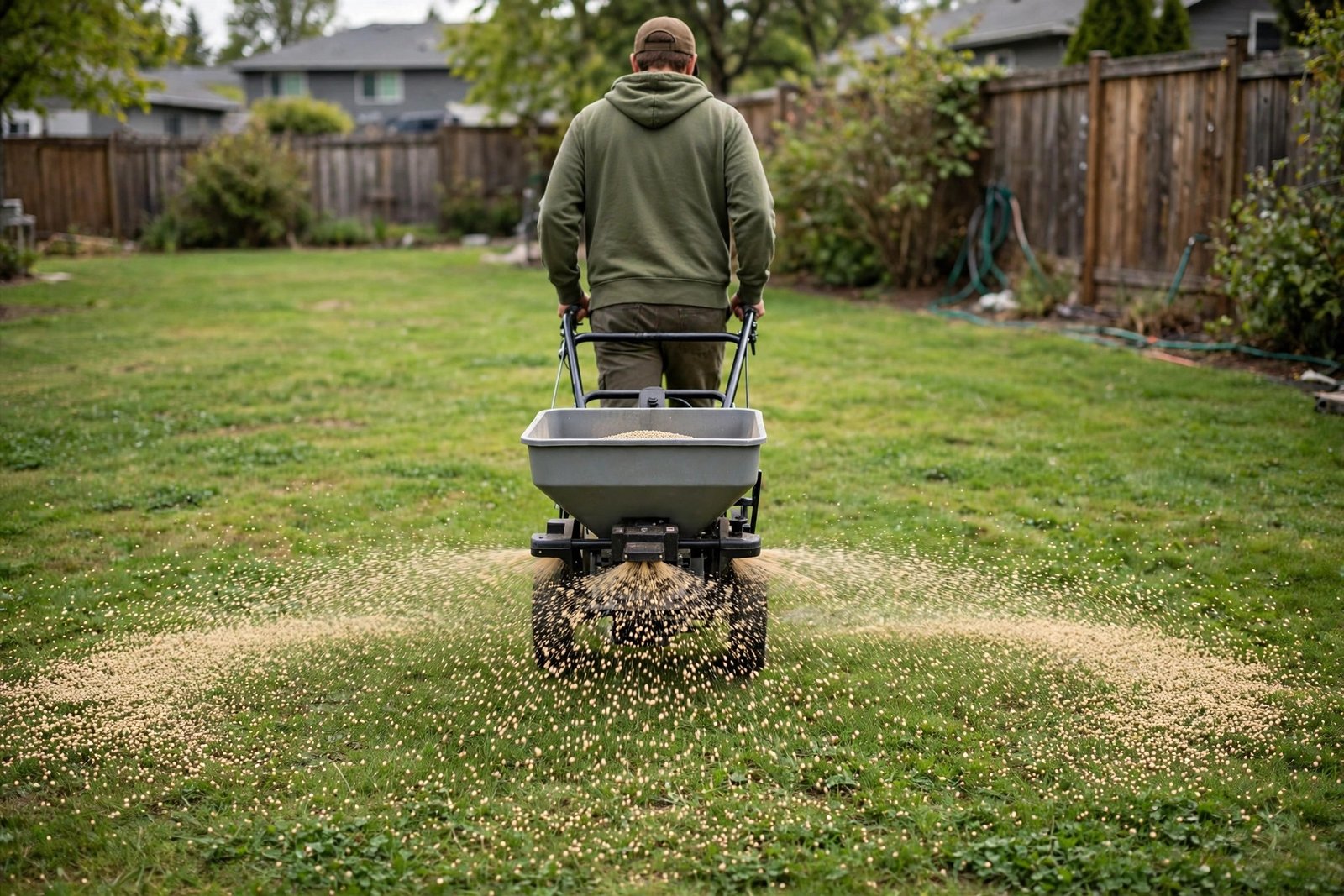
A broadcast spreader is the fastest honest way to feed a lawn. One pass fans granules across a wide arc, so a job that would take an afternoon with a handheld shaker takes twenty minutes on foot.
The wrong spreader turns that speed into stripes. Too wide for a small yard, too small for a big one, or a pattern that dumps heavy on one side, and the lawn tells on you for weeks. These four picks cover the lawns most homeowners actually own.
The four picks at a glance
| Spreader | Best for | Capacity | Spread width | Needs |
|---|---|---|---|---|
| Scotts Elite Spreader | Most lawns | Up to 20,000 sq ft per fill | Wide broadcast pattern with edge control | A homeowner on foot |
| Agri-Fab 45-0463 Tow-Behind | Large properties | 130 lb hopper, about 25,000 sq ft per fill | Up to 12 ft | A riding mower or tractor |
| Scotts EdgeGuard Mini | Small lawns | Up to 5,000 sq ft per fill | Narrow broadcast pattern with edge control | A homeowner on foot |
| EarthWay 2600A-Plus | Precise application | 40 lb hopper | Adjustable broadcast pattern | A homeowner on foot |
Best overall: Scotts Elite Spreader
The Elite is the spreader to buy if you want one machine for a typical suburban lawn and you want to stop thinking about spreaders. Its hopper covers up to 20,000 square feet per fill, which means most quarter-acre lawns get fed in a single load.
Two features earn the top spot. Dual rotors throw a more even pattern than a single spinning plate, so the middle of the arc does not get a double dose. EdgeGuard lets you shut off the side facing a driveway, sidewalk, or flower bed, so granules stay on the grass instead of staining concrete or feeding the petunias.
The trade-off is size. On a tiny front-yard-only lawn, a 20,000-square-foot hopper is more machine than the job needs, and it takes more garage space than a mini. For anything over about 5,000 square feet, that trade is worth it.
Pros: Large capacity with few refills; dual rotors for an even pattern; EdgeGuard keeps product off hard surfaces.
Cons: Overkill for very small lawns; heavier than a mini when full.
Scotts Elite Spreader
The one-spreader answer for most lawns: big capacity, an even dual-rotor pattern, and edge control.
Runner-up: Agri-Fab 45-0463 tow-behind
Once a lawn passes an acre, walking a spreader stops being exercise and starts being a chore. The Agri-Fab 45-0463 hooks to a riding mower or tractor and throws a spread up to 12 feet wide from a 130-pound hopper, covering roughly 25,000 square feet per fill.
That combination is the whole point. Fewer refills, a wider pass, and a seat instead of a walk. Owners with large properties consistently praise how much ground it covers before the hopper runs dry, and the tow-behind design keeps the weight off your arms entirely.
The catch is the prerequisite. Without a riding mower or tractor, this spreader has nothing to tow it. It is also the wrong tool for a lawn broken up by tight beds and narrow gates, where a tow-behind cannot turn. Buy it for open ground, not for obstacle courses.
Pros: Huge capacity and 12-foot spread; tows behind equipment you may already own; no pushing a heavy hopper.
Cons: Requires a riding mower or tractor; clumsy in tight, gated, or heavily landscaped yards.
Agri-Fab 45-0463 Tow-Behind Spreader
A 130-pound hopper and a 12-foot spread for big, open lawns, towed instead of pushed.
Best small lawn: Scotts EdgeGuard Mini
Small lawns punish big spreaders. The pattern overshoots the edges, the hopper stays half full, and the machine is a nuisance to store. The EdgeGuard Mini is sized for the job, covering up to 5,000 square feet per fill.
It comes pre-calibrated, which matters more than it sounds. A first-time spreader owner can load it and walk, rather than guessing at a dial setting and learning from stripes. EdgeGuard is included too, so the narrow pattern still stops at the sidewalk.
The limit is obvious: capacity. A lawn much over 5,000 square feet means refills, and refills mid-job are where uneven application creeps in. If your lawn is growing or you plan to feed a back forty someday, step up to the Elite.
Pros: Right-sized for small lawns; pre-calibrated for first-timers; EdgeGuard included.
Cons: Too small for medium and large lawns; refills interrupt the pattern.
Scotts EdgeGuard Mini
Pre-calibrated, edge-controlled, and sized for lawns up to 5,000 square feet.
Best precision: EarthWay 2600A-Plus
Some products punish sloppy application. Weed-and-feed on a hot day, or a specialty product with a narrow label rate, is no place for guesswork. The EarthWay 2600A-Plus is built for that job, with a 40-pound hopper and a 3-hole EV-N-SPRED shut-off system that meters granules more evenly than a single-hole plate.
The three-hole design is the difference. It spreads the flow across the plate instead of dumping from one point, which cuts the heavy-center pattern that causes striping. For a homeowner who reads bag labels closely, that control is worth more than raw capacity.
The trade-off is that 40 pounds runs out faster than the Scotts Elite on a big lawn. This is the spreader for the careful applicator, not the one who wants to feed an acre without stopping.
Pros: 3-hole metering for an even, controllable pattern; well suited to label-sensitive products; sturdy build.
Cons: Smaller hopper means more refills on large lawns; overkill if you only spread one basic fertilizer a year.
EarthWay 2600A-Plus
A 3-hole metering system for even, controlled application where the label rate matters.
Honest not-recommended: a handheld spreader for a large lawn
A handheld spreader has a real place: touch-ups, a narrow side strip, a small patch that needs seed. It does not have a place on a large lawn.
The pattern is narrow, the capacity is tiny, and the cranking arm guarantees an uneven pace over a long job. On a big lawn, a handheld spreader turns a twenty-minute feed into an hour of refills and a patchwork result. Walk-behind is the floor for a large lawn, and tow-behind is the ceiling worth reaching for.
How to choose in thirty seconds
Measure the lawn first, then match the machine. Up to 5,000 square feet, the Mini is enough. Between 5,000 and 20,000 square feet, the Elite covers it in one fill. Over an acre with a rider in the garage, the Agri-Fab earns its keep.
If you spread products where the label rate is strict, choose the EarthWay for its metering, even if it means one extra refill. And whichever spreader you buy, calibrate it before the first real application. The steps are in How to Calibrate a Broadcast Spreader, and ten minutes with a scale beats a season of stripes.
Still deciding between spreader types? Broadcast vs Drop Spreaders: Which One Fits Your Lawn? walks through coverage width, edge control, and striping risk side by side. If you are also figuring out how much seed a bare patch needs, the Grass Seed Calculator works out the pounds for your square footage.
Bottom line
Most lawns need the Scotts Elite: big enough for one fill, even enough to avoid stripes, and controlled enough at the edges. Large open properties belong to the Agri-Fab tow-behind, small lawns to the EdgeGuard Mini, and careful applicators to the EarthWay. Match the machine to the lawn, calibrate it once, and the spreader stops being something you think about.