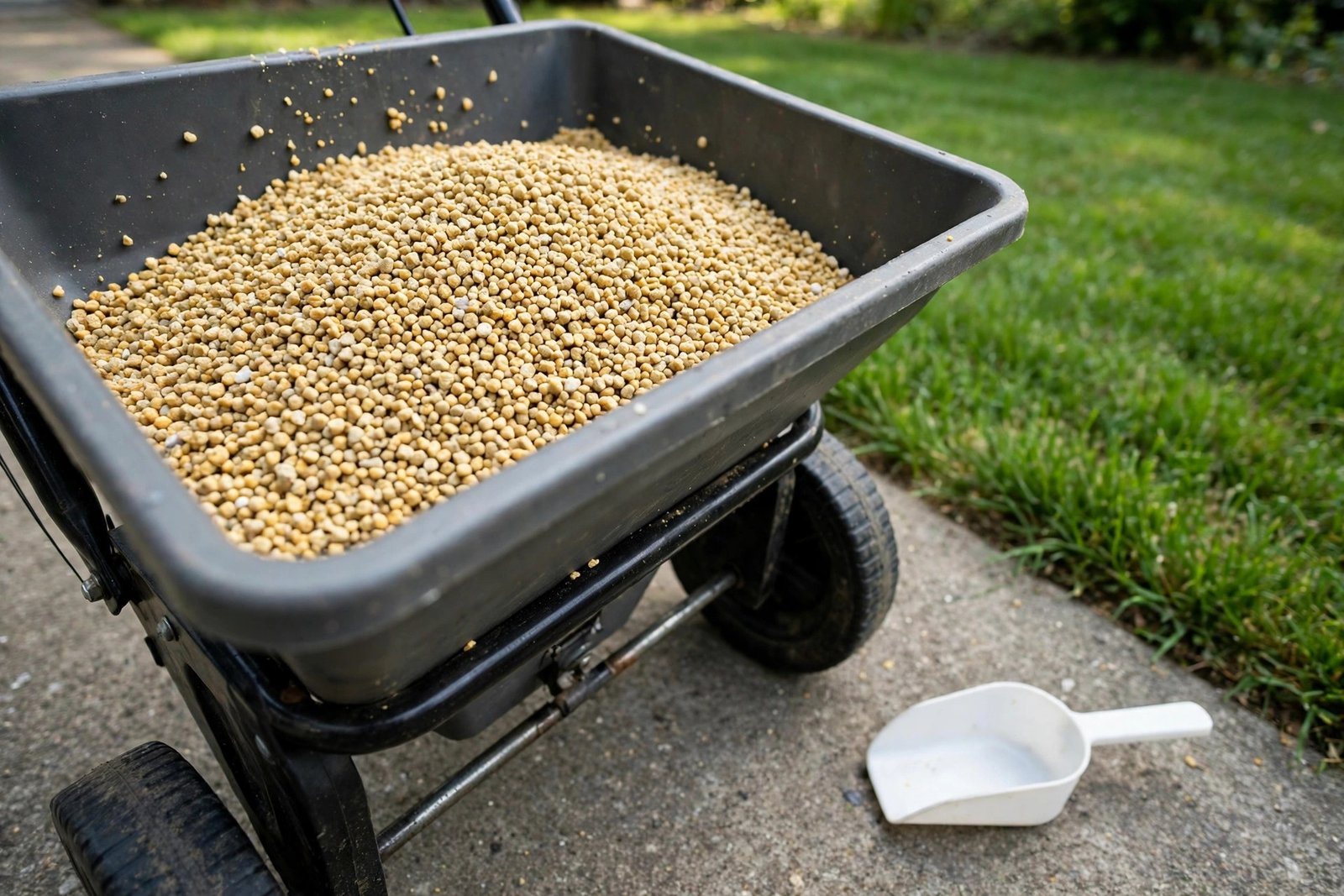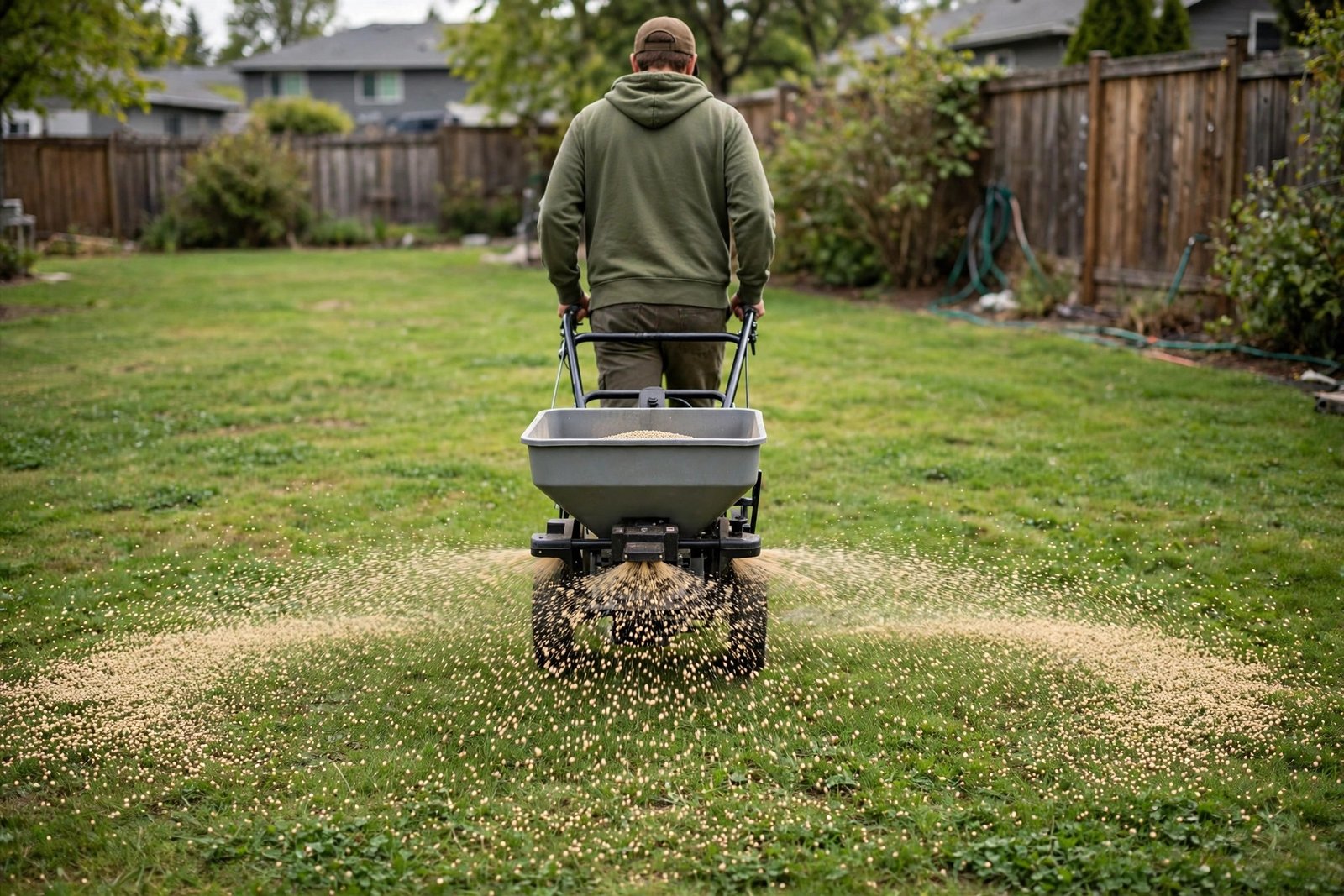
Guessing at fertilizer is how a lawn ends up fed too much, too little, or all at once. This calculator gives you the amount for your warm-season lawn for the whole year, broken into feedings you can actually spread — from Georgia’s nitrogen tables.
Use the calculator
A fertilizer bag shows three numbers, like 28-0-3. The first number is the nitrogen share, in percent. Type just that first number here.
For bermudagrass, Georgia’s table gives 2 to 5 pounds per 1,000 square feet per year. The box starts at the middle of that range, 3.5 — a starting point, not a prescription. Pick lower for a lawn you keep easy, higher for one you push for color and thickness.
What to type in
Start with your grass. The calculator covers the four warm-season lawn grasses in the table below: bermuda, zoysia, St. Augustine, and centipede.
Then type your lawn size in square feet and the first number from your bag. That first number is the nitrogen percentage — on a 28-0-3 bag, it is 28, meaning 28 percent of the bag by weight is nitrogen.
Next, pick where in your grass’s yearly range your lawn sits. The box starts at the middle of the range. Go low for a lawn you keep easy and mow and water lightly; go high for a lawn you push for deep color and dense cover. This is your choice, not a prescription.
Finally, say how many feedings you plan to spread across the growing season. Each feeding should carry between half a pound and one pound of nitrogen per 1,000 square feet. If your numbers would put more than one pound in a single feeding, the calculator will stop you and tell you how many feedings you need at minimum.
For centipedegrass, keep it gentle: pick a low-nitrogen bag, and let a soil test guide you on phosphorus. Centipede is a low-maintenance grass that does not want to be pushed.
How the math works
The calculator starts with your yearly nitrogen target and splits it evenly across your feedings. That gives the nitrogen in each feeding for every 1,000 square feet of lawn.
Then it turns that nitrogen amount into bag weight. It takes the nitrogen each feeding needs and divides it by the nitrogen share of your bag — the first number on the bag, as a decimal. A 28 on the bag means 28 percent, or 0.28 of every pound. That step gives pounds of fertilizer per 1,000 square feet for one feeding.
From there it is simple scaling: multiply by your lawn size to get pounds per feeding, and multiply that by your number of feedings to get pounds for the year.
One rule guards the whole thing: no single feeding may carry more than one pound of nitrogen per 1,000 square feet. If your target and feeding count would break that rule, the calculator refuses the combination and shows the smallest number of feedings that keeps every feeding at or under one pound.
Yearly nitrogen by grass
This is Georgia’s table, in pounds of nitrogen per 1,000 square feet per year. The four warm-season grasses are the ones this calculator covers. Seashore paspalum appears in the table but is not a calculator option, and the two cool-season grasses are shown for context only.
| Grass | Yearly nitrogen (lb per 1,000 sq ft) | In this calculator? |
|---|---|---|
| Bermudagrass | 2 to 5 | Yes |
| Zoysiagrass | 2 to 3 | Yes |
| St. Augustinegrass | 2 to 5 | Yes |
| Centipedegrass | 1 to 2 | Yes |
| Seashore paspalum | 2 to 5 | Table only |
| Kentucky bluegrass | 3 to 5 | Context only |
| Tall fescue | 2 to 4 | Context only |
Worked examples
Example 1 — Bermuda, 5,000 square feet, 28-0-3, target 3, four feedings. Splitting 3 pounds across 4 feedings gives 0.75 pounds of nitrogen per feeding for every 1,000 square feet. At 28 percent nitrogen, one feeding needs 13.4 pounds of fertilizer, and the year needs 53.6 pounds.
Example 2 — Centipede, 5,000 square feet, 15-0-15, target 1.5, two feedings. Splitting 1.5 pounds across 2 feedings gives 0.75 pounds of nitrogen per feeding for every 1,000 square feet. At 15 percent nitrogen, one feeding needs 25 pounds of fertilizer, and the year needs 50 pounds.
Example 3 — Bermuda, 5,000 square feet, target 5, two feedings: refused. Splitting 5 pounds across 2 feedings would put 2.5 pounds of nitrogen in a single feeding for every 1,000 square feet — well over the one-pound limit. The calculator refuses this combination. The smallest number of feedings that works is 5, which puts exactly 1.0 pound in each feeding.
When to feed
Feed warm-season grass only once the soil, measured 4 inches down, stays consistently above 65 degrees. That is the gate: warm soil and active growth first, fertilizer second. Check your own soil temperature — this calculator does not look it up for you.
Spread each feeding evenly, water it in as the bag label directs, and keep feedings inside the growing season, while the grass is actively growing.
What this calculator does not do
This tells you how much fertilizer to spread per feeding — not when to start beyond the 65-degree soil gate, not how often beyond the feeding math, and it does not know your soil test, your weather, or your grass variety. It covers nitrogen only: phosphorus and potassium follow your soil test, and the product label governs rates and safety. It does not price anything.
More tools for the same lawn
If you are starting a lawn from seed, the grass seed calculator works out how much seed you need. If you are establishing bermuda, the bermudagrass establishment calculator covers seed, sprigs, and plugs.
Sources
- UGA Extension, “Basic Turfgrass Management for Georgia” (Clint Waltz, Extension Turfgrass Specialist; 2024 calendar) — governing annual-nitrogen table and per-feeding rule, fetched in full Nov 1, 2026.
- UGA CAES Field Report, “Spring fertilization of lawns should be guided by soil testing, temperatures” — confirms the 65-degree soil gate and the centipede and zoysia ranges, fetched in full Nov 1, 2026. Note: this article gives bermudagrass and St. Augustinegrass as 2 to 4 pounds per year, narrower than the governing table’s 2 to 5. The table above shows the governing figures; read the low end for low-input lawns and the high end for lawns pushed for color and density.
- Published fertilizer calculator (post 2464) — the math engine reused here: fertilizer pounds from desired nitrogen and the bag’s nitrogen share.
- Virginia Cooperative Extension, Soil Test Note 18 (SPES-305P, reviewed Aug 2026) — cross-check only: centipede and mature zoysia do best at 1 to 2 pounds per year, and bermuda and St. Augustine suit the higher seasonal programs.