This post contains affiliate links. As an Amazon Associate, we earn from qualifying purchases — at no extra cost to you.
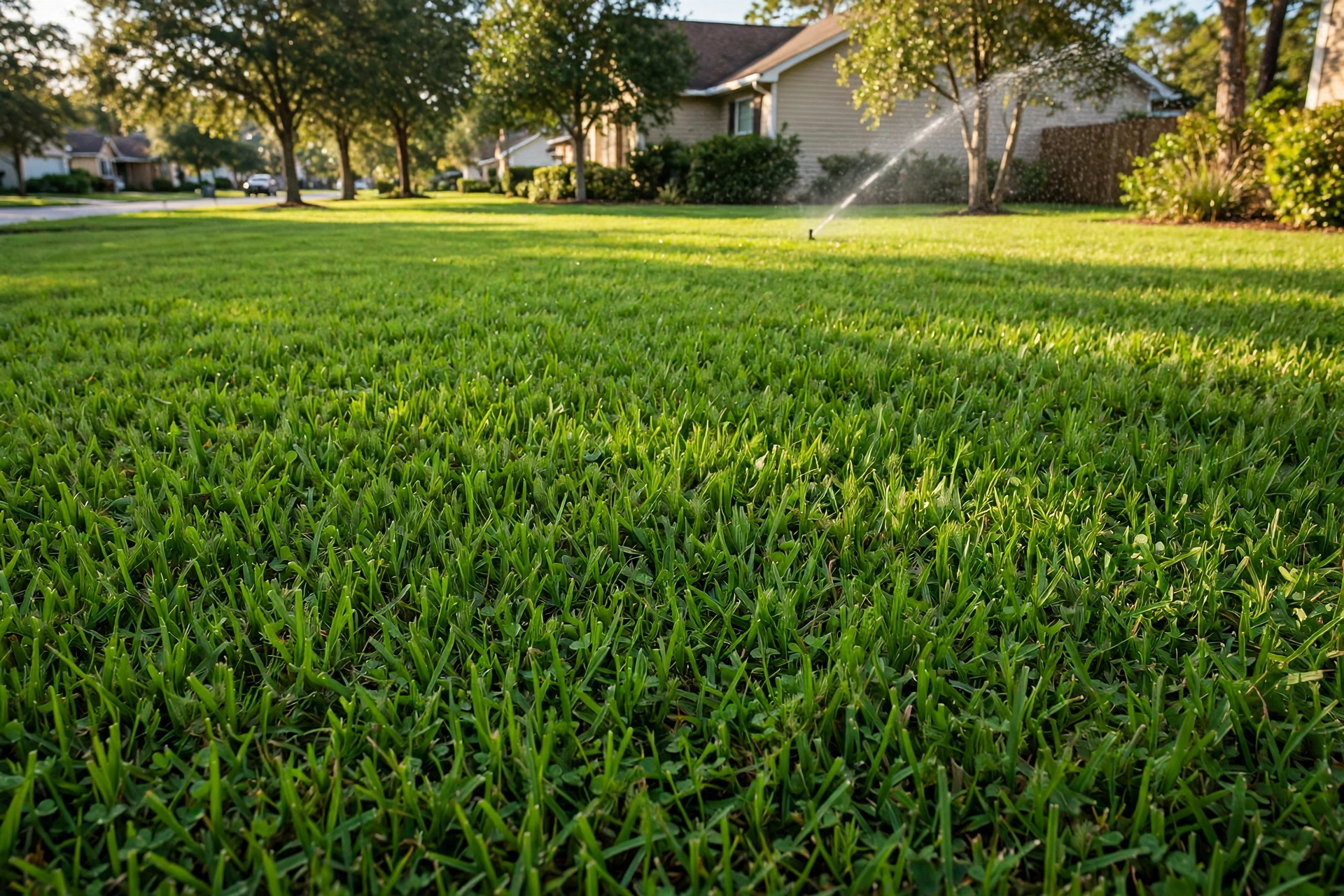
Bermuda is the hungriest grass in the yard. It grows sideways as hard as it grows up, it repairs its own bare spots, and it does all of that on nitrogen — which means a bag blended for a fescue lawn in April is the wrong tool for a Bermuda lawn in June.
Buy the Scotts Turf Builder Southern Lawn Food first. Its 32-0-10 analysis matches what Bermuda actually uses: heavy nitrogen for growth and density, no phosphorus an established lawn rarely needs, and a solid dose of potassium for heat and drought stress. The one condition is timing — it only earns its keep on a lawn that has fully greened up and is growing.
What Bermuda grass actually needs
Clemson Cooperative Extension’s yearly program for Bermudagrass runs 2 to 4 pounds of nitrogen per 1,000 square feet across the whole season, split into three feedings of ½ to 1 pound each: early May once the lawn is fully green, again in June or July, and a last feeding by mid-August.
Nothing with nitrogen goes down from September until the next green-up. Late nitrogen pushes tender growth into the first frost and invites spring dead spot, which is the patchy, slow-to-recover damage Bermuda owners blame on winter itself.
Phosphorus is the passenger nutrient here. Unless a soil test shows it low, an established Bermuda lawn does not need it, which is why the strong picks below all carry a zero in the middle number.
The picks
| Pick | Analysis | Coverage | Best for |
|---|---|---|---|
| Scotts Turf Builder Southern Lawn Food | 32-0-10 | 28.12 lb bag covers 10,000 sq ft | Most established Bermuda lawns |
| Scotts Green Max Lawn Food | 27-0-2, plus 5% iron | 16.67 lb bag covers 5,000 sq ft | Fast color before an event |
| Milorganite | 6-4-0, slow-release | 32 lb bag covers 2,500 sq ft | Sandy soil and cautious feeders |
Best overall: Scotts Turf Builder Southern Lawn Food
The 32-0-10 analysis is the point. One pass at the bag rate delivers close to the 1-pound nitrogen target per 1,000 square feet, the potassium supports the root system through July heat, and the All-in-One Particles blend the nutrients into every granule so the feeding comes out even instead of striped.
The trade-off is pace: this is a largely quick-release feed, so the lawn answers fast and asks again in about six weeks. On a lawn you mow twice a week in summer, that growth surge is real work.
- Formulated for Southern warm-season grasses, Bermuda included
- Can go on a wet or dry lawn
- Do not apply within one month of the first expected frost
Scotts Turf Builder Southern Lawn Food
The 32-0-10 analysis matches Bermuda’s nitrogen appetite, with potassium for heat stress.
Best for fast color: Scotts Green Max Lawn Food
Green Max trades a little nitrogen (27-0-2) for 5% iron, and iron is what deepens color without forcing soft growth. Scotts rates the greening response at about three days, which makes this the bag to reach for the week before a backyard event rather than the backbone of the season.
The trade-off is staying power. Iron-driven color fades as the lawn grows it out, so Green Max works best slotted between the regular Southern Lawn Food feedings, not instead of them. Sweep granules off concrete — iron stains pavement.
Scotts Green Max Lawn Food
Five percent iron deepens Bermuda’s color in days, without a growth surge.
Best gentle feed: Milorganite
Milorganite’s 6-4-0 analysis looks weak next to 32-0-10 until the math lands: at 6% nitrogen, covering 1,000 square feet at a full pound of nitrogen takes nearly 17 pounds of product. What that buys is a slow, steady release that will not burn, on a schedule forgiving enough for sandy soils where quick-release nitrogen washes through.
Owners consistently praise the even color and the low stress of using it; the recurring complaint is the number of bags a large lawn eats. For a small Bermuda yard, that trade is easy to accept.
Milorganite
Slow-release 6-4-0 that feeds for weeks and will not burn the lawn.
Not recommended: weed-and-feed as the main fertilizer
A weed-and-feed ties two different calendars together. The herbicide half wants to go down on the weed’s schedule, the fertilizer half on the grass’s schedule, and Bermuda’s feeding window rarely matches either one cleanly. Feed with a straight fertilizer, handle weeds as their own job, and each product lands when it works.
How much to put down
The bag math is one division. Texas A&M AgriLife Extension’s rule: divide 100 by the first number on the bag to get the pounds of product that supply 1 pound of nitrogen per 1,000 square feet. For the 32-0-10 Southern Lawn Food, that is about 3.1 pounds of product per 1,000 square feet.
Keep any single feeding at or under 1 pound of nitrogen per 1,000 square feet. More than that buys burn risk and a mowing problem, not a greener lawn — our guide to fertilizer burn covers what an overfed lawn looks like and how it recovers.
The feeding calendar
- Early May, at full green-up: first feeding, ½ to 1 pound of nitrogen per 1,000 square feet.
- June or July: second feeding at the same rate; this is the peak-growth feed.
- By mid-August: final feeding, favoring potassium; after this, nitrogen stops for the year.
An open bag keeps fine into next season if it stays dry — how long fertilizer stays good explains the storage details. New sod is the one exception to this calendar: young roots take smaller, more frequent feedings, so follow the rate on the bag for new grass until the sod has knitted in.
Bottom line
Feed Bermuda like the heavy eater it is: Scotts Turf Builder Southern Lawn Food at green-up, midsummer, and mid-August, ½ to 1 pound of nitrogen per 1,000 square feet each time, and nothing after the August cutoff. Green Max covers the weeks when color matters most. That is the whole program.
Sources
Clemson Cooperative Extension, Bermudagrass Yearly Maintenance Program (HGIC 1216) — seasonal nitrogen totals and feeding windows. Texas A&M AgriLife Extension — the divide-100-by-the-first-number rate calculation. Product analyses and coverage from the manufacturers’ listings named above.