This site contains product affiliate links. We may receive a commission if you make a purchase after clicking on one of these links.
Here is the mistake: comparing two patio heaters by their purchase price, then being surprised by the fuel bill. A propane mushroom heater and an electric infrared heater are different machines with different running costs, and the cheaper heater to buy is often the more expensive heater to run. Do the hourly math before you choose.
The hourly math
An electric infrared heater like the Dr. Infrared DR-238 draws 1,500 watts at full power — 1.5 kilowatt-hours per hour. At an illustrative 15 cents per kilowatt-hour, that is about 23 cents per hour. A propane mushroom heater like the Hiland HLDS01 burns up to 48,000 BTU per hour. A standard 20-pound propane tank holds about 4.6 gallons, and propane carries about 91,500 BTU per gallon, so a full tank holds roughly 420,000 BTU — about 9 hours at full blast. At an illustrative $20 to $25 per tank exchange, that is roughly $2.20 to $2.80 per hour. Electric costs roughly a tenth as much per hour to run; propane delivers roughly 32 times the heat output of a 1,500-watt electric heater (48,000 BTU is about 14,000 watts). Both numbers matter, and neither tells the whole story alone.
| Factor | Electric (1,500W infrared) | Propane (48,000 BTU mushroom) |
|---|---|---|
| Heat output | About 5,100 BTU/hr | Up to 48,000 BTU/hr |
| Illustrative running cost | About $0.23/hr | About $2.20–$2.80/hr |
| Coverage | People directly in front | A whole seating area |
| Fuel logistics | Outlet + circuit | Tank swaps, storage |
Electric: cheap to run, narrow in reach
Electric infrared heat warms people and objects directly, not the air, so it feels warm quickly in calm conditions and wastes little energy — but only within its beam. The DR-238 runs on a standard 120-volt, 12.5-amp circuit with three settings (900, 1,200, and 1,500 watts) and an IPX4 weatherproof rating, and it mounts on a wall or ceiling, out of the way. Its limits are reach and circuit capacity: one heater covers a few chairs, and two heaters on one 15-amp circuit will trip the breaker. It is the right choice for a covered patio, a small seating group, or a spot where a propane tank would be in the way.
Dr. Infrared Heater DR-238 Carbon Infrared Outdoor Heater
1,500 watts, three heat settings, wall or ceiling mount for covered patios.
Propane: big heat, real running cost
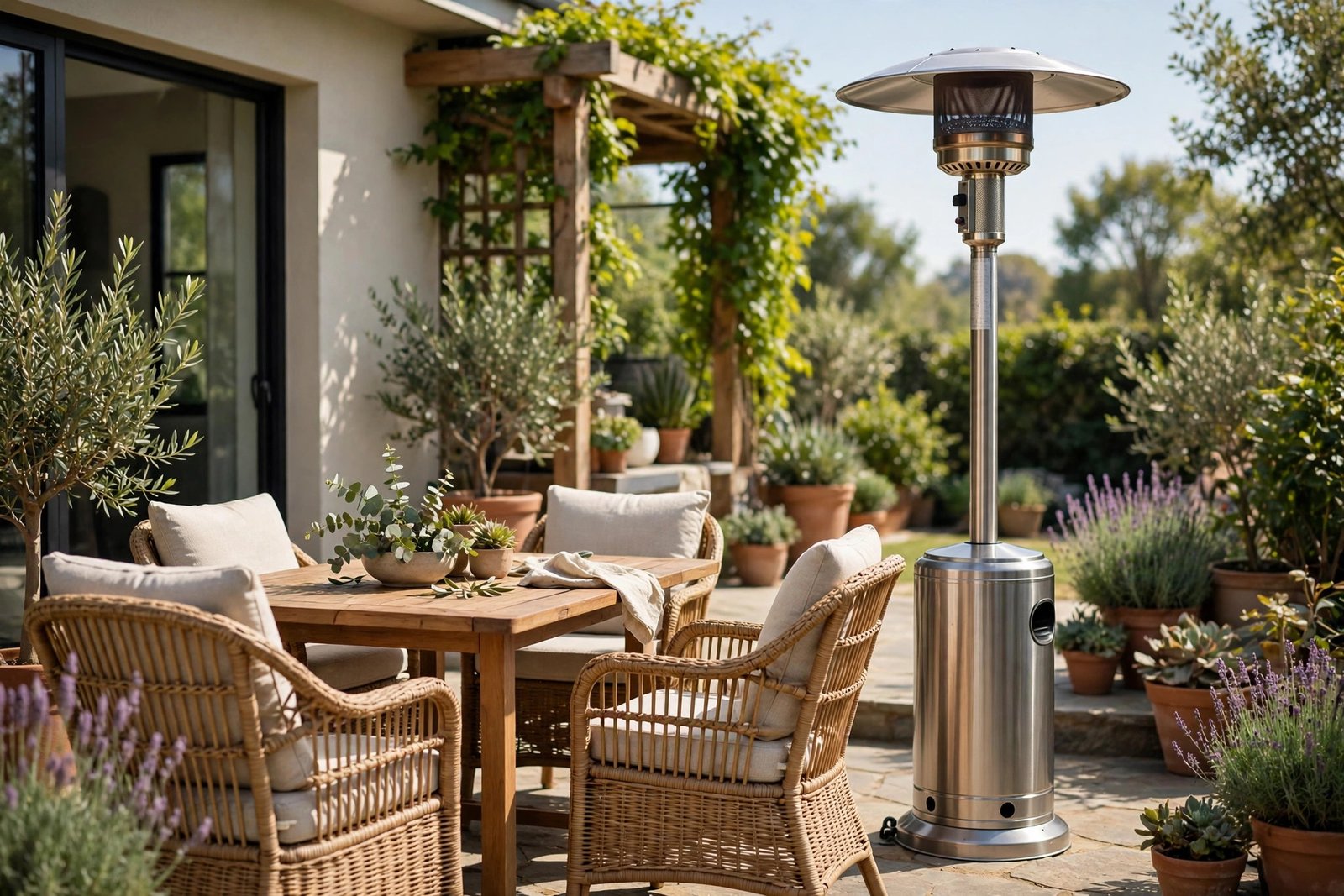
Propane mushroom heaters throw heat in a wide circle and need no outlet, which is why restaurants use them. The Hiland HLDS01 stands 87 inches tall, delivers up to 48,000 BTU, runs on a 20-pound tank (not included), and carries CSA approval with tip-over and thermocouple safety devices. Its costs are the tank, the swaps, and the storage: a tank lasts about 9 hours at full output, less on a cold night when the heater runs flat out, and a half-empty tank in a cold snap delivers noticeably less heat. Propane heaters also need ventilation — never use one in an enclosed space — and clearance from combustibles per the manufacturer’s manual.
Hiland HLDS01 48,000 BTU Propane Patio Heater
Wide-circle heat for a whole seating area, with wheels and CSA-approved safety devices.
The verdict
Small, covered patio with an outlet: go electric, and size it to the seating, not the patio. Large, open patio or frequent gatherings: go propane, and budget for tank swaps as a real running cost. Do not buy propane for a two-chair balcony, and do not buy a single electric heater to warm a party of ten. For placement and safety rules, see our patio heater safety guide and our patio heater roundup, and compare the other heat source in fire pit vs patio heater.