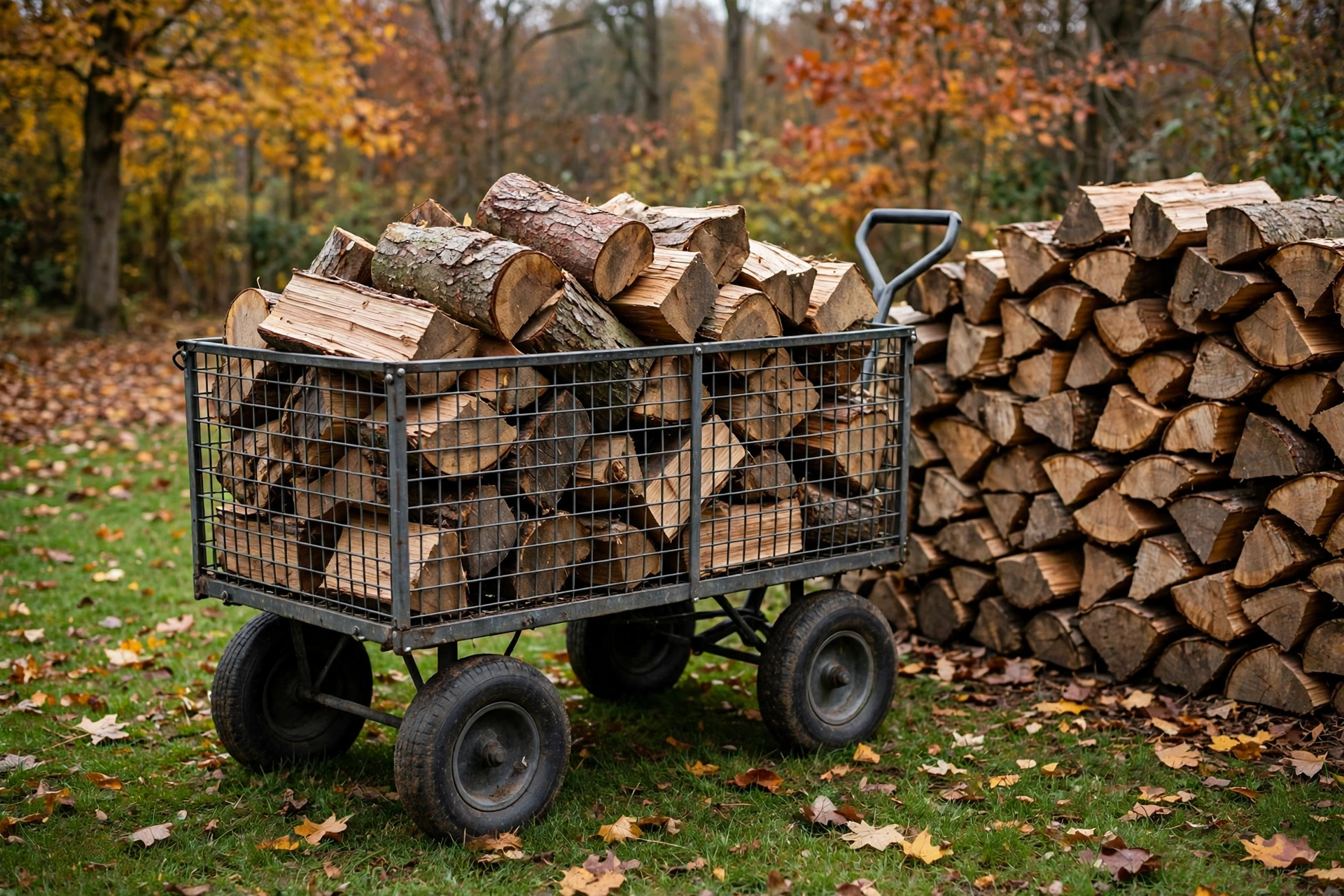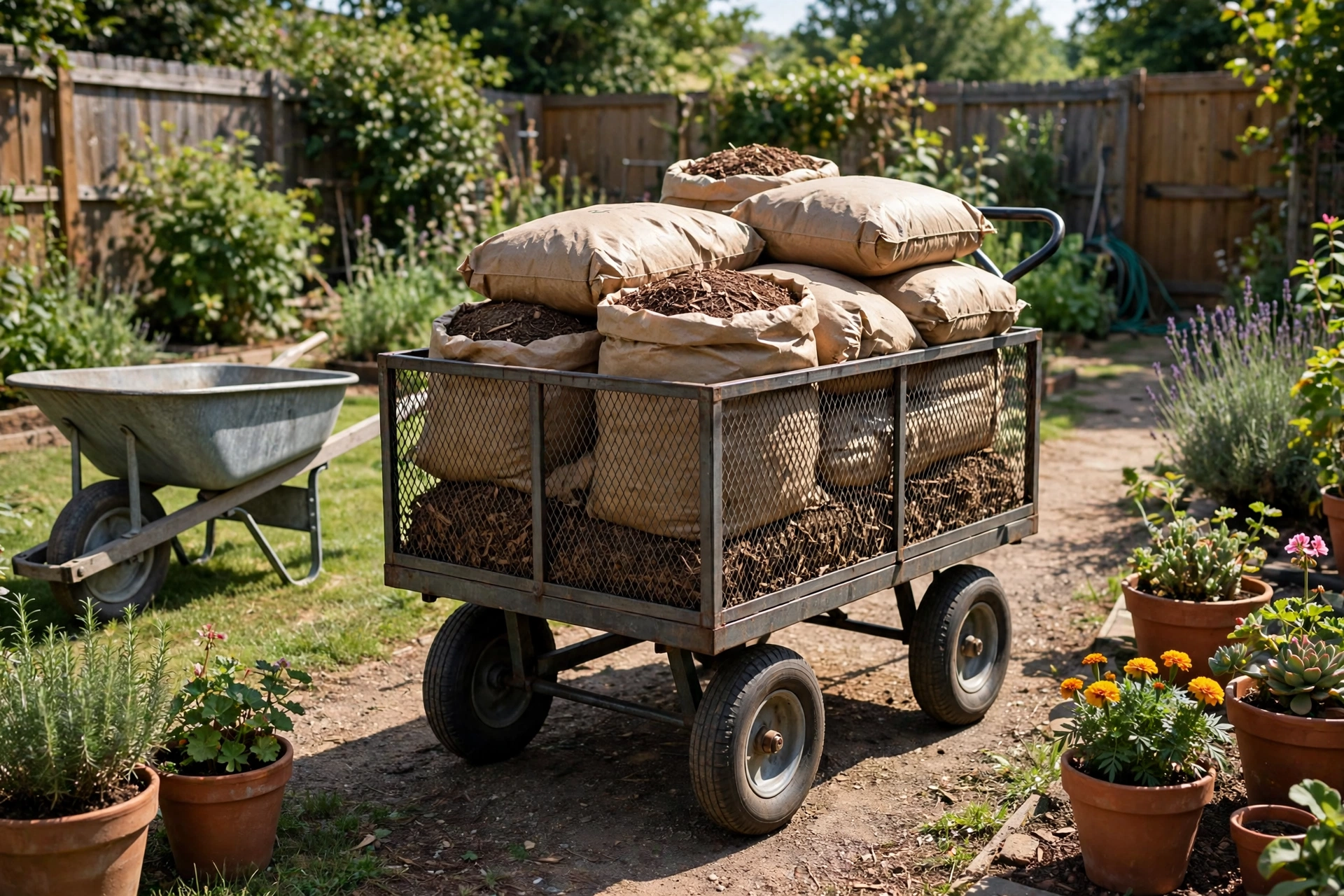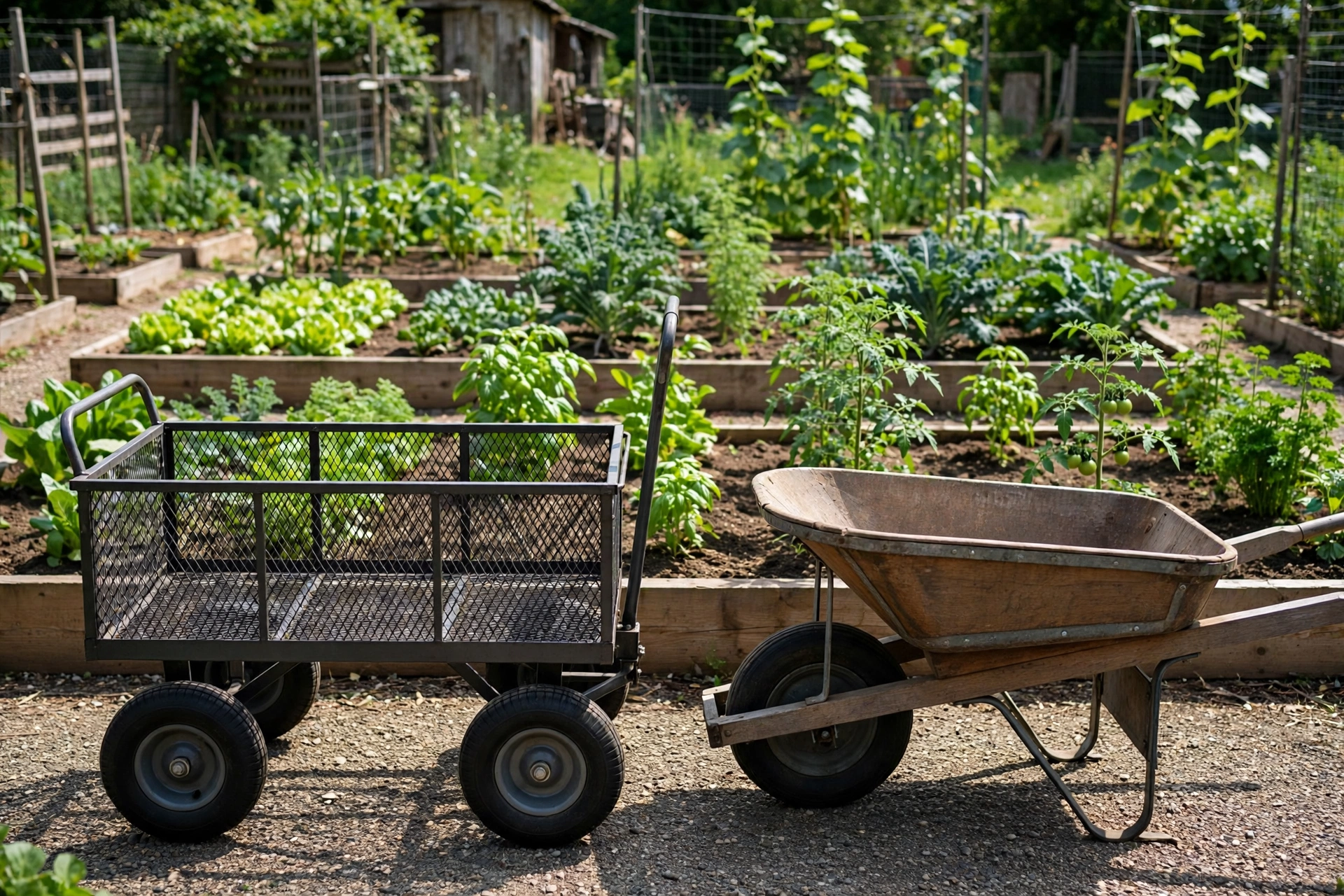
Most people buy the wheelbarrow first, then haul half-loads all afternoon because a full one tips. That is the mistake this comparison exists to fix.
A wheelbarrow is a fine tool. It is also the wrong tool for the most common hauling job in a yard: moving a pile of mulch, soil, or firewood from the driveway to the back beds. A garden cart does that job with four wheels, a bigger bed, and a dump lever — and the difference is not close.
The real difference: four wheels vs. one
A wheelbarrow balances its load on a single front wheel. That makes it nimble, and it makes it tippy. The moment you let go of the handles, a loaded barrow wants to fall over.
A garden cart spreads the same load across four wheels. It stands on its own when you stop to open a gate. It does not dump itself on a slope. And because the bed sits low between the wheels instead of high over one, the load stays put on uneven ground.
That stability is the whole argument. Everything else — capacity, dumping, effort — follows from it.
Capacity: the cart hauls more per trip
A standard steel wheelbarrow holds about 6 cubic feet. A typical garden dump cart holds 4. On paper the wheelbarrow wins — until you load them both.
Nobody fills a wheelbarrow to the brim with wet soil. A heaped 6-cubic-foot barrow of topsoil weighs close to 480 pounds, since topsoil runs about 80 pounds per cubic foot, and no one wants to push that on one wheel. So wheelbarrow owners load half-full and make twice the trips.
A 4-cubic-foot cart rated for 600 pounds takes the full load without complaint. The bed is the limit, not your balance. For mulch, the math is even friendlier: a full cart of mulch weighs roughly 60 to 120 pounds, well inside any cart’s rating, so every trip carries a full bed.
Dumping: a lever beats a lift
Emptying a wheelbarrow means lifting the handles and tipping the whole load forward, by hand, while the barrow balances on its wheel. With a full load of soil that is a back workout disguised as yard work.
A dump cart empties with a quick-release lever. The bed pivots, the load slides out, and all four wheels stay on the ground. The Gorilla Carts dump cart in our best garden carts roundup is built around exactly this mechanism, and it is the feature owners and testers both praise.
Terrain and tight spaces
This is where the wheelbarrow earns its keep. One wheel turns in a footprint a four-wheel cart cannot match, and a barrow fits through a narrow gate or between tight beds where a cart’s wider track will not go.
A cart also needs a turning circle. Pulling it backward through a gate works; spinning it around in a 3-foot path does not. If your beds are reached by narrow, twisting paths, measure the cart’s width against the narrowest gap before you buy.
On open ground, though, the cart is easier to pull loaded than a barrow is to push. The load sits low and balanced, so your arms steer instead of carrying.
What each one costs
A basic steel wheelbarrow costs roughly half what a good garden dump cart costs. That is real money, and it is the wheelbarrow’s best argument.
But the cart pays it back in trips. A cart that carries a full bed every time finishes a mulch pile in fewer runs than a barrow loaded at half capacity, and it does it without the tipping and spilling that wastes material. If hauling is a regular job in your yard, the cart is the cheaper tool per trip.
When the wheelbarrow still wins
Keep the wheelbarrow for three jobs. Mixing and pouring concrete, where you need to tip a wet load into a form. Working in tight, narrow paths a cart cannot turn in. And any job where you need to dump a load precisely into a small spot — a barrow’s single wheel lets you aim the pour.
For everything else that involves moving a pile from one place to another, the cart is the better tool.
The verdict
If hauling is the job — mulch, soil, firewood, stone — buy the garden cart. It carries a full load without tipping, dumps it with a lever, and finishes the pile in fewer trips. Our best garden carts roundup names the 600-pound dump cart to start with.
Keep the wheelbarrow for concrete and tight paths. It is a good second tool. It just should not be the first one you reach for when there is a pile in the driveway.
One more thing before you load up: check how much a garden cart can actually haul so you load for the weight limit, not just the bed size. And if you are weighing the heavy-duty end of the cart range, our review of the VEVOR Heavy Duty Steel Garden Cart covers the 900-pound steel option.