This post contains affiliate links. If you buy through them, we may earn a commission at no extra cost to you.
Late March, the soil is still cold enough to sting bare fingers, and that is precisely when arugula wants to go in. The same seed sown into a warm June bed gives you a fortnight of leaves and then a stem. That timing decides what the crop tastes like and how long it lasts.
Arugula is frost tolerant and germinates in soil as cool as 40 degrees, ideally 50 to 70. Everything in this guide hangs off that one fact: sow early, sow often, and treat heat as the deadline rather than the starting gun.
When to sow
The packet window is 2 to 4 weeks before your average last frost date, outdoors, because starting arugula indoors is not recommended for the bed varieties. The plants resent transplanting and the crop is fast enough that it does not need the head start.
In mild climates the calendar flips: sow in fall for a winter harvest. The plant prefers the cool end of the year in both directions, which is why spring and fall arugula taste milder than anything picked in July.
How to sow
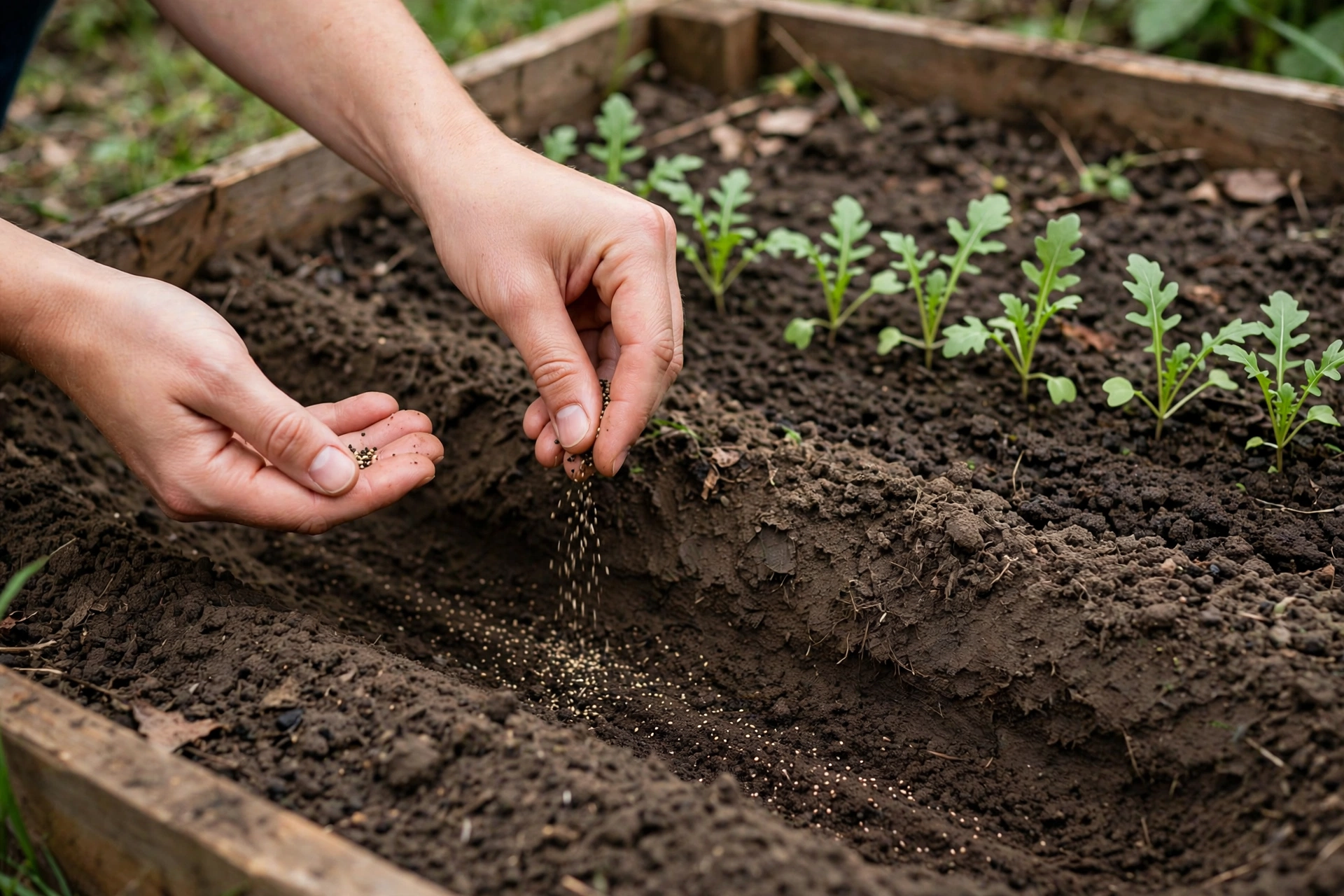
Sow a quarter inch deep. For classic Rocket and the wild types, scatter a group of 6 seeds every 6 inches; for Astro, a group of 3 every 6 inches, since its packet is counted for wider spacing. Rows sit 6 inches apart.
Germination takes 10 to 15 days, and cool soil stretches that rather than stopping it. When seedlings stand half an inch tall, thin to one plant every 6 inches and eat the thinnings, because at that size they are already peppery.
The one exception is Baby Greens, which is sown three-quarters of an inch apart, never thinned, and cut as a flat. That packet is built for containers and indoor shelves rather than rows.
Arugula Baby Greens Seeds
Sown three-quarters of an inch apart with no thinning, cut at 2 to 4 inches, up to three harvests per flat.
Check Price at Botanical InterestsSuccession, the actual system
One sowing of arugula is a brief event. The packet instruction is successive sowings every 3 weeks, running until 4 to 6 weeks before your average first fall frost, and that rhythm matters more than any single sowing date.
I mark three sowings at the start of the season rather than trusting myself to remember the third. A short row every 3 weeks means a new patch is reaching 2 to 4 inches just as the older patch starts to think about flowering, so the harvest hands over instead of ending.
| Sowing | Timing | Harvest window | Note |
|---|---|---|---|
| First | 2–4 weeks before last frost | Baby leaves in 20–28 days | Mildest leaves of the year |
| Second | 3 weeks later | As the first patch matures | Full leaves at 32–45 days |
| Third | 3 weeks after the second | Into early summer | Afternoon shade helps it hold |
| Fall | Until 4–6 weeks before first frost | Through the cool weeks | Flavor mellows again |
Bolting, and what actually causes it
Bolting is the plant switching from leaves to flowers, and with arugula the trigger is heat arriving on a maturing plant. The leaves turn hotter and more bitter as the stem rises, and once flowering starts the leaf harvest is effectively over, though the flowers themselves are edible.

Three things slow it down, in the order I would use them. Succession comes first, because a young plant in the same heat still gives mild leaves. Afternoon shade comes second; the Astro packet names it directly as a way to prolong the harvest. Variety comes third, and it is a real lever: Astro is slower to bolt than the other annuals, and the wild perennial Rocky shrugs off conditions that finish an annual patch.
Astro Arugula/Rocket Seeds
The annual arugula that holds its mild flavor longest, especially with afternoon shade.
Check Price at Botanical InterestsWhat does not work is rescuing a bolted plant. Cutting the flower stem off a plant that has already switched buys a few harsh leaves at best, so I pull it, compost it, and let the next sowing in the rotation carry the salad.
Harvest
Pick leaves at 2 to 4 inches for the mildest flavor, either leaf by leaf or by cutting the plant at ground level. Harvest before the plant begins to flower unless the flowers are the point, since flavor peaks ahead of the stem.
A cut-and-come-again patch rewards frequent picking: taking the outer leaves keeps the center producing, while a neglected patch races to flower. In the fall bed the same plants slow down and sweeten, and a row that looked finished in August can give a second, calmer harvest in October.
Bottom line
Sow early, sow every 3 weeks, and pick young. The variety decision behind those sowings is ranked in the best arugula varieties roundup, and when summer heat wins anyway, arugula vs other salad greens covers which green to put in its place.
The seed is cheap and the season is short, so the only real mistake with arugula is sowing it once.