This post contains affiliate links. If you buy through them, we may earn a commission at no extra cost to you.
Spring is when parsley is won or lost, and it is lost quietly: a packet sown at tomato time is still a seedling when the summer cooking starts. Parsley runs on a longer clock than the herbs it sits beside, so the season has to start earlier than feels reasonable.
The packet timing is plain. Start indoors 6 to 8 weeks before your average last frost date, or sow outdoors, which Botanical Interests marks recommended, 4 to 6 weeks before that date or as soon as the soil can be worked.
Either way, the seed then takes 14 to 28 days to emerge. That wait is the whole crop in miniature: gardeners who plan for it get parsley, and gardeners who improvise around it get a bare patch and a story about bad seed.
Sowing, at the packet numbers
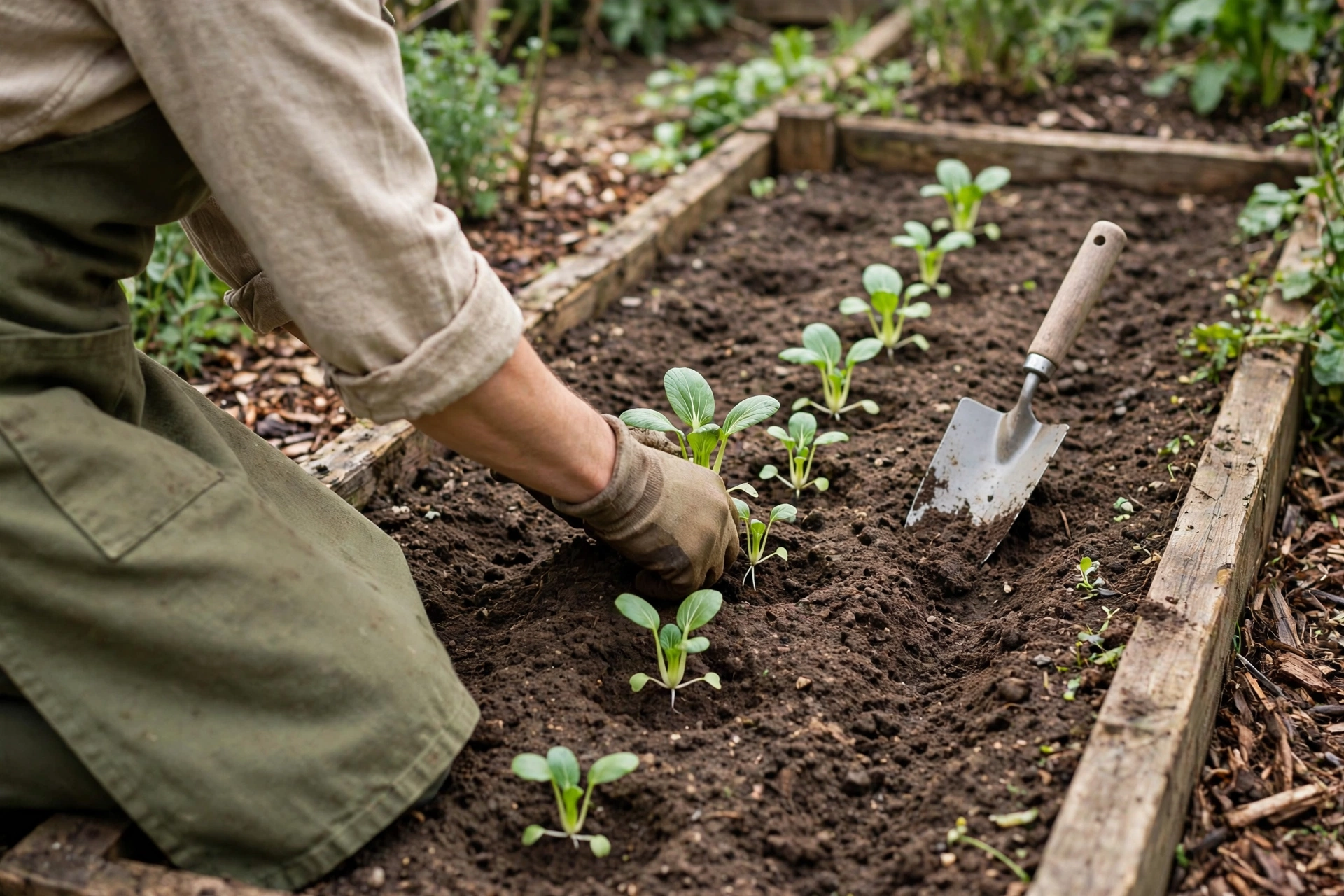
Sow a quarter inch deep. Both Botanical Interests parsley packets, Italian Giant and Moss Curled, carry the same instruction: a group of 3 seeds every 8 inches, in rows 16 inches apart.
The group sowing is insurance, not waste. With a germination window that stretches to four weeks, three seeds at a station give you a plant even when one seed gives up, and the packet holds enough seed for the method: Italian Giant runs to about 690 seeds and sows up to 154 feet of row.
| Step | Packet figure | Timing |
|---|---|---|
| Start indoors | Quarter inch deep, groups of 3 | 6 to 8 weeks before last frost |
| Sow outdoors | Quarter inch deep, groups of 3 every 8 inches | 4 to 6 weeks before last frost, or as soil can be worked |
| Germination | Keep the seedbed evenly moist | 14 to 28 days |
| Thin | To 1 plant every 8 inches, rows 16 inches apart | When seedlings are 1 inch tall |
Keeping the wait alive
The seedbed cannot dry out during those 14 to 28 days, and that single sentence is most of parsley growing. Outdoors, a light cover over the row holds moisture between waterings; indoors, a tray with a bottom reservoir does the same job without daily hovering.
There is a particular quiet to a parsley tray in its third week: nothing green, nothing visibly wrong, just dark mix and patience. Water it anyway. The sprouts, when they come, arrive as thin green threads that are easy to mistake for weeds, so mark the row and leave it alone.
Epic 1020 Universal Bottom Tray
Bottom watering that keeps parsley seed moist through a germination window of up to 28 days.
Spacing and thinning
When seedlings stand an inch tall, thin each group to the single strongest plant, keeping 1 every 8 inches. Parsley thinnings are too small to transplant usefully and too mild to bother cooking with; snip them at the soil line and move on.
Give the plants full sun to part shade. Italian Giant finishes at 12 to 24 inches tall and wants the back of the herb bed; Moss Curled stays under 12 inches and fits the front edge or a pot, which is the practical half of the flat-leaf versus curly decision.
Harvest, from the outside in
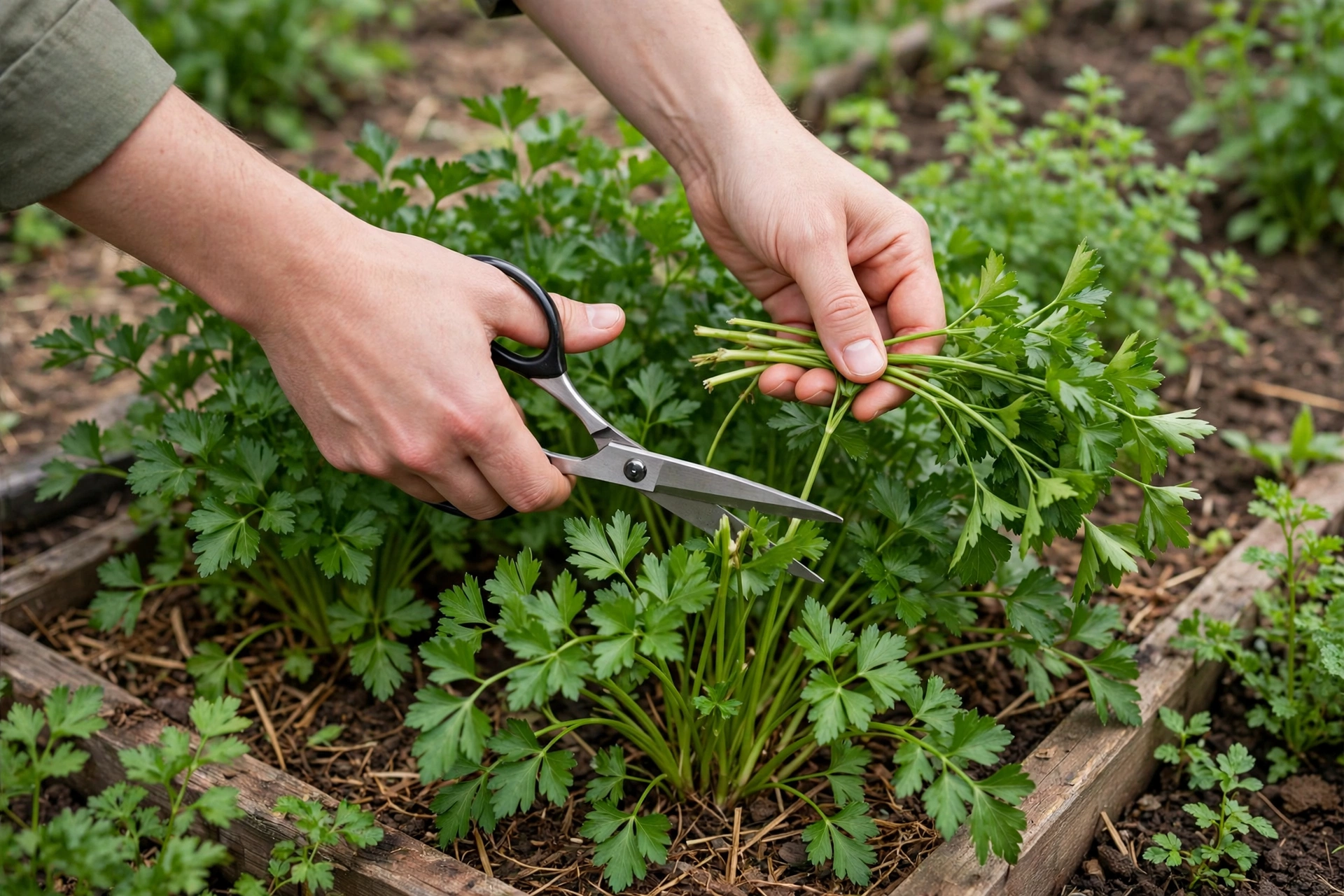
Cut the outer stems first, at the base, and leave the center growing point alone. A parsley plant harvested that way keeps replacing what you took, while a plant scalped to the crown sulks and slows.
Take what the kitchen needs, a few stems at a time, rather than a single heavy cut. Flat-leaf stems go into the pot whole for stocks and stews; curly stems are the garnish handful, snipped fresh because the curled leaves lose their spring on the counter.
Moss Curled carries one more harvest trick: its cold tolerance keeps it growing through fall and into winter, long after tender herbs finish. In mild spells it is the last green thing worth picking.
Parsley Italian Giant Seeds
The flat-leaf to grow for cooking: robust flavor, about 690 seeds, sows up to 154 feet.
The short version
Sow early, sow in threes, and water like you mean it for a full month. Parsley rewards exactly one virtue, patience, and it starts paying it back at the first cutting and keeps paying into the cold. The packet was never the problem.