Landscape & Leisure is reader-supported. When you buy through links on our site, including Botanical Interests seed links, we may earn a commission at no extra cost to you. Prices change, so click through to confirm current pricing.
Every tomato seed packet sits in one of two camps, and the catalog rarely explains the difference plainly. Heirloom tomatoes promise old-fashioned flavor and seeds you can save; hybrids promise vigor, disease resistance, and reliability. Both claims are mostly true, both have fine print, and the right choice depends on your season length, your disease pressure, and what you actually want from the plant. Here’s the honest breakdown — no camp, no hype — so you can buy the right seeds for your garden.
If you haven’t picked varieties yet, our short-season tomato roundup includes strong picks from both camps, and our indoor-starting guide covers getting either type going.
What the Words Actually Mean
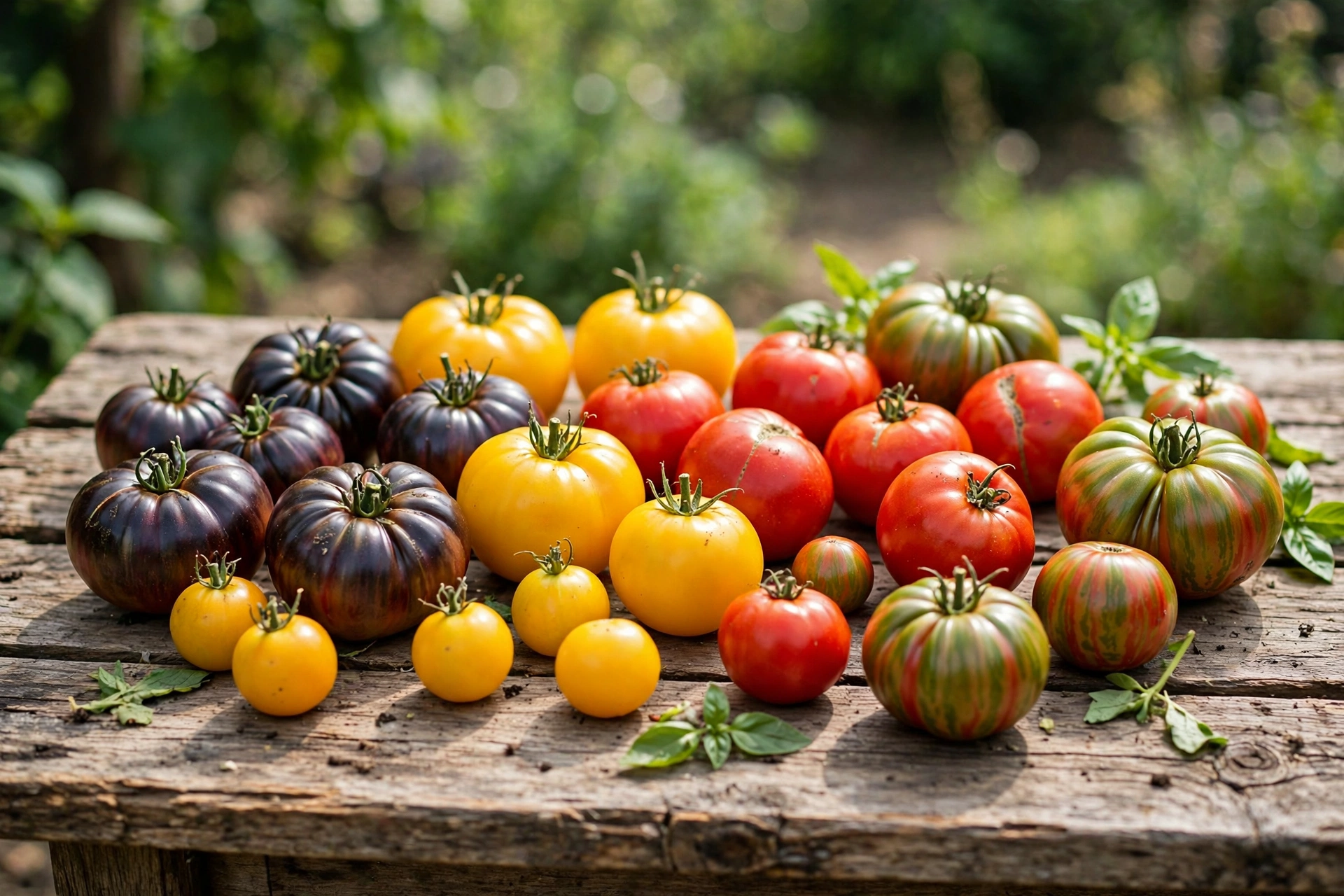
Heirloom (and the closely related open-pollinated) means the variety breeds true: seeds saved from the fruit grow plants essentially identical to the parent. Most heirlooms are varieties passed down for 50+ years — Black Krim from Russia, Cherokee Purple from Tennessee, Gardener’s Delight from 1950s Germany. Open-pollinated includes newer non-hybrid varieties too; the key trait is seed that grows true.
Hybrid (labeled F1) means a deliberate cross of two parent lines, made to combine specific traits — usually disease resistance, vigor, or concentrated ripening. The catch: seeds saved from a hybrid won’t grow true. They revert toward the parents unpredictably. You buy fresh hybrid seed every year. That isn’t a scam; it’s genetics. It does change the economics, which we’ll get to.
Flavor: Heirlooms Win, But It’s Closer Than It Used to Be
The reputation is earned: many heirlooms were selected over decades specifically for flavor, while mid-century hybrids were often selected for shipping durability and uniform color — traits that correlate poorly with taste. A ripe Black Krim or Cherokee Purple has a depth that standard hybrid slicers rarely match.
But the gap has narrowed. Modern hybrids like Mountain Merit and Cherokee Carbon (itself a hybrid of two heirlooms) were bred with flavor as an explicit goal, and blind taste tests keep humbling the purists. The honest position: the best heirlooms still set the flavor ceiling, but a well-bred modern hybrid beats a mediocre heirloom every time. Don’t buy an heirloom for flavor alone if its disease package and maturity date don’t fit your garden — an uneaten green heirloom has no flavor at all.
Black Krim Pole Tomato Seeds
The Russian heirloom that delivers old-fashioned flavor and still performs in zone-4 seasons.
Disease Resistance and Vigor: Hybrids Win Clearly
This is the hybrids’ home turf and it isn’t close. Breeding programs can stack resistances — fusarium, verticillium, nematodes, late blight, spotted wilt — into one variety in a way that heirloom selection never did. Mountain Merit carries resistance to six major tomato diseases, which is why it keeps producing in years when heirloom plantings melt down by August. Hybrids also tend toward hybrid vigor: stronger early growth, more uniform fruit set.
For short-season gardeners this matters more than it does in long-season climates. You don’t have time for a plant to get sick in July and recover — a disease setback in a 100-day season is a lost season. If your garden has a history of blight, a resistant hybrid isn’t settling; it’s strategy.
Mountain Merit Bush Tomato Seeds
Six-disease resistance in a compact determinate — the reliability play for tough seasons.
Seed Saving: Heirlooms Only
If saving your own seed matters to you — for cost, for self-reliance, or for adapting a variety to your exact garden over seasons — heirlooms and open-pollinated varieties are the only game. Ferment the seeds from your best fruits, dry them, and they’ll grow true next year. (Tomatoes are mostly self-pollinating, so crossing is minimal, though growing varieties a few dozen feet apart is prudent if purity matters.)
Hybrid seed must be repurchased yearly. Factor that into the cost math below — and note that it also means you’re dependent on the variety staying in the catalog. A beloved hybrid can be discontinued; an heirloom you save is yours forever.
Cost and Packet Math
Hybrids cost more per seed, and the gap is real: Mountain Merit runs $6.49 for 10 seeds versus $2.99 for 20+ seeds of an open-pollinated variety like Black Krim or Glacier. But packet math favors thinking per plant, not per seed. Ten Mountain Merit seeds, started two-per-cell with thinning, give you five strong plants — plenty for most families — and the disease resistance protects the investment. Meanwhile a $5.99 cherry packet like Sun Gold, with 105 reviews behind it, pays for itself the first week of harvest. The expensive seed is the one that doesn’t produce; buy for the outcome, not the packet price.
Which Should You Grow in a Short Season?
Grow both — deliberately. The short-season playbook is a split ticket: hybrids (or early, tough heirlooms) for reliability, flavor heirlooms for the eating experience. A concrete version: Mountain Merit as your disease-proof workhorse, Glacier for the earliest slicers, Sun Gold for guaranteed cherry production, and Black Krim or Cherokee Carbon for the tomatoes you’ll brag about. That’s exactly the portfolio in our short-season roundup — built so a bad blight year still leaves you with a harvest, and a good year leaves you with stories.
Cherokee Carbon Pole Tomato Seeds
A hybrid of two heirlooms — heirloom flavor that ripens earlier, with better crack resistance.
Frequently Asked Questions
Are hybrid tomatoes GMOs?
No. Hybrid tomatoes are crosses made by traditional pollination — pollen from one variety onto the flowers of another. No laboratory gene transfer is involved. (No GMO tomato is sold to home gardeners at all.)
Can I save seeds from hybrid tomatoes?
You can, but you shouldn’t expect the same tomato. F1 hybrids don’t breed true — saved seed grows into a unpredictable mix reverting toward the grandparent lines. Save seeds from heirlooms and open-pollinated varieties instead.
Do heirlooms really taste better?
The best ones do, on average — but variety matters more than category. A great modern hybrid out-tastes a poor heirloom, and some heirlooms are prized for history or looks rather than flavor. Read variety reviews, not just labels.
Which type is better for containers?
Habit matters more than breeding: determinate and dwarf types suit pots regardless of camp. Mountain Merit (hybrid) and Glacier (open-pollinated) are both compact bush types that work in containers.
The Bottom Line
Buy heirlooms for flavor ceilings and seed sovereignty; buy hybrids for disease resistance, vigor, and reliability. In a short season, lean hybrid for your workhorse plants and heirloom for your flavor plants — and if you want one variety that refuses to choose, Cherokee Carbon is the hybrid that tastes like an heirloom. Either way, start them right: our indoor seed-starting guide walks through the timing, and our drip irrigation guide keeps watering even once they’re in the ground.