“How often should I fertilize this?” is the question every houseplant owner asks while holding a bottle whose label answers a different one. The label gives a dose for a plant growing flat-out in perfect light. Your plant, on a windowsill in November, is doing nothing of the kind.
The honest answer is a rhythm, not a date: half strength every 2 to 4 weeks while the plant is actively growing, and nothing at all when it rests. This post settles how to read which mode your plant is in, how much to mix, and the three situations where feeding does harm instead of good.
The symptom that sorts it out
A houseplant tells you its feeding status in its newest leaves, so start there before you reach for the bottle.
New leaves arriving small and pale, with older leaves yellowing evenly from the bottom up, point to a plant that has used up what the potting mix held. That pattern builds slowly, over months, and it answers to a regular half-strength feed.
Brown, crispy leaf edges and a white crust on the soil surface point the other way: fertilizer salts have built up faster than the plant can use them. Feeding that plant again makes it worse. The fix is a flush, covered below.
No new growth at all in winter is neither one. Most houseplants rest when the light drops, and a resting plant cannot spend nutrients. Anything you pour in sits in the mix as salt.
The schedule, by plant
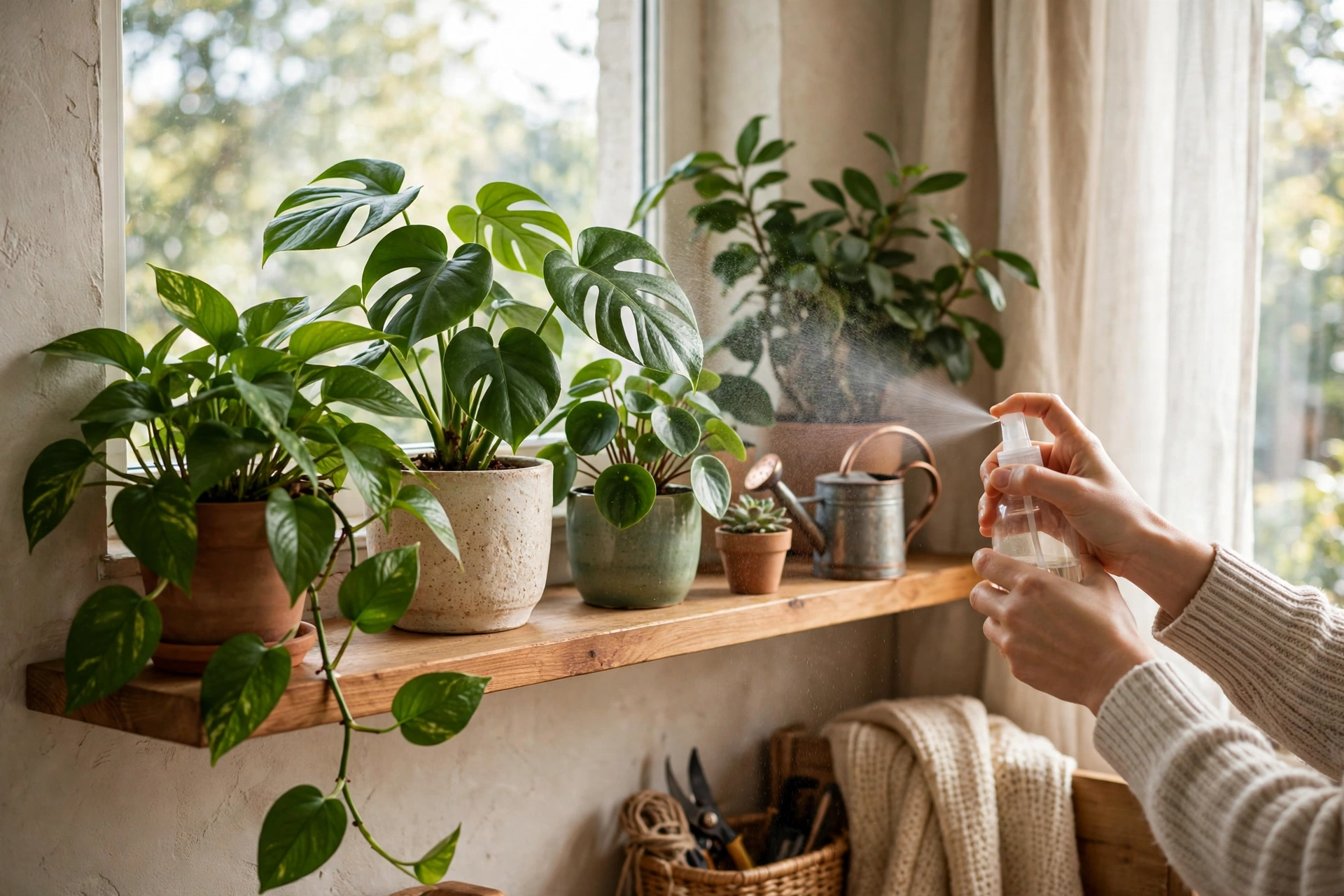
- Fast-growing foliage (pothos, monstera, philodendron): half strength every 2 to 4 weeks, spring through early fall.
- Slow growers (snake plant, ZZ plant, cast iron plant): half strength every 4 to 8 weeks in the growing season; two or three feeds a year is genuinely enough.
- Flowering houseplants (African violet, peace lily): every 2 to 3 weeks while growing or in bloom, half strength.
- Cacti and succulents: quarter strength, two or three times across the whole season.
- Anything under grow lights year-round: every 4 weeks at half strength, easing to quarter strength in winter.
A balanced liquid feed — 10-10-10 or 20-20-20 on the label — covers nearly every foliage plant. There is no need for a different bottle per plant; the schedule does the adjusting, not the formula.
How to feed without burning roots
Water first. Fertilizer solution on dry roots is the fastest route to burn. Feed as the second half of a normal watering, once the mix is already moist.
Mix at half strength. Labels are written for vigorous outdoor growth. Indoors, in lower light, plants use far less, and half the stated dose carries a wide safety margin.
Watch the next flush. New leaves coming in full-sized and normally colored mean the rhythm is right. Growth is the receipt — it arrives a few weeks after the feeding that caused it, so judge a change by the leaves that follow it, not the ones already open.
There is a particular quiet to a plant room in January — the watering can makes its rounds less often, and the feed bottle stays in the cupboard where it belongs. Rest is part of the cycle, and the spring restart is gentle: one half-strength feed when the first new leaf shows, then the regular rhythm.
When to skip a feeding
For 4 to 6 weeks after repotting. Fresh potting mix already carries nutrients, and disturbed roots burn easily. The same pause applies to a plant that just came home from the nursery, where it was fed on a commercial schedule.
When the plant is struggling. A wilting, pest-covered, or recently dried-out plant needs water, light, and time — in that order. Fertilizer is food for a growing plant, not medicine for a sick one.
All winter, for most plants. If no new leaves are coming, no feed goes in. The exception is a plant under strong grow lights that is visibly still growing; that one can take a light monthly feed.
Flushing out salt buildup
Every few months, or whenever a white crust forms on the mix, flush the pot. Set it where it can drain freely and run plain water through slowly — roughly three to four times the pot’s volume — so dissolved salts wash out the drainage holes instead of concentrating at the roots.
Then pause feeding for one cycle and restart at half strength. Brown leaf tips stop appearing on new growth once the salts are gone; the damaged edges on old leaves stay, and that is fine — they are history, not a current symptom.
The short version
Feed houseplants at half strength every 2 to 4 weeks from spring to early fall, slower for slow growers, and stop when growth stops. Water before you feed, flush the pot a few times a year, and let new leaves — not the calendar alone — tell you the plant is ready. For outdoor feeding decisions, the same read-the-plant logic applies to choosing between fertilizer formulas in the yard.
Sources
University of Minnesota Extension and University of Maryland Extension houseplant guidance — half-strength feeding at 2-to-4-week intervals during active growth, no feeding during winter rest, and a 4-to-6-week pause after repotting.